Driving in fog: which lights to use, how to adapt your driving and when it is best to stop
Dipped beam headlights, fog lights, speed, distance and stopping safely: a practical guide to tackling fog on the road without adding risks.
Key points
In fog, the priority is to adjust your speed so you can stop within the distance you can see, leave a much larger margin and use lights that make you visible without causing glare. If visibility does not allow safe driving, leave the road and wait for conditions to improve.
Quick answer: leave a margin rather than rushing
Knowing how to drive in fog is not about switching on every available light and continuing at your usual pace. The practical response is to reduce speed until you can stop the vehicle within the distance you can see, greatly increase your distance from other traffic and make every manoeuvre early and smoothly.
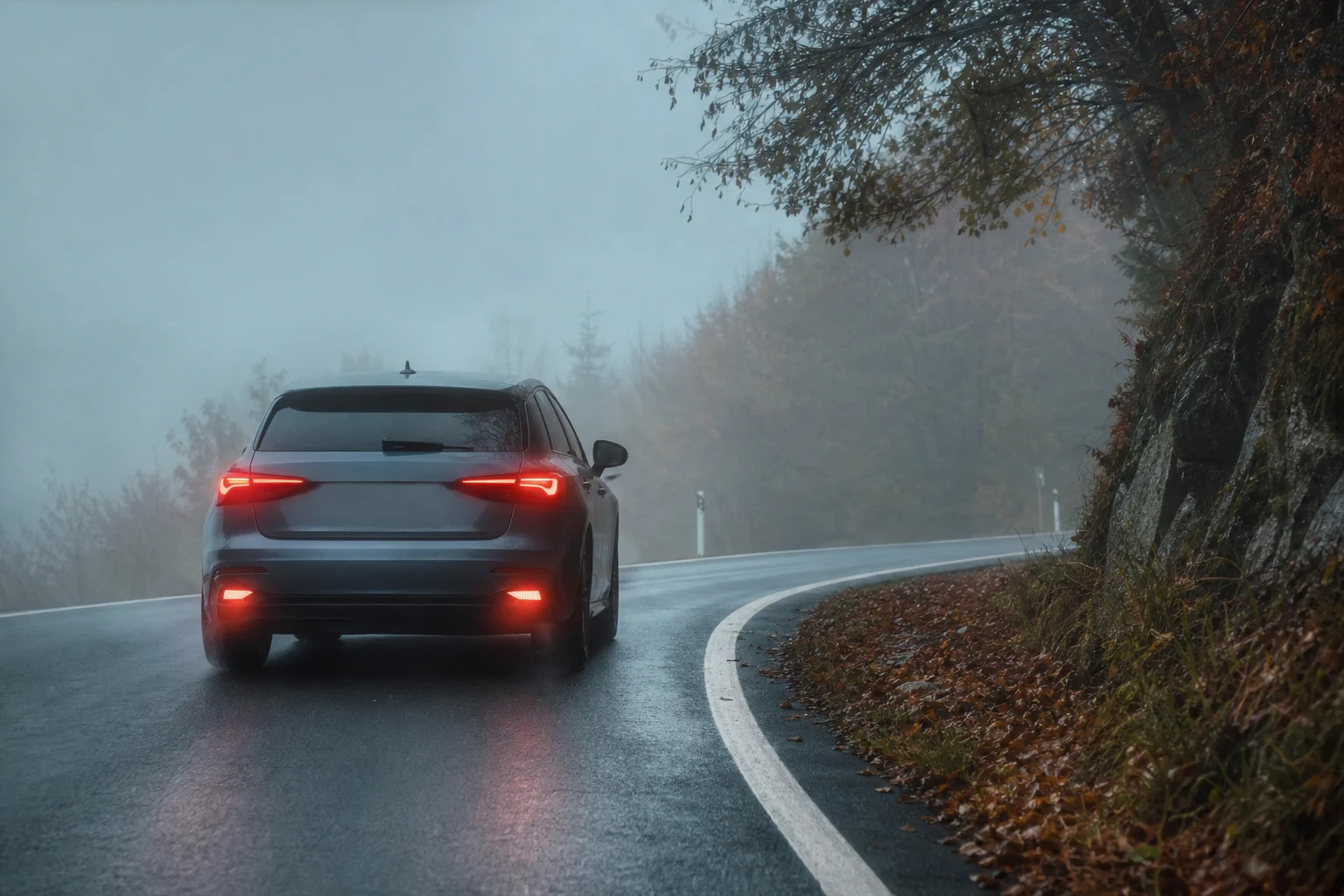
Use dipped beam headlights. Spain’s Directorate-General for Traffic (DGT) advises adding the front fog lights when the vehicle has them and reserving the rear fog light for dense fog. Do not use full beam: according to the DGT, its beam reflects off the fog bank and can cause glare.
The deciding factor is not reaching a particular speed, but retaining a real ability to stop without hitting an obstacle, another vehicle or the end of a traffic queue that appears within the visible field. If that margin disappears, do not try to make up for it by following another car too closely: slow down further and look for a way to leave the road safely.
Section references: Reglamento General de Circulación, art. 106 (texto consolidado) ↗ · Visibilidad cero ↗ · Conducción invernal: preparados para el mal tiempo ↗
- Dipped beam headlights: yes, when fog significantly reduces visibility.
- Full beam headlights: avoid them in fog.
- Rear fog light: only in dense fog or other especially adverse conditions.
- Braking: anticipate it and apply the brake smoothly.
- Visibility too poor for safe driving: leave the road and wait for it to clear.
Before setting off: decide whether the journey can wait
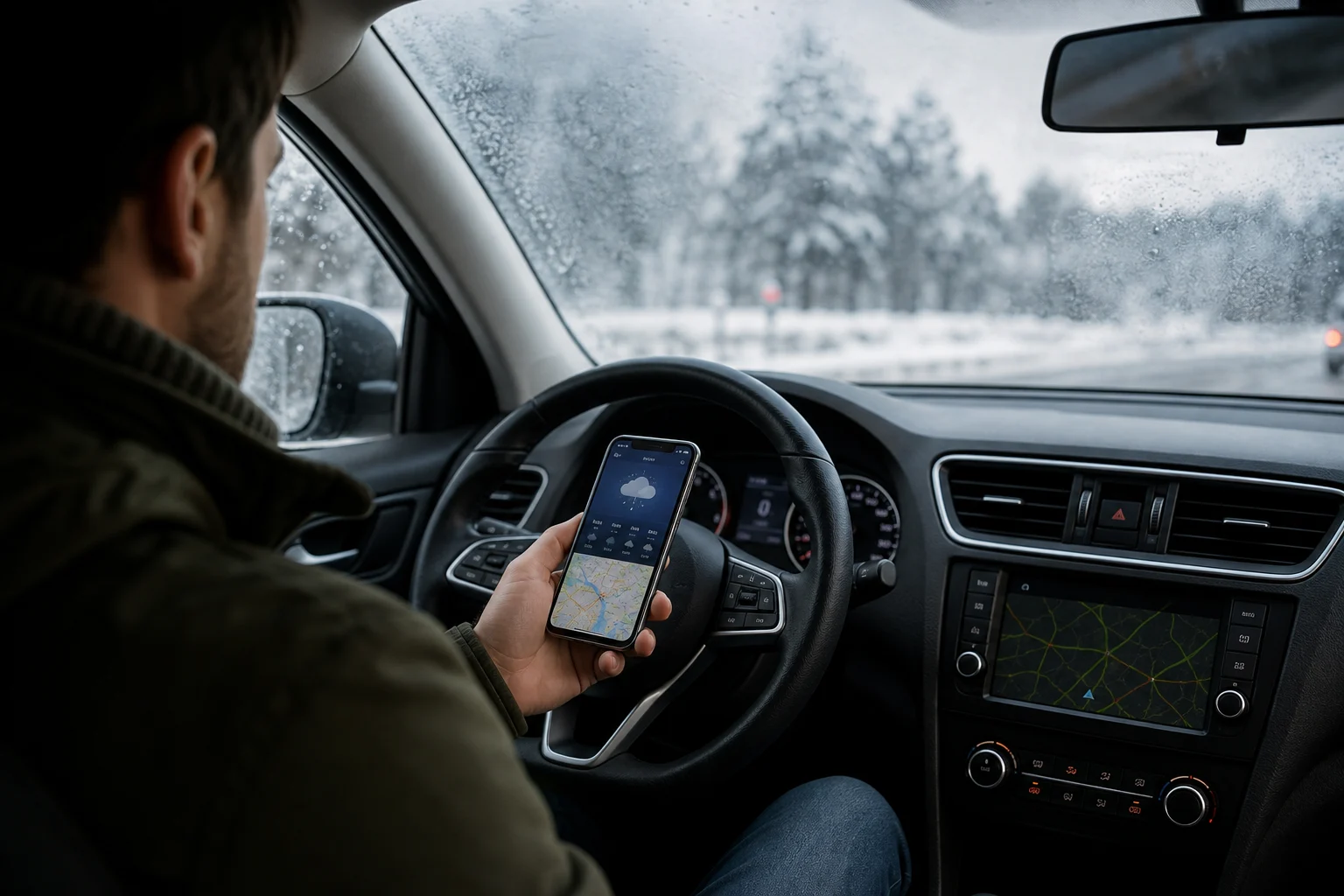
The safest decision is sometimes made before you start the engine. If your route passes through an area where fog is forecast, check the weather conditions and traffic situation. AEMET’s MeteoRuta brings together road weather conditions, current warnings and the forecast for the next 24 hours. The DGT traffic map provides official information on traffic and incidents, and updates automatically 24 hours a day.
Postpone the trip when the forecast, warnings or incidents indicate a situation you cannot handle with a safe margin. This assessment is particularly important on interurban journeys, in the early hours or early in the morning, and when the trip is not essential. Leaving later can prevent you from entering a dense fog bank with no immediate alternatives.
Before leaving, also make sure you know how your car’s lights work and, as a preparation measure, consider carrying a connected V-16 beacon. From 1 January 2026, it is the only legal means in Spain of signalling a vehicle immobilised on the carriageway.
Section references: Información e incidencias de tráfico ↗ · MeteoRuta ↗ · Dispositivos de preseñalización V16 ↗
- Check MeteoRuta to review the forecast and warnings along your route.
- Check the DGT traffic and incident map before starting your journey.
- Consider delaying or cancelling the trip if forecast visibility compromises a safe margin.
- Locate the fog light controls before you need them.
- As a preparation measure, consider carrying a connected V-16 beacon.
Which lights to use in light and dense fog
Fog legally requires the use of vehicle lighting when visibility is significantly reduced. Spain’s General Traffic Regulations allow the use of front fog lights or dipped or full beam headlights in these circumstances. However, the DGT’s operational guidance is more specific: use dipped beam headlights and, if fitted, front fog lights in fog of any intensity; when the fog is dense, add the rear fog light.
The key is to avoid confusing reduced visibility with permission to use all lighting continuously. The rules reserve the rear fog light for especially adverse situations, including dense fog.
Nor should you turn to full beam. Although the regulations include it among the options when visibility is reduced, the DGT recommends not using it in fog because the beam reflects off suspended droplets and causes glare. In practice, dipped beam headlights, front fog lights if available and the rear fog light only when the fog becomes dense are the combination intended to help you see and be seen without adding glare.
| Situation | Recommended lights | What to avoid |
|---|---|---|
| Fog that reduces visibility | Dipped beam headlights and, if fitted, front fog lights | Full beam headlights |
| Dense fog | Dipped beam headlights, front fog lights and rear fog light | Keeping full beam headlights switched on |
| The fog improves | Dipped beam headlights as conditions require | Leaving the rear fog light on unnecessarily |
Section references: Reglamento General de Circulación, art. 106 (texto consolidado) ↗ · Visibilidad cero ↗ · Conducción invernal: preparados para el mal tiempo ↗
- Switch on dipped beam headlights when fog significantly reduces visibility.
- Use front fog lights as support if the vehicle has them, following DGT guidance.
- Add the rear fog light only in dense fog.
- Switch off the rear fog light when it is no longer needed.
- Do not use full beam headlights in fog.
Adjust speed, distance and controls to your field of vision
Fog shortens the useful distance you can perceive and may conceal a bend, a traffic queue or an immobilised vehicle until very late. That is why your speed must allow you to stop the car within your field of vision. This is a safer criterion than trying to maintain a usual speed: when you can see less, you must drive more slowly.
Increase your following distance substantially. This margin allows you to detect changes in the speed of the vehicle ahead and brake progressively, rather than reacting with hard braking. The DGT recommends anticipating braking and applying it smoothly. Fog can also dampen the road surface and make it more slippery; at low temperatures, it can encourage ice formation.
Drive deliberately smoothly: look ahead, reduce speed before you need to brake heavily and avoid late decisions. The usual mistake is waiting until you can clearly identify the danger before acting; in fog, the manoeuvre must be prepared earlier precisely because visual references appear late.
Section references: Visibilidad cero ↗
- Reduce speed until you can stop within the distance you can see.
- Increase your following distance substantially.
- Start braking early and smoothly.
- Allow for a wetter and potentially more slippery road surface.
- Do not maintain your usual speed simply because the road seems familiar.
Keep reliable references and postpone risky manoeuvres
To avoid losing your position in the lane, the DGT advises driving on the right and following the shoulder lines. This road infrastructure reference helps maintain an orderly path when fog reduces visibility.
Do not make the lights of the vehicle ahead your only guide. Your own field of vision, following distance and road markings must continue to determine your speed. Moving closer so you do not lose sight of the other vehicle removes your reaction margin and can cause a collision if it brakes or an obstacle appears ahead of it.
On two-way conventional roads, the DGT considers overtaking dangerous and inadvisable when visibility is reduced; if it is very limited, the manoeuvre is prohibited. The practical solution is straightforward: give up trying to gain positions and wait for visibility to improve. Likewise, avoid unnecessary lane changes and do not improvise turns or exits when you are already upon them.
Section references: Visibilidad cero ↗
- Keep to the right and use the shoulder line as a reference.
- Do not reduce your following distance to follow the lights of the vehicle ahead.
- Do not overtake on a conventional road with reduced visibility; with very limited visibility, it is prohibited.
- Postpone lane changes, overtaking and decisions that require seeing far ahead.
- If you are unsure whether a manoeuvre is safe, do not start it.
When to stop and what to do if you can no longer continue
If the fog closes in to the point where it no longer allows safe driving, the DGT’s instruction is to leave the road and wait for it to clear. This does not mean stopping immediately at any point: continue only as far as necessary, at a speed compatible with what you can see, until you find an exit or a safe place away from traffic.
On an interurban road, stopping or parking must take place off the carriageway, on the right, while leaving the usable part of the shoulder clear. The preferable option is to reach an area outside the carriageway where you can wait without being exposed to passing vehicles.
If an emergency forces you to immobilise the car on the carriageway, signal it with the connected V-16 beacon. In the event of a breakdown or accident, occupants must leave by the side away from traffic whenever there is a safe place outside the traffic area. If it is not possible to get out safely, they must remain inside the vehicle with their seat belts fastened. The priority is to prevent an incident from becoming a pedestrian impact or secondary collision.
Section references: Reglamento General de Circulación, art. 106 (texto consolidado) ↗ · Visibilidad cero ↗ · Dispositivos de preseñalización V16 ↗
- Do not continue driving if you can no longer do so safely.
- Look for an exit or a safe place off the carriageway to wait.
- On an interurban road, do not occupy the carriageway and leave the usable part of the shoulder clear when parking.
- If you are immobilised on the carriageway, use the connected V-16 beacon.
- Leave by the side away from traffic only if there is a safe place outside the traffic area; otherwise, remain inside with your seat belt fastened.
Which lights should you use in fog?
Use dipped beam headlights. The DGT recommends adding front fog lights if the car has them and using the rear fog light only when the fog is dense. Avoid full beam headlights.
What speed should you drive at in fog?
Drive at a speed that allows you to stop the car within your field of vision. There is no single valid figure: the lower the visibility, the more you should reduce speed and increase your following distance.
Can you overtake in fog?
On two-way conventional roads, the DGT advises against overtaking with reduced visibility and states that it is prohibited when visibility is very limited. The prudent choice is to postpone the manoeuvre.
When should you stop because of fog?
When visibility does not allow safe driving. The recommendation is to leave the road and wait for it to clear, stopping off the carriageway without occupying the usable part of the shoulder.
What should I do if I am immobilised on the carriageway?
Signal the vehicle with a connected V-16 beacon. Leave by the side away from traffic only if there is a safe place outside the traffic area; if you cannot do so safely, remain inside with your seat belt fastened.