Can Your Car Tow That Trailer? Vehicle Documents, Masses and B96/B+E
The vehicle documents, towbar, actual weight and maximum authorised masses (MAM; MMA in Spanish documentation) answer different questions. This guide explains how to check them before buying or hitching up a trailer, caravan or motorcycle trailer, and when to review B96 or B+E.
Key points
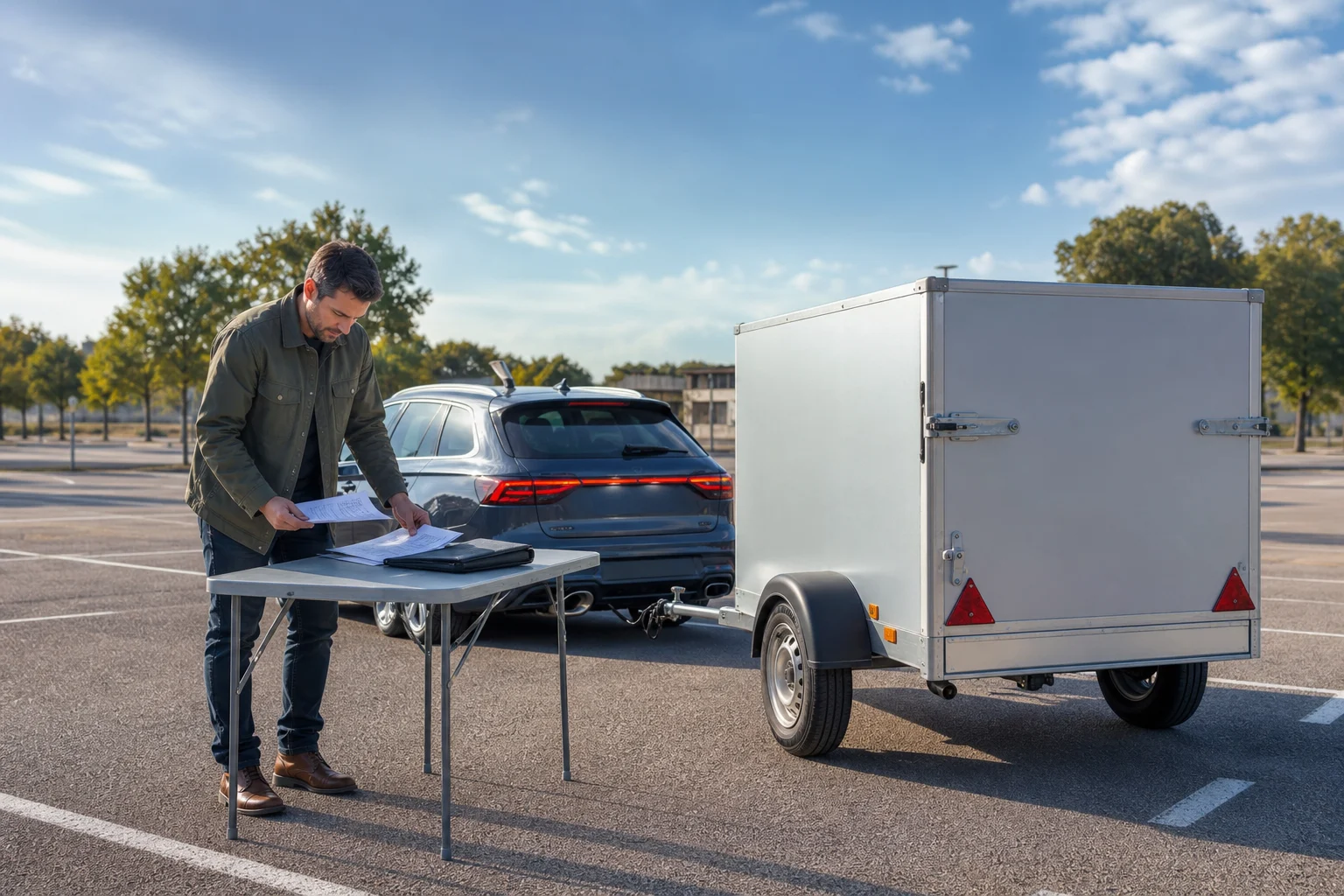
To find out whether your car can tow a particular trailer, check the technical limits in the ITV card/technical inspection card (ficha técnica) and towbar documentation, the maximum authorised masses (MAM; MMA in Spanish documentation) and the actual loaded weight. This guide also explains when to check B96 and B+E licence requirements.
The short answer: checking just one weight is not enough
Before buying, renting or loading a trailer, answer four questions separately. First: what is your car's technically permissible maximum towing mass? Second: what limit does the towbar you have fitted allow? Third: how much will the car and trailer actually weigh once loaded? Fourth: do the combination's maximum authorised masses (MAM; MMA in Spanish documentation) meet the B96 and B+E requirements where applicable?
The towing vehicle's ITV card/technical inspection card (ficha técnica) is the starting point for finding its MAM and maximum towing mass. But the final capacity cannot exceed the technical limit declared for the vehicle or, where applicable, the limit resulting from the strength of the coupling device. That is why engine power alone does not determine whether a combination is valid.
The right decision requires complying with all technical limits at the same time: exceeding any one of them prevents that combination from being used in those conditions. The licence is a separate check, based on MAM. A trailer may require checking B96 or B+E while exceeding the car's towing capacity; the reverse may also happen.
Section references: Reglamento General de Vehículos: definiciones y masas remolcables ↗ · Reglamento General de Conductores: clases B y B+E ↗ · DGT: conducir seguro con remolque ↗
- Check the car's ITV card/technical inspection card (ficha técnica), not just a catalogue figure.
- Identify the MAM and specifications of the particular trailer.
- Check the entry and limits for the fitted towbar.
- Calculate MAM separately to check B96 and B+E, and actual weights for driving when loaded.
Documents to gather before doing any calculations
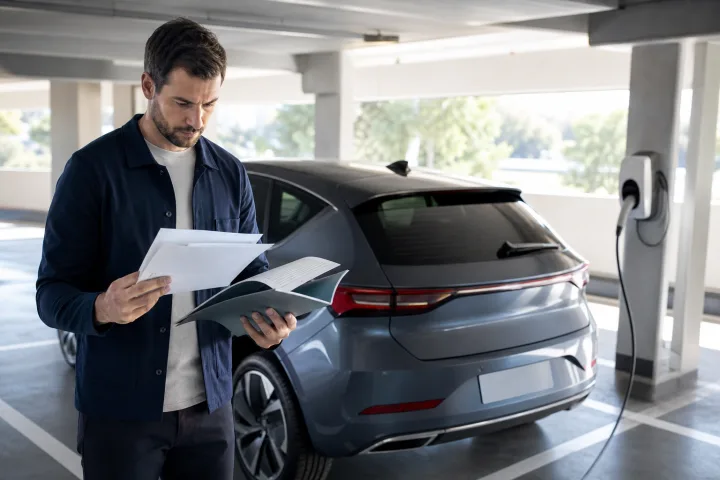
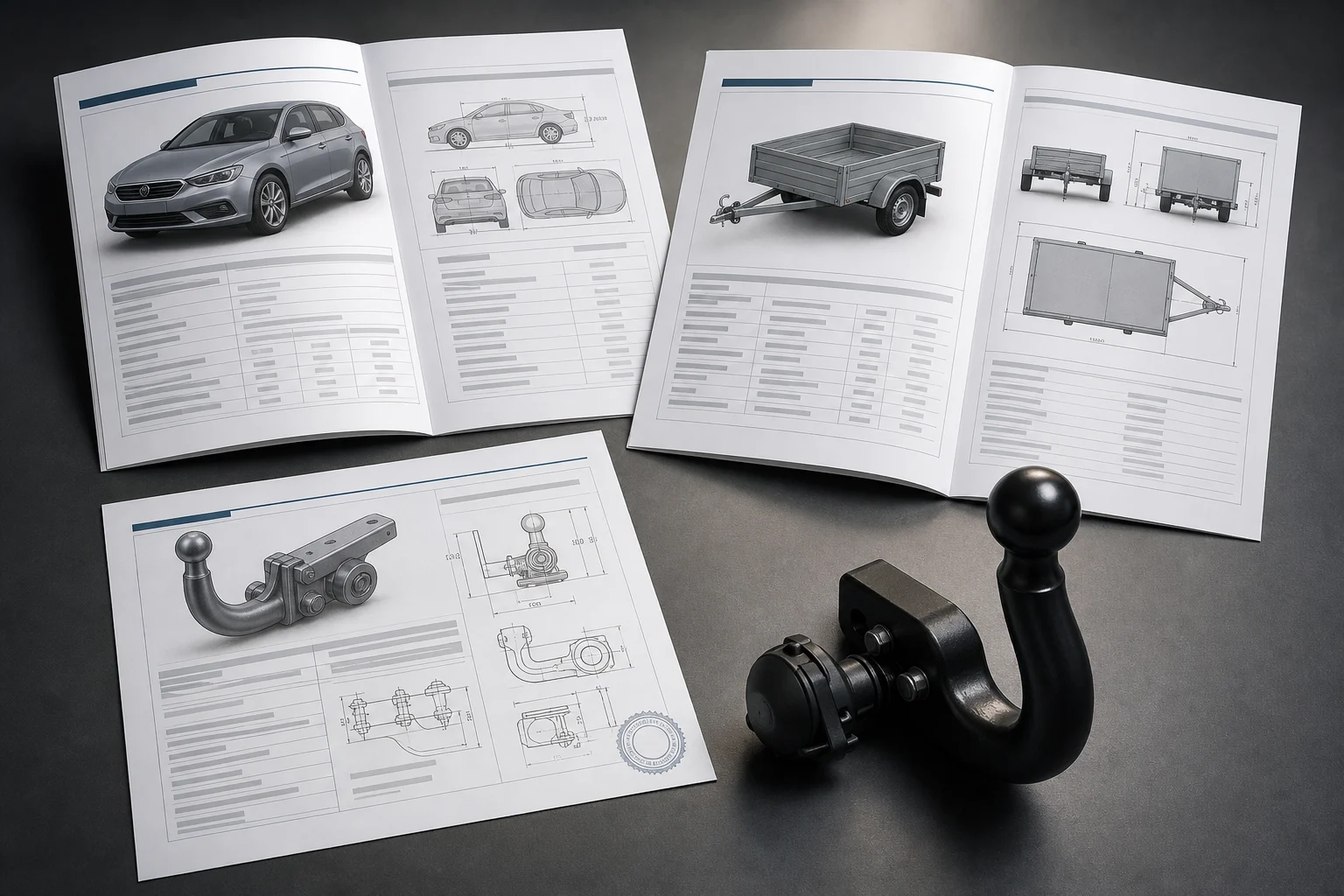
Gather the car's ITV card/technical inspection card (ficha técnica) and the specific documentation for the coupling device. If you are buying second-hand, request these documents before paying a deposit: compatibility depends on the exact version of the car and the towbar actually fitted, not just the make or model.
In the car's ITV card/technical inspection card (ficha técnica), look for its MAM and maximum towing mass. Identify the MAM and specifications that apply to the particular trailer. European approval separately covers the ability to tow unbraked trailers, trailers with overrun brakes, and trailers with continuous or semi-continuous brakes; therefore, confirm which applies to the trailer you will use.
The towbar documentation or entry may state both a permissible towing mass and a maximum vertical load at the coupling point. If the device limit is lower than the figure recorded for the vehicle, the Vehicle Modifications Manual provides for the ITV card data to be amended. Do not assume that a fitted towball automatically retains all the capacity specified by the car manufacturer.
Section references: DGT: conducir seguro con remolque ↗ · Manual de Reformas de Vehículos, revisión 7.ª, corrección 2.ª ↗ · Reglamento (UE) 2018/858 sobre homologación de vehículos y remolques ↗
- Towing vehicle ITV card/technical inspection card (ficha técnica): MAM and towing masses.
- Trailer data: MAM and trailer specifications.
- Towbar documentation: permissible towing mass and maximum vertical load.
- If a document is missing or data conflict, ask the installer or an ITV inspection station for confirmation before using the combination.
MAM, actual weight and combination weight: what each limit means
MAM is the maximum mass for a vehicle in use; it is not necessarily the weight it has on a particular day. Laden mass, by contrast, is the actual mass of the vehicle and its load. For a car and a trailer, the actual weight depends on the load carried by each one.
Mass in running order is neither the MAM nor the actual weight before setting off. Under Spain's General Vehicle Regulations, it is the tare plus a standard driver mass of 75 kg. It can serve as an initial reference, but it does not replace weighing a combination that will be close to its limits.
There is also a limit for the loaded combination: the technically permissible maximum mass of the combination is the sum of the masses of the loaded motor vehicle and the loaded towed trailer. This is a separate check from the individual MAM of the car and trailer. With a centre-axle trailer or semi-trailer, the permissible towing mass takes account of the actual vertical load borne by the coupling point; this is an additional reason to check the type of trailer and its documentation.
| Information to check | Document or place to check | Decision it allows you to make |
|---|---|---|
| MAM of the car and trailer | Car ITV card/technical inspection card (ficha técnica) and trailer data | Calculate the B96 and B+E requirements that need to be checked for the combination. |
| Maximum towing mass of the car | Towing vehicle ITV card/technical inspection card (ficha técnica) | Rule out trailers whose actual loaded mass exceeds the applicable limit. |
| Maximum combination mass | Technical documentation applicable to the particular vehicle | Check that the loaded car and trailer do not exceed the combination limit. |
| Actual weight before setting off | Actual load and, if there is doubt or it is close to the limits, weighing | Avoid exceeding technical limits even where the MAM are correct. |
| Permissible towing mass and vertical load of the towbar | Device documentation or entry | Confirm that the coupling does not limit the combination. |
| Trailer braking type | Trailer data | Check the combination documentation to confirm compatibility. |
Section references: Reglamento General de Vehículos: definiciones y masas remolcables ↗
- MAM: maximum mass for use; it is key to determining the B96 and B+E requirements.
- Laden mass: the actual weight of each vehicle once loaded; it is key to avoiding technical limits being exceeded.
- Mass in running order: a reference based on tare plus a 75 kg driver.
- Maximum combination mass: the technical limit for the loaded car and trailer together.
Braked trailers, vertical load and B96/B+E requirements: three independent checks
Do not treat a braked trailer and an unbraked one in the same way. For unbraked trailers, Spain's General Vehicle Regulations set an additional limit: the towing mass may not exceed half the tare mass (tara in Spanish documentation) of the towing vehicle plus 75 kg, and may never exceed 750 kg. Even if the car's documentation shows another towing figure, this specific limit must be respected for an unbraked trailer.
The vertical load on the towball also has a technical maximum defined by the vehicle manufacturer and/or the coupling device manufacturer. With a motorcycle trailer, cargo trailer or caravan, check that both the actual mass and the vertical load do not exceed the values stated in the vehicle and towbar documentation.
For B96 and B+E, the check is determined by MAM, not by the actual weight carried on a particular trip. Category B with code 96 covers combinations in which the trailer exceeds a MAM of 750 kg and the combination exceeds 3,500 kg without exceeding 4,250 kg. The B+E licence covers a category B towing vehicle and a trailer or semi-trailer whose MAM does not exceed 3,500 kg. This check does not replace any of the previous technical checks.
Section references: Reglamento General de Vehículos: definiciones y masas remolcables ↗ · Reglamento General de Conductores: clases B y B+E ↗ · DGT: con caravana, remolque o autocaravana ↗
- Unbraked trailer: apply its specific limit, based on the towing vehicle's tare mass (tara), in addition to the limits of the car and towbar.
- Braked trailer: confirm compatibility of that particular configuration in the documentation.
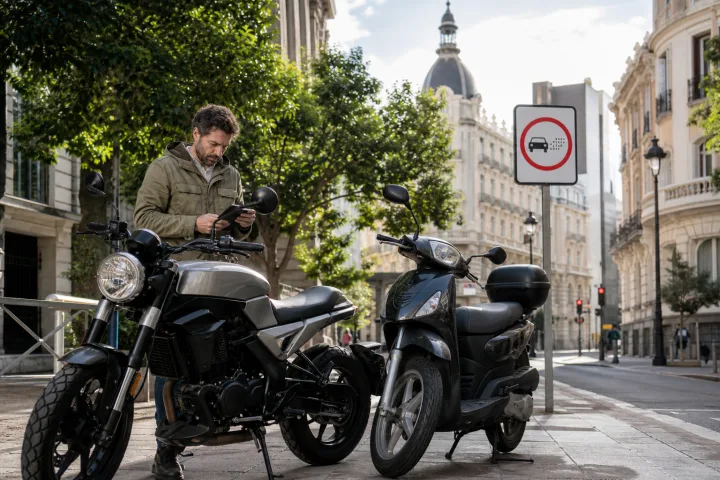
- Motorcycle trailer: check both the total mass and the permissible vertical load.
- Caravan: separate technical towing capacity from B96 and B+E requirements.
Before setting off: documents, installation and mistakes to avoid
Installing or modifying a coupling device on vehicles in categories M and N is considered a vehicle modification. In addition to ensuring its data are correctly documented, check that the towbar is securely attached to the structure and has no dents, cracks or corrosion that could compromise its connection to the chassis.
Administratively, light trailers with a MAM of 750 kg or less do not need their own insurance, but according to Spain's DGT they must be included in the towing vehicle's policy. Trailers and semi-trailers with a MAM over 750 kg must be registered before being driven. Carry the required vehicle documents: driving licence, registration certificate and ITV card. The DGT states that, since 2008, it has not been compulsory to physically carry the insurance policy or receipt.
The most common mistakes are choosing based on the car's advertised power, looking only at the trailer's MAM, forgetting the vertical load, or assuming that all towbars are equivalent. Avoid them by taking the seller, installer or ITV station a readable photo of the car's ITV card/technical inspection card (ficha técnica), the complete trailer details, the towbar documentation and the MAM calculation you will use to check B96 or B+E.
Section references: DGT: conducir seguro con remolque ↗ · DGT: documentación que debe llevarse en el vehículo ↗ · Manual de Procedimiento de Inspección de las Estaciones ITV, versión 7.9 ↗ · DGT: matricular un vehículo nuevo ↗
- Confirm that the towbar is securely fitted and has no visible damage that could compromise its connection.
- Check that the light trailer is included in the towing vehicle's insurance.
- If the trailer's MAM exceeds 750 kg, confirm that it is registered before driving.
- Carry your driving licence, registration certificate and ITV card.
- If there is doubt or the combination is close to its limits, verify the actual weights and consult the technical documentation or a qualified professional.
- If you are buying a used car for towing, identify its exact version before assessing its capacity.
How do I find out how much my car can tow?
Check the towing vehicle's ITV card/technical inspection card (ficha técnica) for its maximum towing mass and compare it with the trailer's actual loaded mass. Also apply the limit of the fitted towbar, the combination limit and, if the trailer is unbraked, its specific limit based on the towing vehicle's tare mass (tara).
Is a trailer's MAM the same as what it weighs?
No. MAM is the maximum mass for use; laden mass is the trailer's actual weight with everything being carried. B96 and B+E use MAM; actual weight matters for avoiding technical limits.
Can I tow more because my car has a lot of power?
No. Capacity depends on the vehicle's approved towing masses, the fitted towbar, the trailer braking type, the vertical load and the technical limit of the combination.
When might B96 or B+E be required for towing?
The check uses the MAM of the trailer and combination, not the actual weight of the trip. B96 covers combinations over 3,500 kg and up to 4,250 kg with a trailer over 750 kg. The B+E licence covers a category B towing vehicle and a trailer or semi-trailer with a MAM of up to 3,500 kg.
Does a light trailer need its own insurance?
The DGT states that a light trailer with a MAM of 750 kg or less does not need its own insurance, but it must be included in the towing vehicle's policy.