Water in a campervan or motorhome: calculate litres and use service points
A practical guide to calculating water for a campervan or motorhome trip, monitoring its weight and confirming where to fill and empty without confusing services with overnight stays.
Key points
There is no universal amount of water to carry: it depends on travellers, days, habits, equipment and payload. Plan using your vehicle manual, confirm each service point before diverting to it, and always keep filling, emptying and any overnight stay separate.
The quick answer: plan litres, weight and stops
Managing water in a motorhome is not about filling every tank before setting off. The useful decision is to calculate how much water your group will need until the next confirmed service point, check that this volume fits within the payload, and plan where you will empty wastewater and the toilet cassette.
There is no universal range that applies to every campervan and motorhome. Two people travelling for the same number of days can use very different amounts depending on how they use the vehicle and its fitted equipment. That is why the starting point is not a generic recommendation of litres per person, but the capacity and configuration stated in the documentation and manual for the specific vehicle.
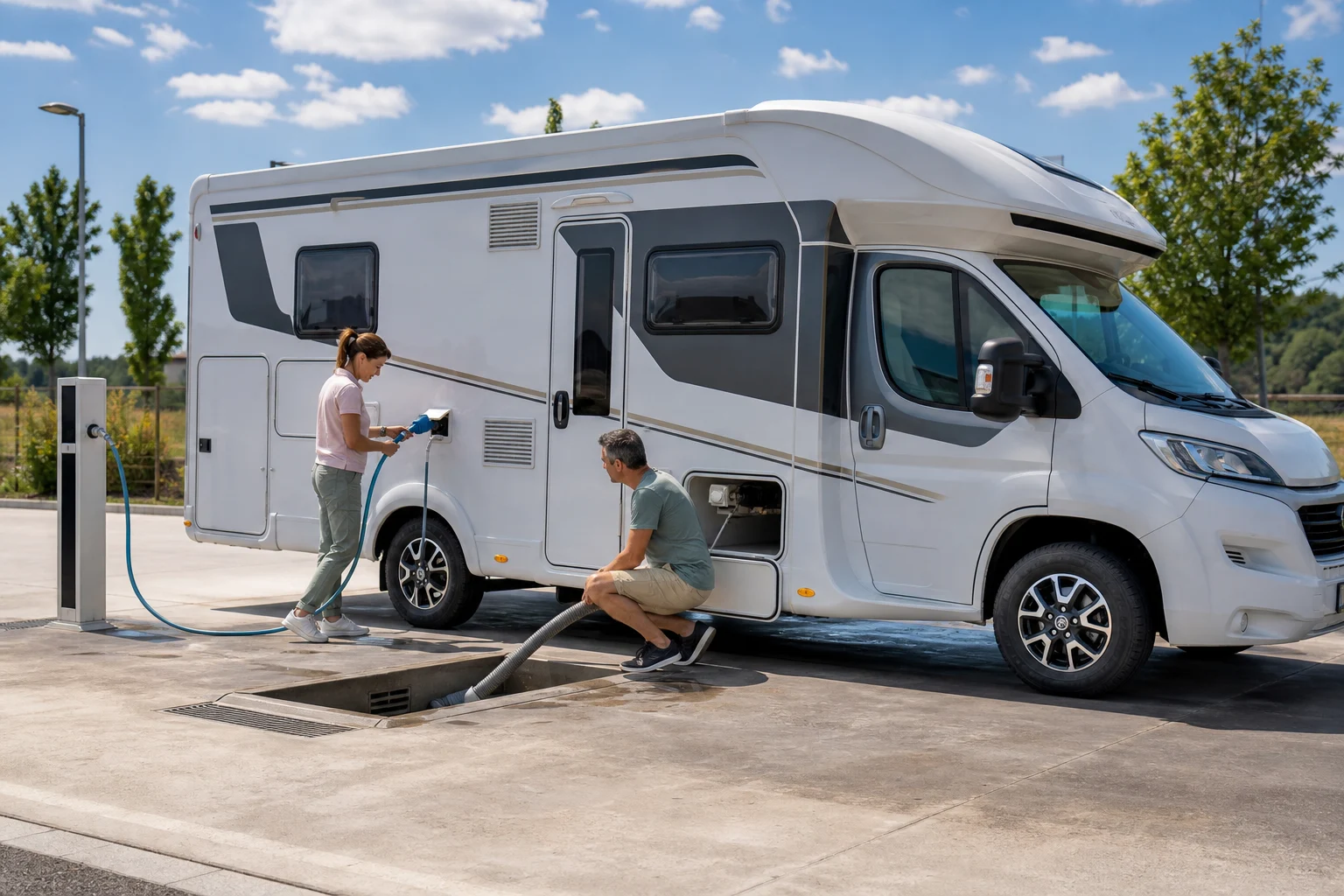
As a planning recommendation, before setting off identify a filling point and an emptying point on your route or near the destination, and confirm their conditions with the operator. Do not assume availability, permitted vehicle dimensions or overnight stays just because a place appears in an app, on a map or in a user post.
Section references: Gama Amphitryon 2027, modelo A968 ↗ · Cómo funciona: áreas y campings de la red ↗
- Check capacity, masses and conditions of use in your campervan or motorhome documentation.
- Note the planned days and occupants, the water uses you expect and a reasoned reserve.
- Find water and emptying services before departure; do not look for them when the tank is already near its limit.
- Treat filling, emptying and overnight stays as three separate matters.
Which tanks you need to identify in your vehicle
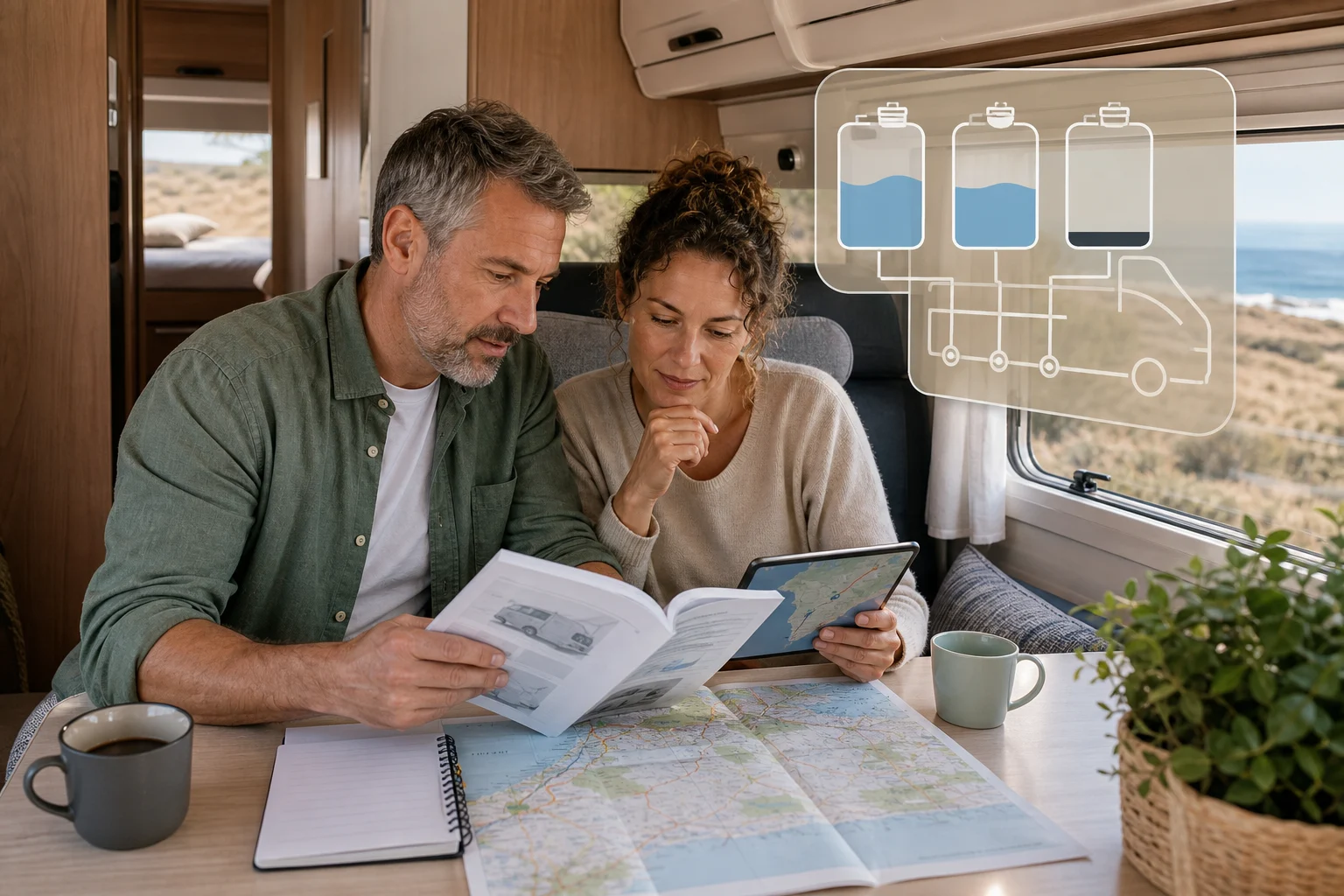
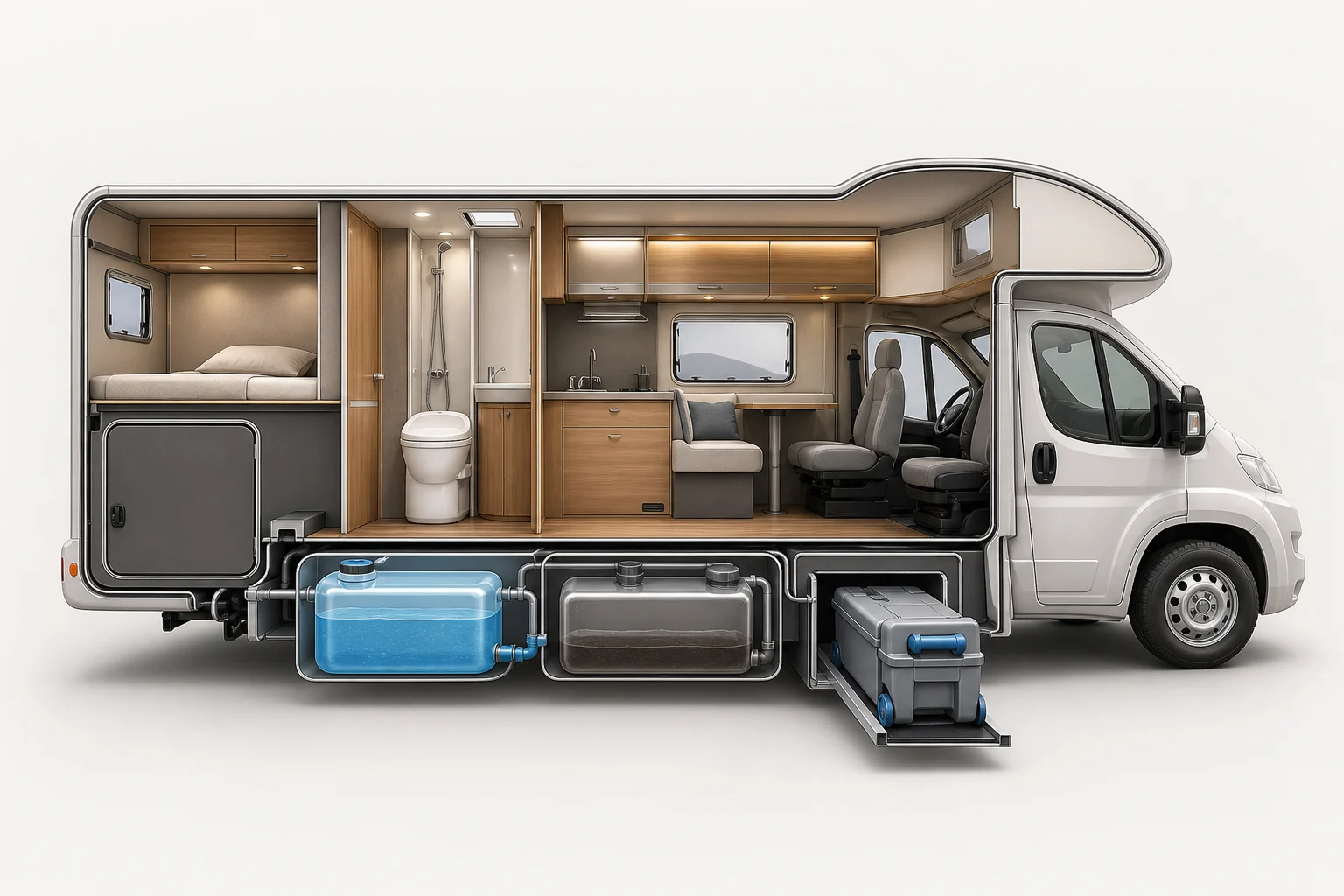
Start by not assuming that your vehicle has the same layout as another one. Check which fresh-water tank yours has, its stated capacity for driving and how its level is shown. Manufacturer Benimar expressly warns that technical specifications and equipment may vary by country or region; the documentation for your own unit is therefore the reference that takes priority.
You also need to know how your vehicle manages wastewater. Sign S-128 identifies a wastewater emptying point for caravans and motorhomes, but it does not in itself specify which particular facilities will be available alongside it. Check the requirements of your installation before choosing the destination or service point.
If your bathroom has a cassette toilet, waste is stored in a removable tank. Thetford states that it must be emptied at points specifically designated for that purpose. Do not confuse this circuit with the fresh-water system or assume that any drain is suitable for the cassette.
Section references: Tráfico actualiza la Instrucción de autocaravanas ↗ · Gama Amphitryon 2027, modelo A968 ↗ · Inodoros de cassette ↗
- Fresh-water tank: capacity, level and volume permitted while driving.
- Wastewater: installed system and the emptying method specified by the manufacturer.
- Toilet cassette, if fitted: location, removal and specific disposal point.
- Model documentation: version, optional equipment and intended market.
How to calculate water for a trip without inventing a range
Make a conservative forecast using your own data, not a standard figure. Break the trip down by the days until the next confirmed service point and note the planned uses for every occupant: drinking and cooking, hygiene, cleaning, and any use related to onboard equipment. Estimate the total for those days and add a margin for route changes, a closed point or a late arrival.
Then compare the result against two limits: the usable capacity declared for your vehicle and the available payload. If the calculation exceeds either one, the answer is not to assume that it “fits”; it is to reduce planned consumption, bring forward a service stop or revise the itinerary.
A practical way to improve the forecast on your first trips is to record the days, occupants and actual uses whenever you fill up and empty out. This does not turn consumption into a general rule, but it helps you prepare the next trip using evidence from your own vehicle and habits.
In some models, the difference between physical capacity and approved water capacity for driving is decisive. For example, Benimar states a fresh-water capacity approved for driving of 1 litre for the 2027 Amphitryon A968 range, and says that occupants, load and water volume must be adapted to the available payload. Do not extrapolate this figure to another range, year or configuration.
| Step | What to note | Decision if the result does not fit |
|---|---|---|
| 1. Section between services | Days, occupants and next confirmed point | Shorten the section or add a service stop |
| 2. Planned uses | Drinking, cooking, hygiene, cleaning and equipment | Reduce or reorganise the planned uses |
| 3. Margin | Reserve for route changes or lack of availability | Do not rely on a single unverified point |
| 4. Vehicle limits | Declared capacity and available payload | Carry less water or redistribute the load |
Section references: Gama Amphitryon 2027, modelo A968 ↗
- Define when and where the next confirmed filling point will be.
- Add up the uses you genuinely expect during that section of the journey.
- Include a margin for an incident, but do not ignore the payload limit.
- Record the actual result of each trip to refine the next forecast.
One litre of water is also one kilogram of load
Transported water directly affects the vehicle's mass. As a useful approximation, one litre of water equals one kilogram: NIST gives the density of water as approximately one gram per cubic centimetre. Therefore, 40 litres represent around 40 kg, while 100 litres represent around 100 kg. This mass is added to passengers, luggage, food, accessories and everything else you carry onboard.
Payload is not a minor detail in motorhome travel. Benimar notes that accessories and optional equipment reduce payload and can reduce the actual number of seats available while driving. Its 2026 catalogue also explains that mass in running order includes a 75 kg driver, a maximum water reserve while driving, 90% fuel and 100% gas. This convention must always be checked in the documentation for your specific version.
Before filling up, avoid two common mistakes: treating the tank's maximum capacity as a volume you can always carry while driving, and forgetting that you are already travelling with occupants, luggage and optional equipment. The valid figure is the one that keeps the whole vehicle within its authorised masses.
| Water carried | Approximate mass added to the load |
|---|---|
| 10 litres | 10 kg |
| 40 litres | 40 kg |
| 75 litres | 75 kg |
| 100 litres | 100 kg |
Section references: Gama Amphitryon 2027, modelo A968 ↗ · Catálogo Benimar 2026 ↗ · Density ↗
- Convert planned water into mass using the approximation 1 litre ≈ 1 kg.
- Check what is included in the mass in running order for your model.
- Count people, luggage, accessories and water as part of the same load budget.
- If there are doubts about the version or declared capacity, use the documentation specific to the unit.
Service points, sites and overnight stays are not the same
A service point may provide a specific service, such as wastewater emptying, without authorising an overnight stay. The DGT defines sign S-128 as a “Caravan and motorhome emptying point”; in itself, it describes the location of that service, not a general authorisation for overnight stays.
DGT Instruction PROT 2026/04 distinguishes parking, governed by traffic rules, from camping, which is regulated by tourism legislation. To be considered parked, among other conditions, the vehicle must rest only on its wheels, must not deploy projecting elements, and must not release fluids or noise outside. Also check the local rules and signage applicable to the chosen location.
There are networks of sites and campsites that offer services and stays, but their conditions cannot be extrapolated. CAMPING-CAR PARK states that services vary by site or campsite and asks users to check the information on its website or app. For its stopover sites, it states that access is available 24 hours a day all year round, with services such as water and emptying included in the stay; this is an example of a specific network, not a rule for every location.
Section references: Instrucción PROT 2026/04: Autocaravanas ↗ · Tráfico actualiza la Instrucción de autocaravanas ↗ · Cómo funciona: áreas y campings de la red ↗
- S-128: confirms a wastewater emptying point; it does not presume overnight stays.
- Site or campsite: check the operator's conditions for services, stays and access.
- Parking: check that you meet traffic conditions and local signage requirements.
- Camping: do not infer it from the mere existence of a water or emptying service.
Final checks and responsible-use rules
Confirm every point before diverting to it. Find the operator and verify the exact address and available services. Where the operator publishes information about access, opening times, costs, size restrictions or availability, review it before going. If the location belongs to a network, check its official listing or app, as a service advertised for one facility may not exist at another or remain available without changes.
To fill with water, follow the instructions given by the service-point operator. For the cassette, Thetford is explicit: you must locate a specific waste-disposal point or facility and empty it there.
The Spanish Regulation on the Public Water Domain generally prohibits direct or indirect discharges of water and waste products liable to pollute inland water or any other element of the public water domain, unless prior authorisation has been granted. Besides being an essential principle of respect for the environment, this helps prevent a water service from becoming a source of problems for travellers who come after you.
Section references: Reglamento del Dominio Público Hidráulico ↗ · Inodoros de cassette ↗ · Cómo funciona: áreas y campings de la red ↗
- Operator and contact details checked.
- Address and available services reviewed.
- Where published by the operator, opening times, costs, size restrictions and availability reviewed.
- Wastewater and toilet cassette emptied only at designated points.
- Parking, staying and local signage rules checked.
How many litres of water do I need in a motorhome?
There is no universal figure supported for every trip. Calculate the days until the next confirmed service point, the number of occupants and planned uses; add a margin and compare it with your vehicle's declared capacity and payload.
Can I fill the water tank completely before driving?
It depends on the documentation for your model and the available payload. Water adds approximately one kilogram per litre, and some manufacturers state a specific capacity approved for driving. Check the specification and also account for passengers, luggage and optional equipment.
Does an emptying point allow overnight stays?
Not necessarily. Sign S-128 identifies a wastewater emptying point; it does not in itself grant general authorisation for overnight stays. Check the operator's conditions, the signage at the location and applicable local rules.
Where should the toilet cassette be emptied?
At a point or facility specifically designated for disposing of this waste. Thetford says to locate that specific point before emptying; it must not be assumed that every drain is suitable.