Work Van Shelving: Load, Anchors and Documents to Check
A guide to comparing shelving, drawer units and load modules in a professional van: what to weigh, what to request in writing and when to confirm the applicable documentation.
Key points
Before ordering shelving for a work van, check authorised weights, the weight of every component, axle distribution, load restraint and the paperwork required for the final configuration. The number of drawers is only useful if the solution keeps the load safe, accessible and compatible with the vehicle.
The short answer: buy a load solution, not just furniture with drawers
Work van shelving should be chosen only after checking five points: the vehicle's maximum authorised mass (MAM) and maximum authorised axle masses recorded in its Spanish vehicle documentation, the weight of the conversion and the actual load, how that weight will be distributed, the system that will prevent tools and packages from moving, and the documentation the final configuration may require.
MAM is the maximum mass at which the loaded vehicle may be used. It is not equivalent to the cargo compartment volume or to the stated capacity of a shelving unit. There are also maximum authorised axle masses recorded in the specific vehicle's Spanish documentation, so a van may fail to comply even if its calculated total does not exceed the MAM.
The practical starting point is to turn the quotation into a configuration sheet. It should identify the specific van, the parts to be fitted, their masses, the fixing points used and the method for restraining each type of item. If the supplier only talks about the number of shelves, drawers or litres available, there is not enough information to assess the solution.
Section references: Reglamento General de Vehículos — masas, amarres y retención de carga ↗ · Reglamento General de Circulación — disposición de la carga ↗
- Ask for the quotation to identify the intended vehicle, version and load configuration.
- Request the weight of shelving, drawer units, bulkhead and other fixed equipment separately.
- Check the MAM and maximum authorised axle masses recorded in the specific vehicle's Spanish documentation.
- Require a written description of the anchorage points and load restraint system.
- Before accepting fixed modules, confirm which documentation applies to that configuration.
Start with the work activity and an inventory using real weights
A van used for electrical work, maintenance, HVAC or assistance services may carry items of similar size but with very different weights and access requirements. The inventory should not be limited to counting tool cases. It should list tools, consumables, spare parts, fixed equipment, occasional packages and anything that travels every day.
For each item, note its weight, usual quantity, preferred location and frequency of use. Also distinguish between items that must remain in closed boxes, those that need access from the side or rear door, and those that can be loaded only for specific jobs. This information helps avoid two common mistakes: buying a layout that forces workers to move heavy loads several times a day, and allocating the areas best suited to the greatest masses to lightweight items.
Do not use an exceptional day or an empty van as the reference point. The configuration should suit normal service and allow for foreseeable cargo peaks. If several people share the vehicle, agree on a standard load list: it is the only way to check whether the available capacity will remain sufficient when the van is actually in operation.
Section references: Reglamento General de Vehículos — masas, amarres y retención de carga ↗
- Tools and machines: individual weight and usual quantity.
- Spare parts and materials: maximum weight expected per day or job.
- Fixed equipment: shelving, drawer units, bulkhead and other fitted items.
- Access: rear door, side door or both, depending on the task.
- Variable load: what is removed before carrying an especially heavy or bulky package.
Calculate the available payload after fitting out the van
Spain's General Vehicle Regulations define tare mass as the mass of the vehicle with its authorised fixed equipment. They also define laden mass as the actual mass of the vehicle and its load, including service personnel and passengers. Therefore, the weight of a fixed conversion is not neutral: it reduces the capacity available for occupants and goods.
As a planning check, start with the difference between the MAM and the vehicle mass shown in its documentation. Then subtract the documented weight of every fixed item to be added, and allow for the weight of the people travelling and the usual load. The result should be treated as an operational estimate, not as an authorisation independent of the values stated for the vehicle and its axles.
Fuel, accessories and items left permanently inside are also part of real-world use. The main weakness in this calculation is subtracting only boxes and tools while overlooking a heavy drawer unit, a bulkhead, fixed equipment or a second occupant. The other is assuming that, because there is total mass margin, any location is valid: the maximum authorised axle masses recorded in the specific vehicle's Spanish documentation still apply.
Section references: Reglamento General de Vehículos — masas, amarres y retención de carga ↗ · Inspecciones técnicas en carretera de vehículos comerciales — sujeción de carga ↗
- MAM and maximum authorised axle masses: use the values recorded in the specific vehicle's Spanish documentation.
- Conversion weight: request an itemised figure in writing.
- Occupants and service personnel: include them in the usual work scenario.
- Goods, tools and consumables: calculate the daily load and foreseeable peak.
- Review the calculation when the configuration, workforce or type of service changes.
Distribute masses and keep the load capable of being secured
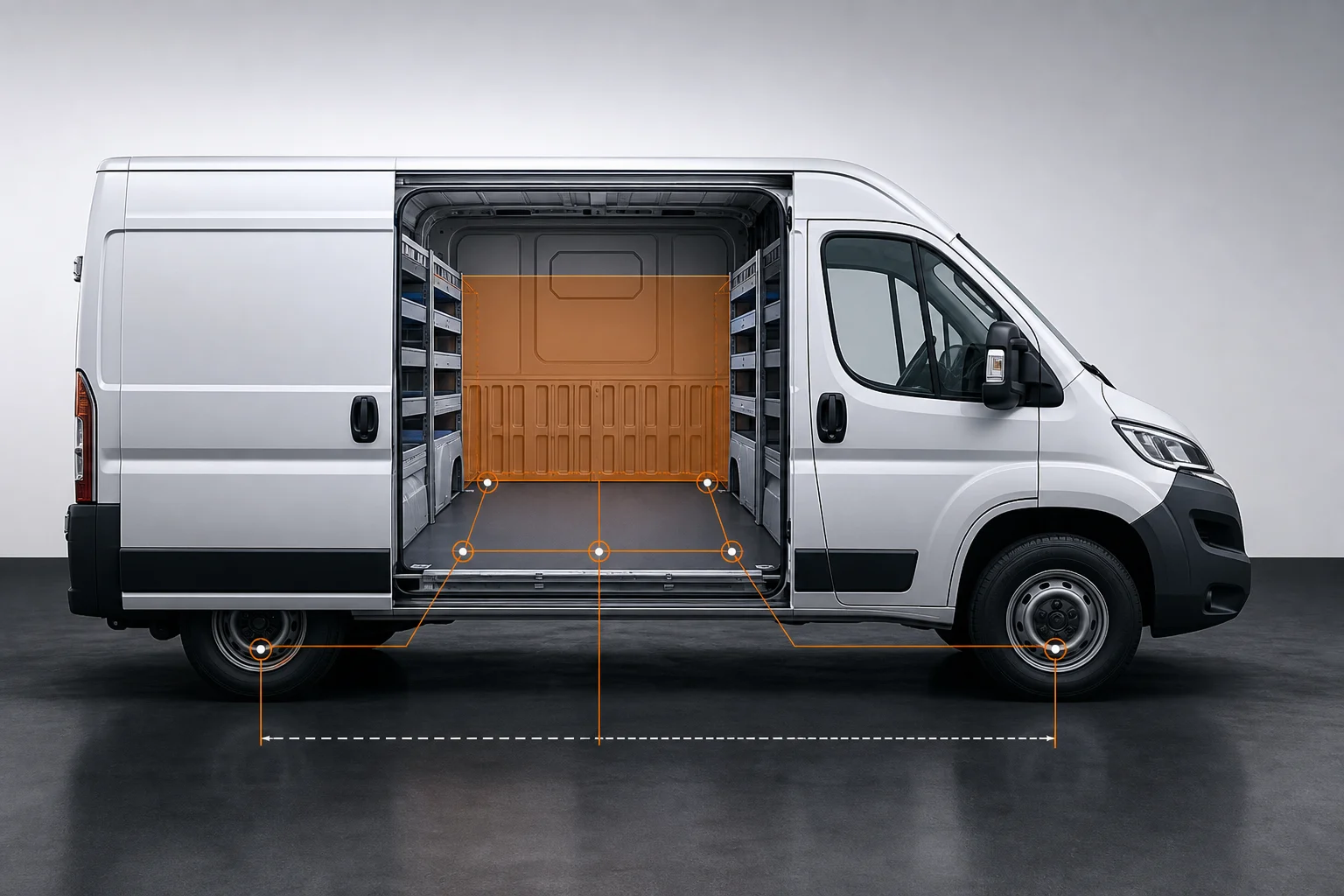
Distribution matters as much as total mass. Roadside technical inspections of commercial vehicles take account of the maximum authorised axle loads recorded for the specific Spanish vehicle and the minimum axle loads required within the MAM. As an operating guideline, Spain's DGT recommends placing the heaviest items in the centre, between the two axles, and securing the load properly.
The General Traffic Regulations require cargo and the accessories used to arrange or protect it to be positioned and, where necessary, secured so they cannot move dangerously or compromise stability. This duty covers material carried on the floor as well as cases, boxes or parts stored in a module.
When comparing quotations, look at the loaded system as a whole: shelving may organise items, but it does not in itself replace the restraint needed to prevent movement. Avoid blocking every vehicle tie-down point, as variable cargo may still need them. It is also advisable to retain access that allows packages to be placed and removed without temporarily leaving loose items in the aisle or by the doors.
Section references: Reglamento General de Circulación — disposición de la carga ↗ · Inspecciones técnicas en carretera de vehículos comerciales — sujeción de carga ↗ · Cómo transportar la carga en una furgoneta ↗
- Place the largest masses with the maximum authorised axle masses recorded in the specific vehicle's Spanish documentation in mind, not just loading convenience.
- Provide a means of securing cases, boxes and packages that are not effectively contained by the module.
- Check that usable tie-down points remain available for variable loads.
- Do not assume that a shelf, drawer or lip retains every item: request the intended solution for each load.
- Review the layout when carrying parts heavier than those in the usual inventory.
Anchors and cab separation: what to request in writing
Do not assess an anchorage by its appearance. For a solution that secures cargo, ask which tie-down points it uses, what strength applies to each component used, and what method has been planned for each type of load. The inspection rules cover, among other methods, locking, immobilisation, direct lashing and top-over lashing, and require account to be taken of the strength of the points when they are used to secure cargo.
The technical references expressly cited in these rules include EN 12195-1, on calculating lashing forces; EN 12640, on tie-down points; and EN 12642, on the strength of body structures. It is not enough for these names to appear in a quotation: ask the supplier to clarify which specific component they refer to and for which vehicle and load configuration they apply.
The separation between cab and cargo deserves a specific check. The rules define a restraint device —a bulkhead, net, grille or bars—as the element that fully or partly separates both areas to protect passengers from possible load movement. When the vehicle is authorised to carry people and cargo at the same time, it must have suitable protection that does not obstruct or injure occupants if the load is projected forward.
For N1 vehicles intended to carry goods, anchorages behind the seat backs are regulated for securing a restraint device. If the device is not fitted, the manufacturer must specify suitable joining elements. Therefore, confirm the exact compatibility between the van, bulkhead and fixing elements; do not replace that information with generic catalogue compatibility.
Section references: Reglamento General de Vehículos — masas, amarres y retención de carga ↗ · Reglamento General de Circulación — disposición de la carga ↗ · Inspecciones técnicas en carretera de vehículos comerciales — sujeción de carga ↗
- The anchorage points and intended joining elements to be used.
- Applicable strength of the points, restraint systems and components used.
- Securing method for tools, boxes and variable packages.
- Documented compatibility of the bulkhead or restraint device with the specific vehicle.
- Access to the load and ability to use the remaining lashings after the module is fitted.
Documentation and comparison: confirm before ordering fixed modules
The right question is not whether all shelving requires the same documentation, but which documents apply to the specific configuration. Spain's Vehicle Modifications Manual determines the documentation for each type of modification, and the Ministry portal publishes Revision 7, Correction 2, as applicable from February 2026. Before signing, provide the installer with the van's complete identification and request a written answer on the applicable documentation, ITV inspection treatment and any compatibility conditions.
Where there is a technical doubt, the Ministry states that the vehicle manufacturer or legal representative, or any of the designated technical services for modifications, may be contacted. This is particularly important when fixed elements, fixing points, cab separation or the vehicle's documented configuration are altered. Do it before placing the order: changing or removing items once installed may require the entire system to be reconsidered.
The three common configurations address different needs. They do not have a universal permitted capacity, compatibility or documentation requirement: these depend on the vehicle, anchorages, module and documented configuration. Compare their access and the space they reserve, but require the specific data for the proposal.
| Configuration | Functional advantage | Limitation to review | Work activity it may suit |
|---|---|---|---|
| Side shelving | Organises tool cases, consumables and parts by category, leaving a central cargo area. | Occupied side volume, effective restraint of every item and tie-down points that remain usable. | Maintenance and assistance work with many small references. |
| Floor drawer units | Provide organised access to tools from the lower part of the compartment. | Added fixed weight, height and available surface for packages, as well as restraint of the load above. | Trades that carry tool cases and compact equipment. |
| Pull-out modules | May make it easier to access organised equipment and boxes from the rear doors. | Space reserved for the mechanism, cargo restraint and compatibility of the complete solution with the vehicle. | Services that need frequent access to materials from the rear. |
Section references: Inspecciones técnicas en carretera de vehículos comerciales — sujeción de carga ↗ · Reglamentación y homologación de vehículos — Manual de Reformas vigente ↗ · Vehículos — consultas sobre reformas ↗
- Give the supplier the van's complete documentation and identification before finalising the design.
- Request in writing the list of documents and procedures that apply to the proposed configuration.
- Keep the detailed quotation, component identification, and compatibility and fixing documentation.
- Check that the final solution matches the one that was assessed and documented.
- If in doubt, consult the manufacturer or legal representative and a designated technical service before ordering.
Can I choose shelving based only on the number of drawers?
That is not enough. First, check the weight of the modules, the MAM and maximum authorised axle masses recorded in the specific vehicle's Spanish documentation, the usual load, weight distribution and how tools and packages will be secured.
Does a bulkhead replace the need to secure the load?
No. Its role is to fully or partly separate cab and cargo to protect occupants from possible load movement. The cargo and its accessories must be arranged and secured so they cannot move dangerously.
Do all fixed shelving systems require the same documentation?
This should not be assumed. The documentation depends on the type of modification and the specific configuration. Confirm it with the installer before ordering and, where there is technical doubt, with the manufacturer or legal representative and a designated technical service.
Which documents should I request in a quotation?
At a minimum, request vehicle identification, the weight of fixed elements, the intended fixing points and restraint system, bulkhead compatibility if fitted, and the list of documentation or procedures applicable to the configuration.