Used electric motorcycle: what to check on battery, charging and warranty
A guide to verifying the identity, history, warranty and charging system of a used electric motorcycle before completing the purchase in Spain.
Key points
Before buying a used electric motorcycle, identify the individual vehicle by VIN, check its history with the DGT, and obtain written battery, charger and warranty terms. Catalogue range and mileage do not replace these documents or prove the battery’s condition on their own.
Quick answer: do not buy based on mileage or advertised range alone
The key check starts by tying every piece of information to the specific vehicle. Ask for the frame number or VIN, registration certificate and technical inspection card; request the available maintenance history, invoices, and the commercial warranty document for the battery and charger. Then physically confirm which charging equipment is included and whether it can be used where you will charge it.
For a motorcycle registered in Spain, the full DGT report makes it possible to check administrative and technical data, Spain’s roadworthiness inspection (ITV) history, mileage, registered keepers, encumbrances, outstanding recall campaigns, and maintenance reported by workshops participating in the electronic logbook. It is a highly useful check before paying a deposit, but it is not a certificate of battery state of health: the information listed by the DGT does not include that value.
If the seller provides a battery diagnostic, treat it as documentation that must be attributable to that motorcycle and to a date. If it is unclear who issued it, which vehicle it identifies or what its scope is, the uncertainty remains. Before signing, record the VIN, included items, applicable warranties and any outstanding commitments in the contract.
Section references: Informe de un vehículo ↗
- VIN and vehicle documentation: they must match each other.
- Full DGT report: useful for checking history, encumbrances, ITV, mileage and campaigns.
- Commercial warranty document: essential if battery, charger or high-voltage cover is advertised.
- Actual charging equipment: charger, cables, connectors and accessories included.
- Compatibility with your usual charging setup: do not assume it from seeing a plug or public charging point.
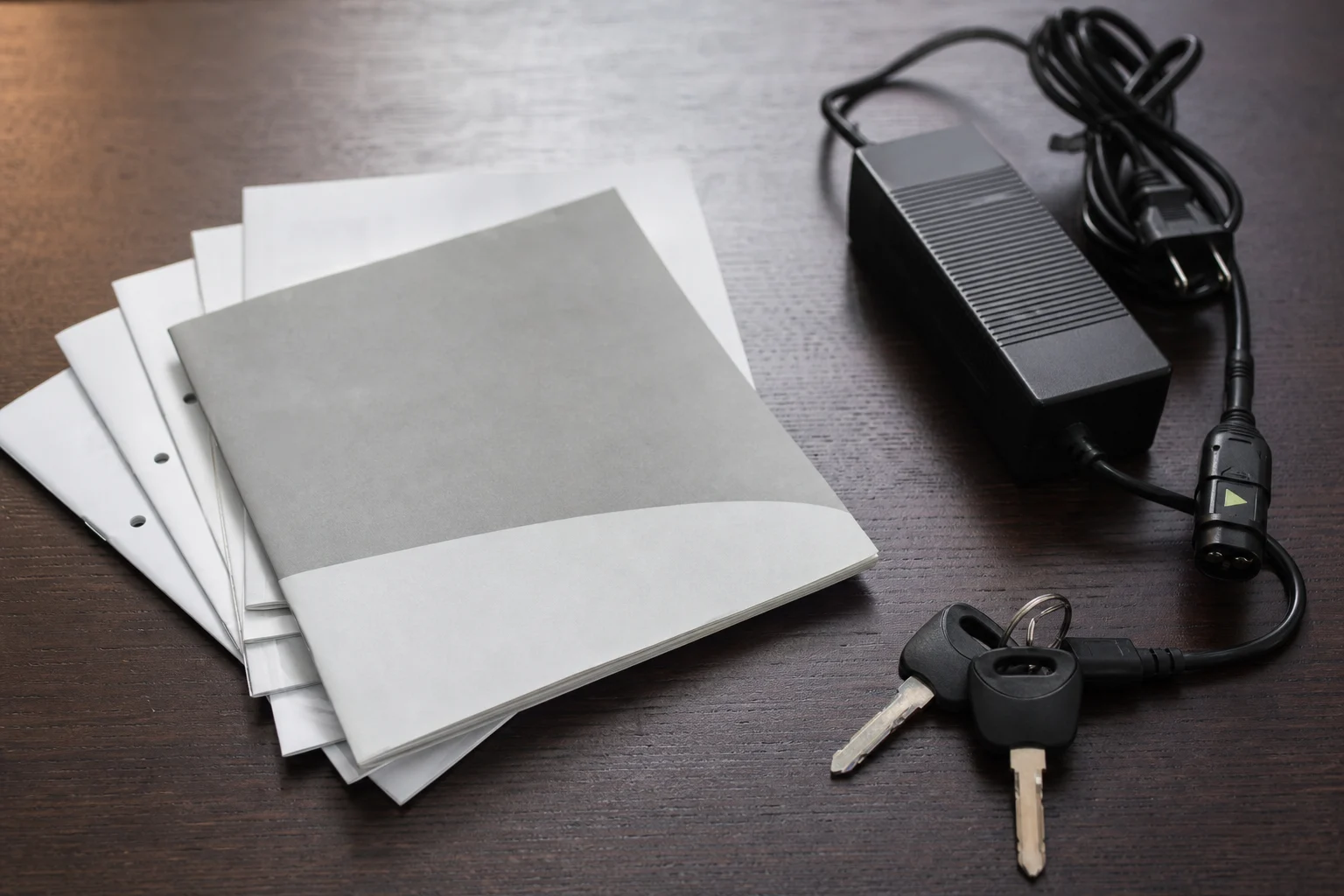
Identify the version and battery by VIN, not by an advert description
If the vehicle is a two-wheeled motorcycle, its European category is L3e, but that classification alone does not identify its configuration. Two commercially similar units may differ in type, variant, version or equipment. Therefore, you should not assign a battery capacity, charging power or accessory to a used motorcycle from photographs, incomplete names or generic model data.
The starting point is the VIN. The European Implementing Regulation requires the certificate of conformity to include the vehicle identification number and the exact technical characteristics, without ranges. Request that certificate when available and compare it with the Spanish documentation and the vehicle’s VIN. If there are discrepancies, stop the transaction until the seller or authorised network clarifies them in writing.
The date of first registration should also be noted, but it does not replace version identification. It is relevant for putting the history in order and reviewing coverage periods, whereas the technical configuration must be supported by documents relating to that specific vehicle.
Section references: Reglamento de Ejecución (UE) n.º 901/2014: requisitos administrativos de homologación para vehículos de dos o tres ruedas y cuatriciclos ↗ · Reglamento (UE) n.º 168/2013: homologación de vehículos de dos o tres ruedas y cuatriciclos ↗
- Write down the full VIN before commissioning checks or placing a reservation.
- Compare the VIN, registration certificate, technical inspection card and, if available, certificate of conformity.
- Ask for the exact version to be identified when discussing the battery, charger or equipment.
- Do not accept a generic specification sheet as proof of the advertised vehicle’s specifications.
Battery: what a report can prove and what it will still not answer
Mileage shown in an advert or in the DGT report can be used to check the recorded distance travelled; it does not certify the state of health of the traction battery. Likewise, the DGT report does not provide a battery state-of-health value. Do not turn either of these data points into an automatic conclusion about available capacity, range or the need for replacement.
When a battery report is provided, review it as additional documentation alongside the rest of the vehicle information. Its contents may require clarification before drawing conclusions about the battery. An isolated figure leaves uncertainties that should be assessed before purchase.
If doubts remain about the battery or advertised coverage, ask the seller for the available documentation and record any outstanding commitment in writing. Do not present an original range figure as the range you will achieve: use it only as a reference for the original configuration, after verifying that this configuration matches the vehicle.
Section references: Informe de un vehículo ↗ · Reglamento de Ejecución (UE) n.º 901/2014: requisitos administrativos de homologación para vehículos de dos o tres ruedas y cuatriciclos ↗
- Distinguish between recorded mileage, original specification and any battery documentation provided.
- Do not use the DGT report as a battery certificate: it does not include state of health.
- Review any battery report alongside the vehicle documentation.
- If doubts remain, ask the seller for clarification and documentation before buying.
Warranty: separate legal liability from commercial coverage
In a used sale in Spain by a trader to a consumer, the parties may agree on a liability period shorter than three years, but never shorter than one year from delivery. This rule does not by itself describe a sale between private individuals. Therefore, identify who is selling and ask for the contract to clearly state the delivery date and the applicable coverage regime.
The manufacturer’s or guarantor’s commercial warranty for the battery, charger or high-voltage components is different. Its document must identify the covered item, the guarantor, the claims procedure, the terms, duration and territorial scope; furthermore, it binds the party named as guarantor. It is not enough for an advert to say “battery under warranty”: ask for the full text so you can check what it covers and for how long.
Also check whether the document allows transfer to the next keeper, what requirements it imposes and whether any prior procedure must be completed. If the seller cannot prove it is valid, do not include it in the purchase value as though it were confirmed. A commercial warranty does not remove the consumer’s legal rights against a trader for lack of conformity.
Section references: Texto refundido de la Ley General para la Defensa de los Consumidores y Usuarios, consolidado ↗
- Determine whether you are buying from a trader or a private individual before assessing legal cover.
- Read the complete commercial warranty, not just its advertised duration.
- Check the covered item, guarantor, procedure, terms and territory.
- Request written confirmation that it applies to the vehicle and future keeper.
Charging system: confirm the motorcycle, included equipment and your installation
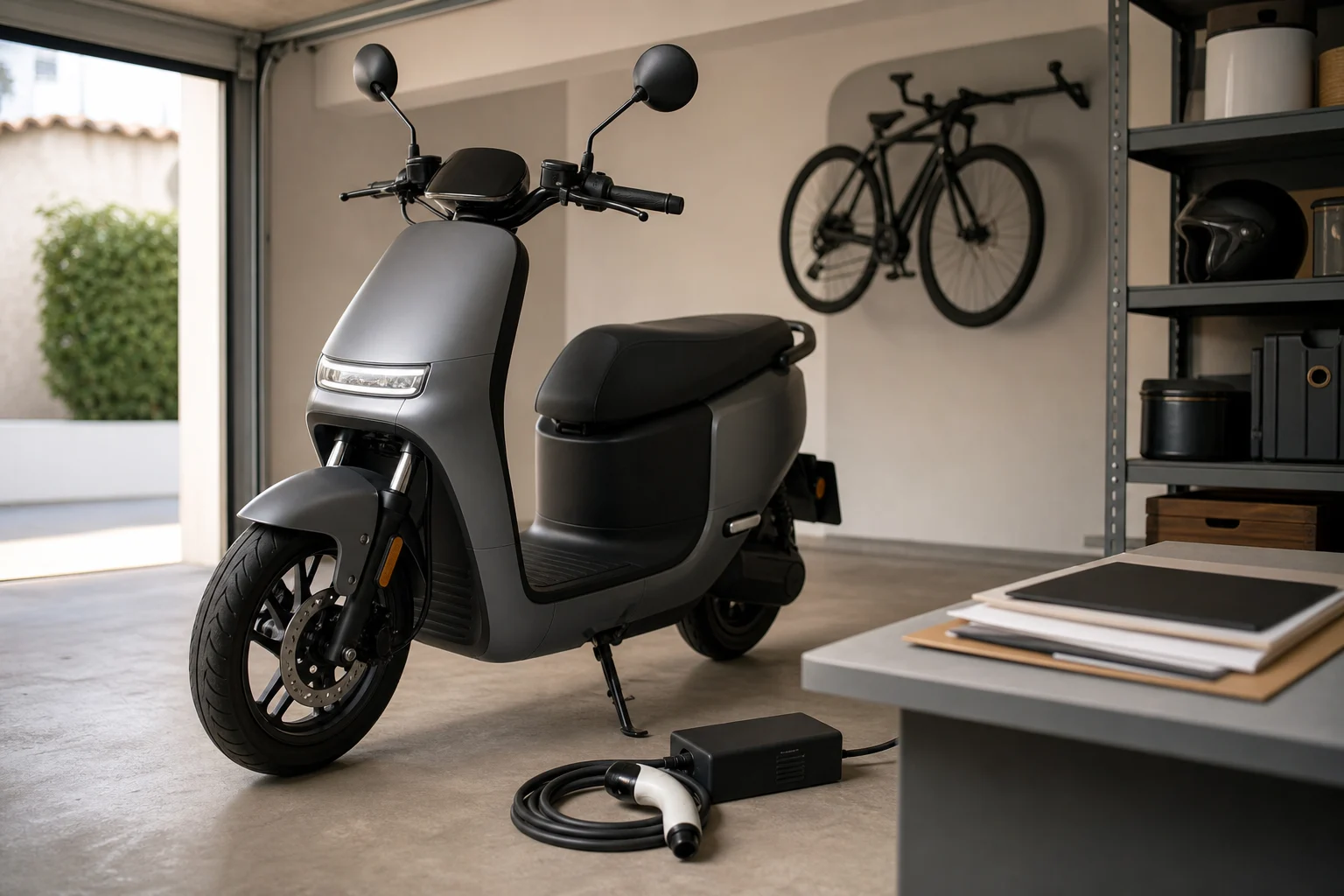
Compatibility cannot be inferred from the motorcycle having a charging plug or from there being a nearby public charging point. Check which connector the vehicle uses, whether the charger is built-in or external, what power the motorcycle accepts, and which items are supplied: charger, cable, adapters and any other advertised accessories. These items should be listed in the contract or delivery document.
Then compare them with your actual charging situation. ITC-BT-52 sets different requirements depending on charging power and mode. For example, for AC charging above 3.7 kW and up to 22 kW, it requires at least a type 2 socket outlet or connector at the charging point. This rule illustrates why the connector, power and charging point must be assessed together.
The power stated on a charger also does not prove that it can be used at that power in your garage. The regulation requires the planned power of each station and the simultaneity factor to be considered when checking the installation’s capacity. Before buying, provide the exact equipment details to the person responsible for the installation or a qualified installer so they can confirm compatibility and available capacity.
Section references: ITC-BT-52: infraestructura para la recarga de vehículos eléctricos ↗
- Make a physical list of the included charger, cables, connectors and adapters.
- Compare the connector and power accepted by the motorcycle and charger with your charging point.
- Do not assume that a public point or plug solves compatibility.
- Request confirmation for the specific installation if planned charging depends on a communal garage or high power.
History, campaigns and the final checklist before completing the transaction
Request maintenance invoices and supporting documents, and compare them with the full DGT report where information has been reported by workshops participating in the electronic logbook. Matching dates, VIN and vehicle details helps put the history in order; the absence of documentation, by contrast, is an issue that should be expressly assessed before setting the price.
Check recalls using the VIN through the DGT search. Since May 2024, campaigns have been incorporated into the Vehicle Register. The search shows only outstanding campaigns: the absence of a campaign does not itself prove how earlier ones were resolved. For more information, the DGT states that you should request a detailed vehicle report.
Leave signing until the end. If the battery, warranty, charger or installation remain unconfirmed, do not turn them into verbal promises. You can organise the visit with this checklist and add the specific electrification points.
| Document or item | What should match | Question to resolve |
|---|---|---|
| VIN, registration certificate, technical inspection card and certificate of conformity if available | The vehicle’s identification and its exact technical characteristics | Type, variant, version and actual battery or charging configuration |
| Full DGT report | Administrative and technical data, ITV, mileage, keepers, encumbrances, campaigns and reported maintenance | It does not certify battery state of health |
| Battery report or documentation | Documentation provided for the vehicle | What information it provides about the battery |
| Commercial warranty | Covered item, guarantor, procedure, terms, duration and territory | Validity and applicability to the future keeper |
| Charger, cables and connectors | Advertised equipment versus what is physically delivered | Compatibility with the motorcycle and available charging |
| DGT campaign search | VIN and outstanding campaigns | Proof for campaigns that may already have been completed |
Section references: Informe de un vehículo ↗ · Llamadas a revisión de un vehículo ↗
- Obtain the full DGT report before completing the purchase.
- Check outstanding campaigns using the VIN and ask for proof of those already completed.
- Include the VIN, delivered charging equipment and provided warranty documentation in the contract.
- Do not complete the transaction until discrepancies between documents, the advertised version and the physical equipment have been resolved.
Does the DGT report say what condition an electric motorcycle battery is in?
No. The full report can be used to check administrative, technical and historical vehicle information, but the data published by the DGT do not include a battery state-of-health value.
Does mileage prove the range of a used electric motorcycle?
Not by itself. Mileage can be checked against the available history, but it is not a certificate of battery capacity or range. To assess a vehicle, review the available documentation alongside the rest of the motorcycle’s information.
What must a commercial battery warranty include?
It must identify the covered item, the guarantor, the claims procedure, the terms, duration and territorial scope. It is also advisable to confirm in writing whether it applies to the future keeper.
Is having a plug in the garage enough to charge the motorcycle?
It should not be assumed. You need to compare the connector and power of the motorcycle and its charger with the available installation. Charging installation capacity depends, among other things, on planned power and simultaneity.