Automatic or manual gearbox in a used car: a document guide
Manual or automatic is not a choice between labels: before buying, confirm which transmission the car has, check its history and do not ignore doubts during the test drive.
Key points
This document-based guide to comparing used manual and automatic cars explains how to identify the exact transmission and check the maintenance that applies to each vehicle. History and invoices reduce uncertainty, but they do not replace a professional inspection whenever there is doubt.
The short answer: history helps reduce uncertainty
If you are choosing between two equivalent used cars, one manual and one automatic, pay particular attention to the work the manufacturer specifies for each vehicle and to the documentary evidence that it was carried out.
There is no basis for treating all automatics as one single product or for assuming that a manual is free from checks. Volkswagen expressly distinguishes manual, automatic and dual-clutch gearboxes when discussing transmission oils. In addition, an official plan may set a DSG oil change solely by mileage rather than years; that example does not allow the same interval to be applied to another make, engine, version or gearbox.
As a practical criterion, give priority to the car whose service book or invoices allow you to verify the work that applies to it. If the seller cannot evidence those points, the manual or automatic label does not reduce that uncertainty.
Section references: Aceites de transmisión ↗ · Plan de Mantenimiento Volkswagen para vehículos híbridos ↗
- Manual: check which maintenance documents and operations apply to that vehicle.
- Automatic: do not assume a shared architecture or maintenance schedule from the listing label.
- In both cases: a maintained, documented transmission is a higher priority than the listing label.

Do not buy a label: identify the exact transmission
“Automatic” describes how it is operated, but it does not by itself confirm the architecture. It is especially important not to turn trade names, acronyms or the selector type into a technical conclusion. Ask the seller for the vehicle identification number, the full version and the relevant owner’s manual or maintenance plan. Then check that the applicable official documentation describes the vehicle being advertised.
For a dual-clutch transmission, Volkswagen explains that there are two transmission shafts and the next gear can be preselected. The same brand states that, depending on the engine, its two clutches may run in an oil bath or dry. Therefore, even “dual clutch” is not enough to infer one configuration or the same maintenance requirements.
There are also automated transmissions derived from a manual gearbox. Fiat Professional describes a robotised sequential transmission with electrohydraulic actuation that combines these functions with a six-speed manual gearbox from which it is derived. Toyota Spain uses the term e-CVT for an electrically continuously variable transmission in a specific catalogue. These references help explain why you must verify the version and documents, not assign a gearbox to any car based on its trade name.
Section references: Cambio automático DSG ↗ · Ducato, un mundo de libertad con matrícula Fiat Professional ↗ · Toyota C-HR: catálogo ↗
- Request the VIN, make, model, year, engine and exact version before comparing two listings.
- Ask for a legible photo of the service book, the applicable manual or an invoice identifying the transmission-related work.
- If the listing says DSG, e-CVT, robotised or simply automatic, ask which documents confirm it for that vehicle.
- Do not use an explanation for another generation, engine or market as a substitute for the plan of the car you intend to buy.
Transmission documentation and discrepancies
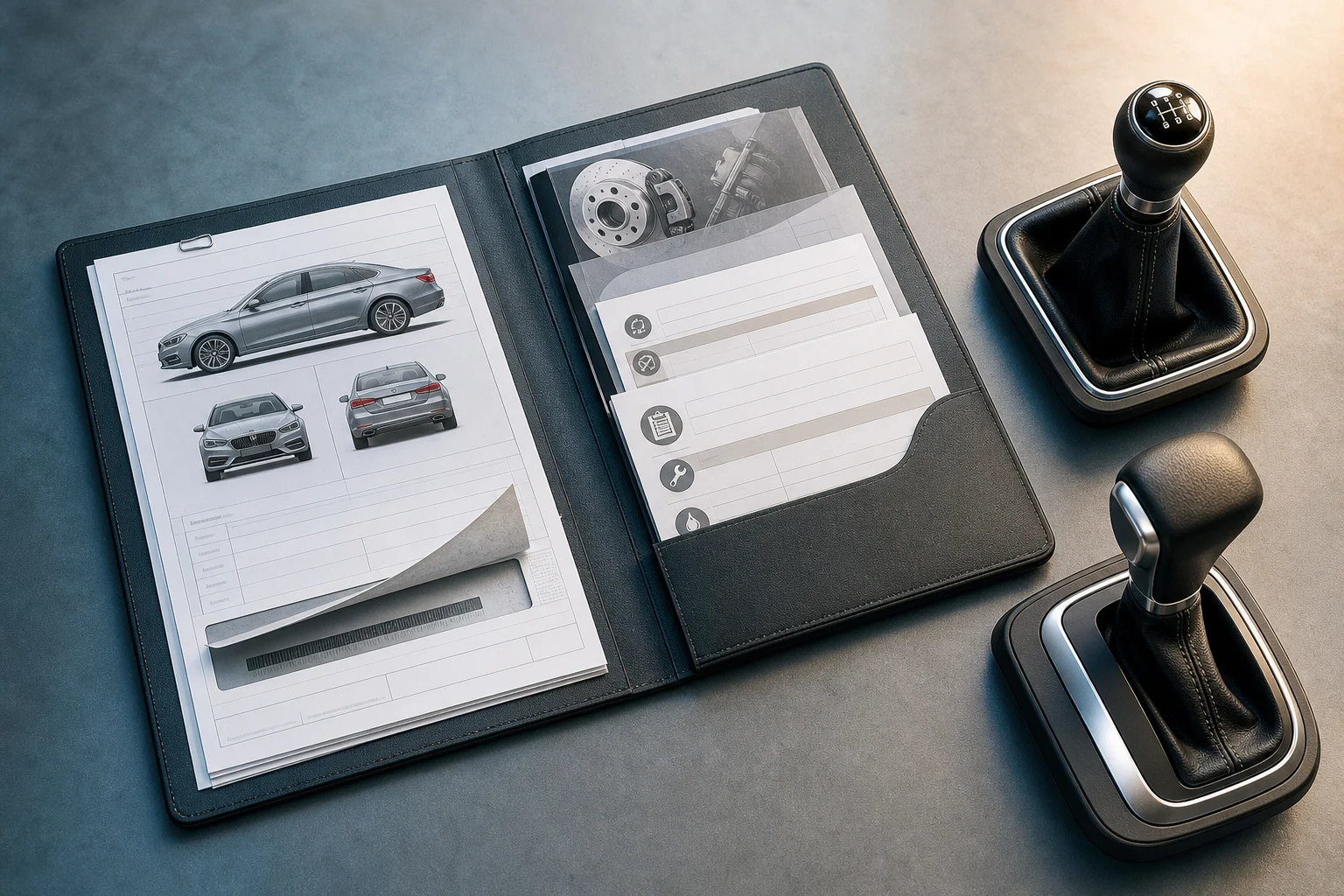
To compare two vehicles, gather the VIN and full version, the applicable manual or plan, the service book and invoices arranged by date and mileage. This lets you distinguish between work recorded and work that applies to the specific vehicle.
The owner’s manual and service book describe proper care and use, while original invoices provide evidence of the service carried out. For each document, check the date, mileage, work performed and issuing workshop. If a fluid, reference number or parts are listed, note them exactly as shown; do not infer that they are equivalent to the prescribed operation without checking the specific plan.
If the VIN, commercial version, manual or an invoice do not match each other, ask for the documentary discrepancy to be clarified before continuing with the purchase. Do not use it to diagnose the transmission, but do not replace that clarification with a verbal explanation either.
Section references: Garantía de Ford y responsabilidades del propietario ↗
- Compare documents for the exact version, not just the manual or automatic wording in the listing.
- Distinguish between work recorded on an invoice and work prescribed in the applicable plan.
- If there is a discrepancy between documents, clarify it before continuing with the buying decision.
- Decide in advance which missing document would make you reject the vehicle or lower your offer.
General history: a summary before the viewing
In addition to transmission-specific documentation, it is useful to summarise the vehicle’s general history before travelling to see it. For a car registered in Spain, the full DGT report allows you to check the roadworthiness test record, mileage, number of owners, encumbrances, technical data, outstanding recalls and recorded maintenance. This check does not replace invoices or certify the transmission’s current condition.
To organise your initial request for documents and information from the seller, see What to ask a seller before viewing a used car. If you need to check an outstanding campaign using the VIN, see How to find out if a car has an outstanding recall in Spain.
Section references: Informes de vehículos en lote ↗ · Aviso a llamadas a revisión de un vehículo ↗
- Use the general history as a cross-check against transmission documentation, not as a replacement for it.
- Confirm that there are no encumbrances affecting the purchase transaction.
- A recall that has already been remedied is not shown as outstanding in the DGT check.
Test drive, warning signs and comparing checks
During a supervised test drive, do not try to diagnose the transmission or normalise behaviour that raises doubts for you. If you notice something you do not understand, pause the buying decision and request a professional inspection before renegotiating or proceeding.
The aim is not to assign a cause to every concern you notice. It is to avoid a verbal explanation replacing a diagnosis. The same applies where the history is incomplete: it does not automatically mean there is a fault, but it does prevent you from claiming that the prescribed maintenance was completed.
To assess cost, do not compare only the advertised price and transmission type. Compare the final price with the available evidence, the maintenance operation that applies to that transmission and a written estimate if there is a documented concern. The guide on Garage quote: how to read it, compare it and avoid surprises can help you structure that request.
| Declared or confirmed type | What to check before buying | Limit of the comparison |
|---|---|---|
| Manual | That the manual and invoices correspond to the vehicle; check history, mileage, roadworthiness test record, encumbrances, technical data and campaigns through the available DGT report. | The manual designation alone does not indicate the prescribed operations or the current condition. |
| Automatic | The exact architecture, the applicable manual or plan, and invoices evidencing the recorded operations. | “Automatic” does not identify one single technology or a shared maintenance schedule. |
| Dual clutch | Version and engine, since clutches may be dry or run in an oil bath; operations set out in the specific documentation. | A DSG interval in a Volkswagen plan cannot be extended to other models or transmissions. |
| Automated or robotised | Whether it is derived from a manual gearbox and the type of actuation stated in that vehicle’s documentation. | The word automatic does not rule out an automated manual gearbox. |
| e-CVT | The trade designation and the catalogue or documentation for the exact version. | Toyota uses e-CVT for an electrically continuously variable transmission in a specific catalogue; it does not confirm other vehicles. |
- Take a copy or photos of the documents the seller has sent and compare them with the car.
- Do not accept statements such as “it needs no maintenance” or “they are all the same” as evidence without the manufacturer’s plan for that version.
- Ask a professional to assess any behaviour that raises doubts before signing.
- Keep the scope of the estimate in writing: what is inspected, what work is proposed and which items are included.
Is an automatic used car better than a manual one?
The comparison must start with the specific vehicle. Applicable official documentation and evidenced maintenance records help reduce uncertainty, but they do not by themselves certify the current condition. Not all automatic transmissions share the same architecture or servicing operations.
What documents should I request to assess the transmission?
Request the VIN, full version, service book and maintenance manual, and original invoices. If you have the full DGT report, check information such as the roadworthiness test record, mileage, encumbrances, technical data, outstanding campaigns and recorded maintenance; it is a cross-checking source, not certification of the transmission’s condition.
Can I identify the gearbox from the listing or selector alone?
That is not enough. A listing that says automatic may refer to different technologies, and a robotised transmission may be derived from a manual gearbox. Verify the exact version using official documentation that applies to that vehicle.
What should I do if I notice something that raises doubts during the test drive?
Do not assign a cause yourself or complete the purchase. Note the circumstances, request a professional inspection and ask for a written estimate before deciding.