Tyres compatible with your car: how to check the size before buying
The ITV card and the tyre sidewall provide the key information needed to avoid ordering the wrong tyres. This guide explains what to compare, what each marking means and when to pause a purchase to verify an alternative.
Key points
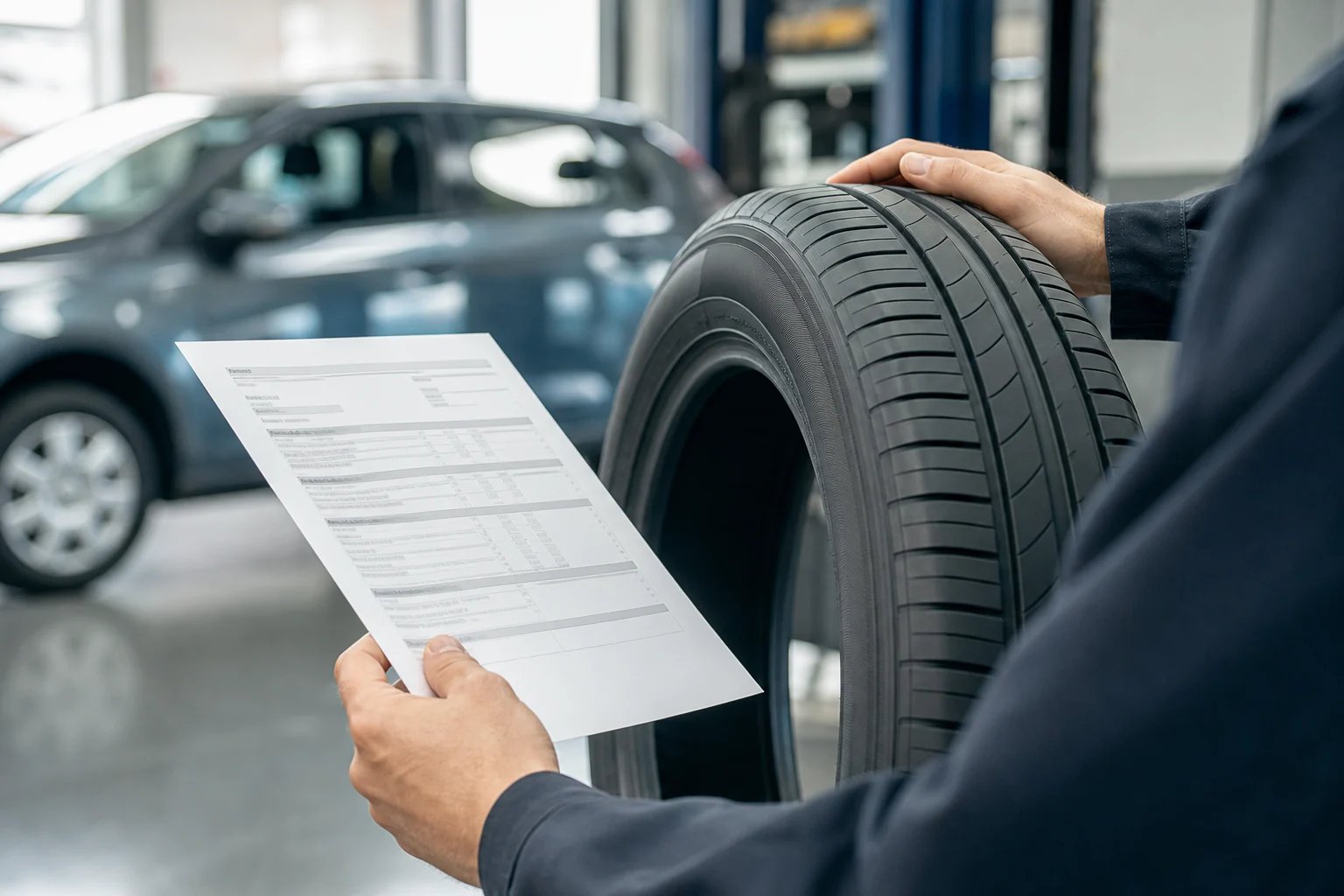
The ITV card (vehicle technical inspection card) is the starting point for confirming which tyres your car can use. Before buying, compare the full sidewall marking, load index, speed rating and tyre uniformity on each axle; an alternative size requires an additional check, not a visual approximation.
The quick answer: the ITV card is decisive, and you must compare more than size
To find out which tyres are compatible with your car, start with the ITV card (vehicle technical inspection card). The Inspection Procedure Manual for ITV stations states that, for vehicles in categories M, N and O, tyre dimensions and characteristics must match those recorded on the ITV card or be equivalent to them. The Manual also refers to type approval as a reference.
It is not enough to order “a 17-inch tyre” or copy only the three main numbers from an offer. The check must include the full size designation, the load capacity index and the speed category or code. For ITV purposes, load and speed must be equal to or higher than the minimum shown on the ITV card or in the type approval.
Therefore, before confirming an online basket or accepting a quote, write down every marking in the authorised size exactly as shown and compare it with the specification of the tyre offered. If a number or letter differs, do not assume it is still valid: pause the purchase and ask for the equivalence or applicability to your specific vehicle to be verified.
Section references: Manual de Procedimiento de Inspección de las Estaciones ITV, versión 7.9 ↗
- Document priority: the ITV card; the Manual also refers to type approval.
- Minimum details to compare: full size, load index and speed code.
- A wheel with the same diameter alone does not prove compatibility.
- If the card does not show minimum load or speed values, the Manual states that they must be suitable for the vehicle's characteristics under the general specifications on the card.
Find the reference and avoid incomplete comparisons
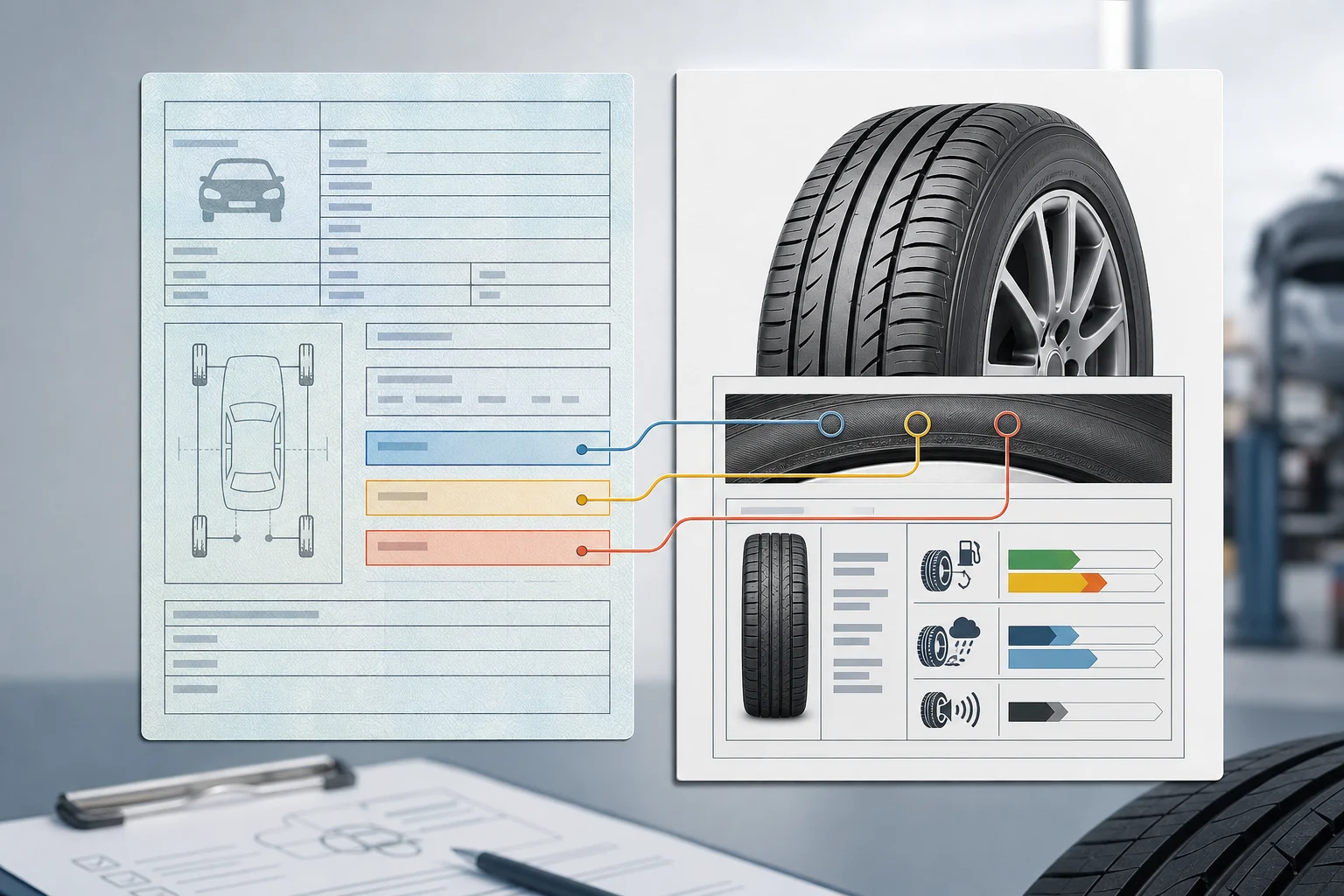
The ITV card should be the first source you consult because it is the reference expressly mentioned in the ITV Manual. Review all notes related to wheels and tyres, not just a size you remember seeing. The same vehicle may have conditions or configurations that should not be reduced to memory when searching for an offer.
The sidewall of the tyre currently fitted lets you read the installed designation, but it does not replace a document check. It may be a different size from the one you need to order, an alternative whose status you have not confirmed or a tyre fitted previously. Use it as a second comparison point, not as automatic authorisation.
If the information in front of you does not clearly identify the minimum load and speed ratings, or if an offer proposes a different designation, request professional verification before fitting. Take or send a legible copy of the ITV card and the full reference from the offer. This means the enquiry is based on verifiable data, rather than the commercial model, wheel diameter or a partial photograph.
| Detail | Where to check it | Why it affects compatibility |
|---|---|---|
| Size designation | ITV card and the sidewall or specification of the tyre offered | The ITV Manual requires dimensions that match or are equivalent to those recorded or included in the type approval. |
| Width, profile and nominal wheel rim diameter | Within the size designation | They form part of the regulated size designation. |
| Structure | Sidewall marking | The letter R identifies a radial structure when it appears before the wheel rim diameter. |
| Load index | ITV card and the sidewall or product specification | It must be equal to or higher than the applicable minimum. |
| Speed code | ITV card and the sidewall or product specification | It must be equal to or higher than the applicable minimum. |
| Type on each axle | Fitted tyres and order | Tyres on the same axle must be of the same type. |
Section references: Manual de Procedimiento de Inspección de las Estaciones ITV, versión 7.9 ↗
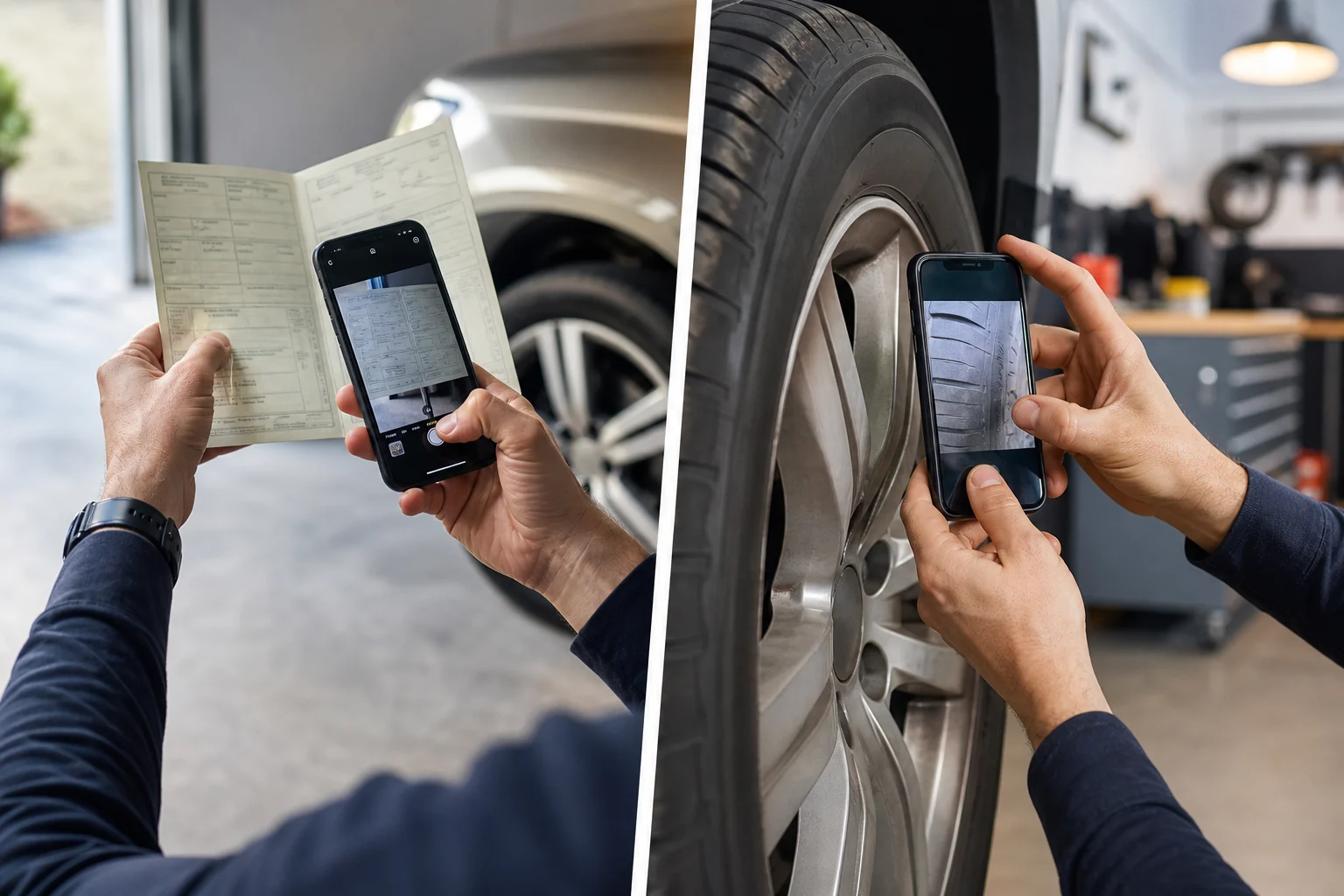
- Photograph the relevant area of the ITV card before requesting prices.
- Copy every character from the tyre offered, including letters after the diameter.
- Check the front and rear axles separately if the vehicle uses different sizes.
- Do not authorise fitting solely because the current tyre looks similar.
How to read a sidewall marking without focusing only on diameter
A common marking may look like 205/55 R16 91V. This is a reading example, not a recommendation for any car. Under UN Regulation No. 30, the size designation brings together the nominal width, nominal profile and a conventional figure identifying the nominal wheel rim diameter. It is also followed by details such as the structure, speed category and load index.
In this example, 205 indicates the nominal width in millimetres. The 55 is not a height in millimetres: it is the nominal profile, defined as the ratio between section height and nominal width, multiplied by one hundred. The R, placed before the diameter, identifies radial construction. The 16 is the conventional reference for nominal wheel rim diameter.
The characters 91V are not merely commercial details either. The 91 is the load capacity index and V is the speed category. Even if an offer matches 205/55 R16, it has not been fully checked until you also compare 91V against the applicable minimums in the vehicle documentation. This is one of the easiest issues to overlook when a search is filtered only by size.
Section references: Reglamento n.º 30 de la ONU: neumáticos para turismos y remolques ↗
- Nominal width: expressed in millimetres.
- Nominal profile: a percentage ratio, not an independent height.
- R: identifies radial construction in this type of marking.
- Wheel rim diameter, load index and speed code must be read as part of the complete reference.
Equivalent size: do not infer it just because it looks similar
The ITV Manual accepts dimensions that match or are equivalent to those listed on the ITV card or in the type approval. That reference does not make any tyre with a similar appearance a confirmed alternative. A difference in width, profile, diameter, load or speed requires reviewing the full set of requirements applicable to the vehicle, not just one figure.
Based on the evidence available for this guide, it would not be prudent to turn equivalence into a quick buying rule or calculate it using a generic tolerance. It is also not enough to say that a tyre “fits the rim” or that its outside diameter looks similar. The safe practical approach is to request a documented check when the designation does not match the ITV card exactly.
The situation requires even greater caution if the offer includes a wheel rim modification, changes the size designation or leaves doubts about the ratings. Before fitting, consult an ITV station or a professional who can compare the ITV card and, where relevant, the type approval. This reduces the risk of buying a set that cannot later be justified or does not meet inspection requirements.
Section references: Manual de Procedimiento de Inspección de las Estaciones ITV, versión 7.9 ↗ · Reglamento n.º 30 de la ONU: neumáticos para turismos y remolques ↗
- Exact match: compare every character, not only width and diameter.
- Different designation: request verification before paying or fitting.
- Do not use generic online calculations as a substitute for your vehicle documentation.
- Keep the quote and the full tyre specification you consulted so the verification can be traced.
Winter, M+S and 3PMSF: seasonal marking does not replace the check
When comparing winter tyres, it is important to separate seasonal marking from dimensional compatibility and ratings. UN Regulation No. 30 covers the M+S, M.S or M&S inscriptions on a snow tyre. That marking does not itself change the size you need to compare or remove the need to check the load index and speed category.
Spain's DGT distinguishes simple M+S marking from the three-peak mountain snowflake symbol, known as 3PMSF. According to its information, only tyres that also carry this winter tyre symbol may legally replace chains when their use is compulsory. Therefore, you should not assume that all tyres with M+S offer the same possibility.
The practical decision involves two separate questions: first, whether the chosen tyre meets the size, load and speed requirements applicable to the car; second, whether its marking meets the winter-use need you are looking for. Answering yes to one does not confirm the other.
Section references: Reglamento n.º 30 de la ONU: neumáticos para turismos y remolques ↗ · Neumáticos de invierno ↗
- M+S, M.S and M&S are inscriptions covered for snow tyres.
- The DGT distinguishes M+S from the 3PMSF symbol for legally replacing chains where they are compulsory.
- Winter marking does not replace comparing size, load and speed.
Final checklist for comparing two offers and authorising fitting
A cheaper offer may leave out essential information or present details in an order that encourages you to look only at the diameter. Compare both references in the same list and flag every difference. The goal is not to choose the tyre with the most numbers or letters, but to confirm that every detail meets your car's documented minimum.
Also review the order composition by axle. The ITV Manual requires all tyres on the same axle to be of the same type; its definition includes, among other elements, the brand or trade name, size designation, category of use and structure. Buying two different units for the same axle because of a promotion, a stock shortage or a reference error can become a compatibility issue.
If there is any discrepancy, do not ask the workshop to “fit them and see what happens”. Request an answer based on the ITV card and the exact tyre specification. The prior documentation is particularly useful when requesting quotes remotely: it lets you compare like-for-like proposals and prevents the lowest price from relating to a different reference.
Section references: Manual de Procedimiento de Inspección de las Estaciones ITV, versión 7.9 ↗ · Reglamento n.º 30 de la ONU: neumáticos para turismos y remolques ↗ · Neumáticos de invierno ↗
- Copy of the ITV card ready to send to the seller or workshop.
- Offered size compared character by character with the applicable reference.
- Load index equal to or higher than the stated minimum.
- Speed code equal to or higher than the stated minimum.
- Additional verification requested if the proposed dimensions do not match exactly.
- Two tyres of the same type planned for each axle.
- 3PMSF marking checked if the aim is to replace chains where they are compulsory.
- Quote showing the full tyre reference, not just diameter and price.
Where can I see which tyre size my car accepts?
First consult the ITV card (vehicle technical inspection card). The ITV Manual refers to it, together with type approval, to check that dimensions and characteristics match the recorded entries or are equivalent.
Is it enough for the wheel rim diameter to match?
No. You must compare the complete designation and also check that the load index and speed code are equal to or higher than the minimums applicable to the vehicle.
What does the R mean in 205/55 R16?
The R identifies radial construction when it appears before the nominal wheel rim diameter reference.
Can I fit two different tyres on the same axle?
The ITV Manual requires tyres of the same type on the same axle. That definition includes, among other elements, the brand or trade name, size, category of use and structure.
Can an M+S tyre always replace chains?
No. The DGT states that the tyre must also carry the winter tyre symbol, 3PMSF, to legally replace chains when their use is compulsory. In addition, the tyre must be compatible with the vehicle.