Motorcycle travel with a passenger: what to check before buying
Approved seating, masses, riding position, luggage and a static check as a pair: a method for choosing a two-seat motorcycle or scooter in Spain.
Key points
For regular travel with a passenger, a motorcycle needs more than a roomy seat: confirm it is approved for two occupants and calculate the available mass using compatible criteria. Both riders should then check that the seat, footrests and access work for them while stationary.
The short answer: four checks before looking at power
A motorcycle for travelling with a passenger must pass four tests: approval for two seats in the documentation, enough mass allowance for people and luggage, a manageable position for the person riding behind, and a luggage solution that does not alter those limits. Engine size or power does not replace any of these checks.
The first issue is legal and documentary. Spain's Directorate-General for Traffic (DGT) states that a passenger may be carried on mopeds and motorcycles when that authorisation is recorded in the registration certificate or vehicle document. A seat that looks long, grab handles or footrests do not replace this requirement.
The second issue is physical, but it cannot be resolved by looking at the motorcycle from the outside. The DGT states that the passenger must use the rear seat, sit astride and place their feet on the side footrests. Therefore, the buyer and their regular passenger should sit on it together, wearing the gear they are likely to use, before placing a deposit or completing the purchase.
The most common mistake is to treat each limit separately: the top box limit, the pannier limits, the people and the motorcycle. The regulated laden mass includes the vehicle, its load, service personnel and passengers. Consequently, occupants, clothing, helmets and luggage form one overall total-mass check.
Section references: DGT — En moto ↗ · Reglamento General de Vehículos — definiciones de masas ↗
- Do not assume that a visually two-seat configuration is approved for two occupants.
- Do not confuse a luggage case's capacity with the mass the loaded motorcycle can carry.
- Do not choose a motorcycle before the passenger has tried their position while stationary.
Documentation: find S.1 and F.2 before comparing versions
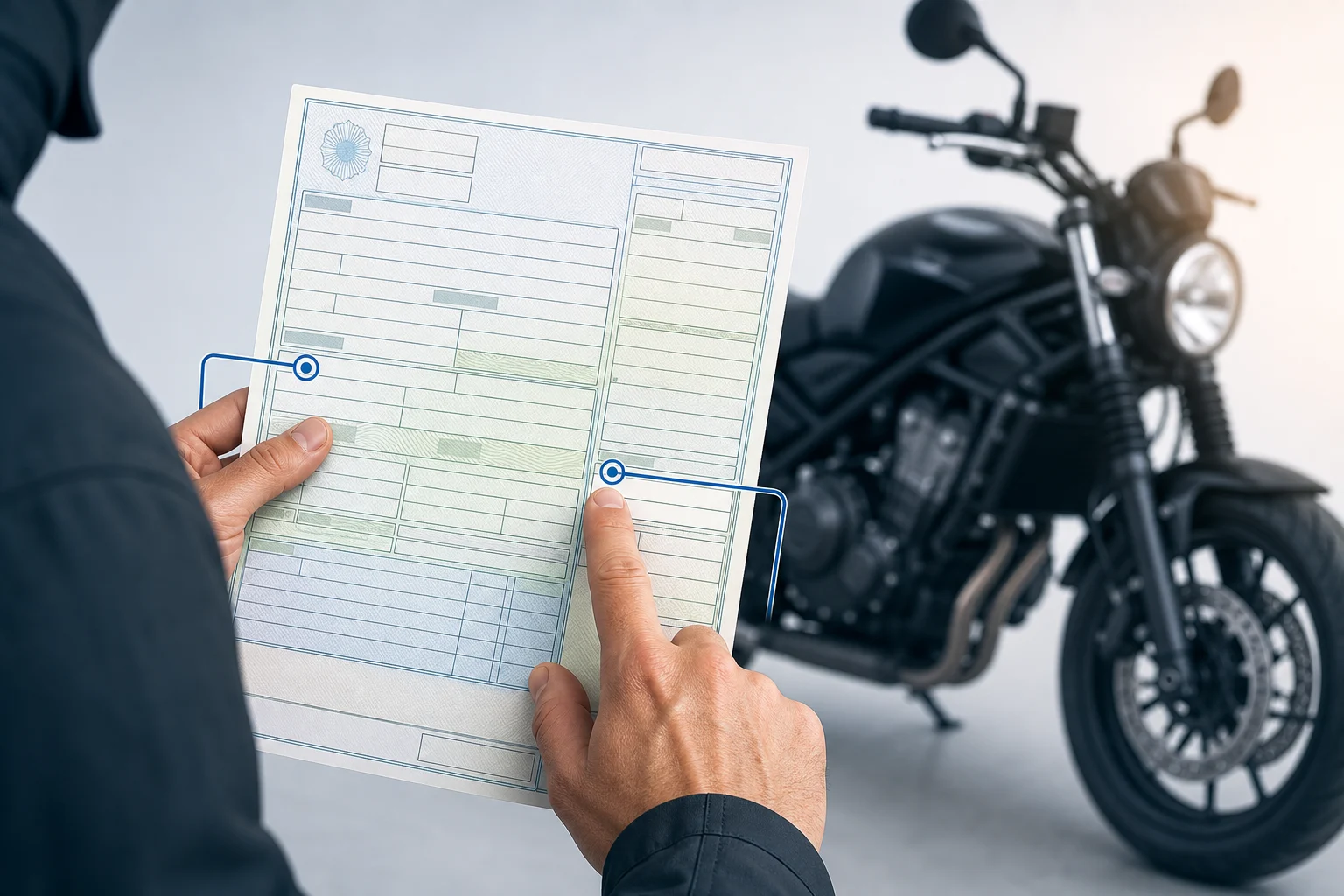
Ask for the documentation for the specific unit, especially if it is a used motorcycle, an import or a version with accessories. Field S.1 identifies the number of seating positions and includes the rider's seat. For regular use as a couple, the starting point is for S.1 to show two seats; if it shows one, it is not sensible to assume the issue is solved because the seat is physically large.
Field F.2 identifies the maximum authorised mass (MMA) permitted for the vehicle in circulation in Spain, expressed in kilograms. It is the relevant documentary limit for use on public roads. It should not automatically be presented as equivalent to the maximum technically permitted mass: the latter is based on the vehicle's construction and specified by the manufacturer, whereas the MMA is the maximum mass for using the vehicle when loaded.
To estimate a load allowance, first check what the mass figure to be subtracted from F.2 represents. The regulatory definition of mass in running order adds a standard rider mass of 75 kg to the unladen mass. Therefore, if a mass in running order defined in this way is used, the calculation must include the passenger, luggage and the difference between the rider's actual weight and those 75 kg. Mixing a document figure, a commercial figure and a mass from another version can produce a misleading result.
An indicative formula, only when both figures use compatible definitions, is: remaining allowance = F.2 − mass in running order − passenger mass − luggage − difference between the rider's actual mass and 75 kg. If the starting mass is not defined in the same way, stop the calculation and request the relevant documentary clarification. It is not prudent to fill in what the document does not state with assumptions.
Section references: Reglamento General de Vehículos — campos del permiso o licencia de circulación ↗ · Reglamento General de Vehículos — definiciones de masas ↗
- Check S.1: it also includes the rider's seat.
- Write down F.2 in kilograms and keep a copy of the documentation before buying.
- Identify how the source defines the starting mass before subtracting it from F.2.
- Separate the passenger's weight, helmets, clothing and every item of luggage in your calculation.
Passenger ergonomics: a static check worth doing as a pair
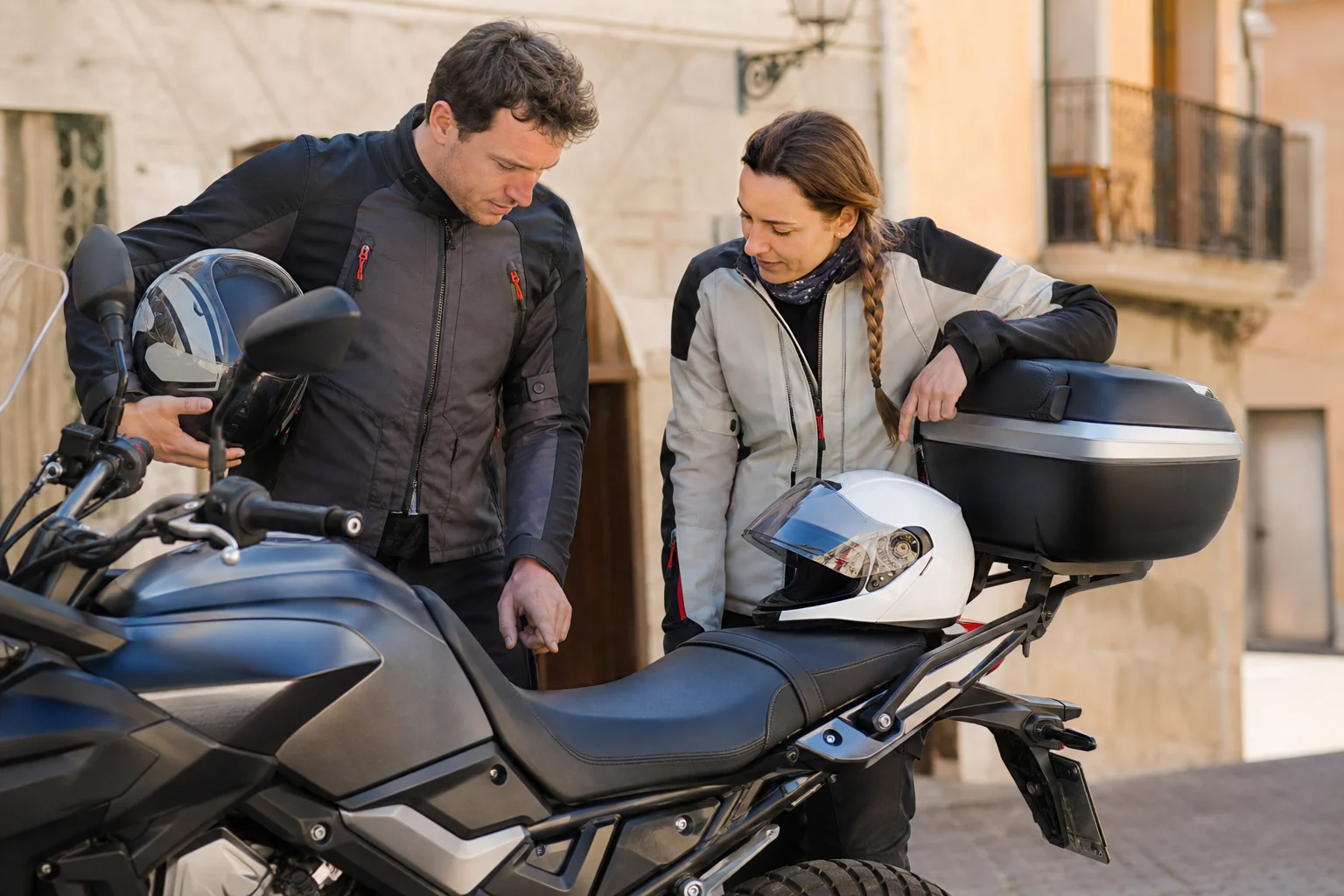
The documentary check answers whether a second occupant can legally be carried; it does not answer whether both of you can do so in a reasonable position. The DGT specifies three basic positioning requirements: the passenger uses the seat behind the rider, sits astride and keeps their feet on the side footrests. For a purchase decision, this means checking that those three requirements can be met without forcing an uncomfortable or unstable stationary position.
With both of you seated and wearing helmets, check the available area for the passenger, how easily they can reach the footrests, and whether they can hold on using the elements provided by the motorcycle. It is also worth repeating the exercise with jackets, boots or other equipment that will be used for commuting and trips. An assessment without that additional bulk may not represent real use.
Observe mounting and dismounting with the motorcycle stopped and in safe conditions. There is no need to improvise a road test to identify obvious problems: if the passenger cannot sit astride, cannot safely reach both side footrests or lacks a clear position on the rear seat, the unit does not suit the intended use.
In a sale, this step is especially important when the person who will ride behind is not the same height as, or does not wear the same gear as, the person viewing the motorcycle. The appropriate motorcycle is not the one that looks comfortable for one person in isolation, but the one that allows the required position and is acceptable for the specific pair.
Section references: DGT — En moto ↗
- Both sit on the motorcycle wearing helmets and the gear you will normally use.
- Confirm that the passenger uses the rear seat and can reach both side footrests.
- Check access, the astride position and the handhold before deciding.
- If only the rider attends the viewing, postpone the decision until the regular passenger can come along.
Scooter, naked, road trail or touring bike: compare the unit, not just the label
The labels scooter, naked, road trail and touring bike do not replace checking S.1, F.2 and the riding position. A useful comparison reviews the same points for every candidate unit.
The intended use does help to prioritise. For everyday journeys, it is advisable to reproduce the real situation: passenger, helmets, clothing and the items that will normally be carried. For trips of several days, the calculation must include the intended luggage and the solution where it will be fitted. In both cases, a motorcycle that appears suitable without a load may no longer be so if the documentation or riding position does not support it.
Regarding suspension, brakes, tyres and rider aids, the information provided does not allow a minimum specification to be established by motorcycle type or any configuration to be claimed as better. The prudent approach is to review the documentation and manual for the selected unit, request all available information from the seller, and avoid assuming features that are not stated in the available information. Any manufacturer recommendation concerning occupants, load or luggage should be read for that specific unit.
This table is a comparison guide, not a technical classification of categories. If a candidate fails on approved seating, mass or ergonomics, it should not move up the list simply because of its style or a luggage accessory.
| Criterion | Scooter | Naked | Road trail | Touring |
|---|---|---|---|---|
| S.1 shows two seats | Verify on the unit | Verify on the unit | Verify on the unit | Verify on the unit |
| F.2 and mass definition available | Verify on the unit | Verify on the unit | Verify on the unit | Verify on the unit |
| Passenger astride with feet on side footrests | Check while stationary | Check while stationary | Check while stationary | Check while stationary |
| Calculation with intended people and luggage | Do before buying | Do before buying | Do before buying | Do before buying |
| Manual and luggage accessories for that version | Cross-check | Cross-check | Cross-check | Cross-check |
Section references: DGT — En moto ↗ · Reglamento General de Vehículos — campos del permiso o licencia de circulación ↗
- Always compare the exact version, not the generic model-range name.
- Request the same set of documents and carry out the same static test for every candidate.
- For trips lasting several days, include the intended luggage in the calculation from the outset.
Luggage: top-box volume is not the motorcycle's limit
The DGT states that luggage must be properly placed on the luggage rack or carrier, or in two rear side bags or panniers. It also states that it must not protrude laterally by more than 50 centimetres. These rules indicate where and how the load must be carried, but they do not authorise ignoring F.2 or turn a top box's stated capacity into an additional mass allowance.
Make a realistic list before buying: rider, passenger, two helmets, clothing and items that will travel on the motorcycle, as well as each piece of luggage. Add these items to the mass assessment using figures defined in compatible ways. If luggage is fitted, include it in the mass assessment.
The two clearest ways to make a mistake are filling luggage to the capacity advertised for the accessory without checking the total mass, and believing that the passenger is excluded from the calculation because they are not inside a pannier. Under the regulations, passengers form part of the laden mass. If the calculation is tight or cannot be made from coherent documentation, a less heavily loaded setup or a different candidate is more transparent than relying on estimates.
Section references: DGT — En moto ↗ · Reglamento General de Vehículos — definiciones de masas ↗
- Put everything that goes on the motorcycle on your list, including clothing and helmets.
- Respect the luggage location and its lateral-projection limit.
- Do not add accessory limits as if they were additional payload.
- Include fitted luggage in the mass assessment.
Final buying checklist: what must be confirmed before signing
Finish the comparison with a record for each motorcycle or scooter. Note the information exactly as it appears on the registration certificate or vehicle document, not as you remember it from an advert. If there is a contradiction between the documentation, the visible motorcycle and what the seller says, do not resolve it by assuming it is merely a cosmetic difference.
The key is not to look for a commercial label such as “motorcycle for two”, but to reach the purchase with seating, mass, luggage and riding position checked.
The result may be a rejection decision that is as valuable as a purchase: a motorcycle with two seats in S.1 may not be suitable for your pair if the passenger cannot position themselves correctly or if the combined people and luggage do not leave a clear calculation within F.2. Identifying this before paying prevents a decision based solely on appearance or power.
Section references: DGT — En moto ↗ · Reglamento General de Vehículos — campos del permiso o licencia de circulación ↗
- S.1 confirms two seats, including the rider's.
- F.2 has been recorded and compared with a mass defined in a compatible way.
- The passenger has sat behind the rider, astride, with their feet on the side footrests.
- The calculation includes the passenger, equipment and luggage.
- Luggage is planned for a carrier/luggage rack or two rear side bags/panniers and does not protrude laterally beyond the permitted limit.
- The unit's documentation has no outstanding contradictions.
Is it enough for the motorcycle to have a seat for two people?
No. To carry a passenger, the authorisation must be stated on the registration certificate or vehicle document. In addition, field S.1 identifies the number of seating positions, including the rider's.
How do I calculate the available load for travelling with a passenger?
Start with F.2 and use only a reference mass with a compatible definition. Regulatory mass in running order includes 75 kg for the rider, so you must add the passenger, luggage and the difference between the rider's actual weight and those 75 kg.
Does the capacity of the top box or panniers allow more weight to be carried?
No. Luggage must be correctly placed on a luggage rack or in rear side panniers, but their capacity does not replace compliance with the vehicle's maximum permitted mass. Passengers also count as part of the laden mass.
What should the passenger check before buying?
They should sit on the rear seat, astride, and check that both feet rest on the side footrests. It is advisable to do this wearing the equipment they will normally use.