Spanish aviation museums: where to see historic aircraft and what to check before you go
A guide to interpreting aviation collections in Spain and planning a visit to Cuatro Vientos, the Infante de Orleans Foundation, Málaga and Barcelona-El Prat using official information.
Key points
A guide to interpreting aviation collections in Spain and planning a visit to Cuatro Vientos, the Infante de Orleans Foundation, Málaga and Barcelona-El Prat using official information.
| Topic | Key point |
|---|---|
| Cuatro Vientos: historic heritage of Spanish aviation | The Museum of Aeronautics and Astronautics at Cuatro Vientos, Madrid, states that its purpose is to acquire, preserve and display the assets that make up Spain’s Historic Aeronautical Heritage. |
| Infante de Orleans Foundation: the collection and a flying day are not the same | The Infante de Orleans Foundation (FIO), in Madrid, requires a different reading from that of a static museum: it presents itself as a museum of historic aircraft in flight. |
| Málaga and Barcelona-El Prat: look at the airport too | Not all aviation heritage is organised around a military aviation collection or historic aircraft in flight. |
| How to read an information panel and prepare a visit without surprises | An aircraft information panel will not always include every field, but it can be useful to read it in a fixed order. |
An aircraft is the starting point, not the whole story
Spain’s aviation museums make it possible to trace the evolution of aerial vehicles from both technical and cultural perspectives. A useful way to approach an aircraft on display is to consider its structure, propulsion system, documented mission and operating environment, rather than only its silhouette or construction date. This can help visitors compare the differing requirements of training, transport, communications, surveillance or airport-service aircraft where the institution identifies those roles.
The preserved heritage extends well beyond airframes. The Museum of Aeronautics and Astronautics brings together aircraft, uniforms, decorations, engines, scale models and other aviation-related holdings. This variety helps visitors move from looking to interpreting: an engine can show how power was produced, a scale model can clarify a configuration, and documents or personal objects can place an aircraft within an organisation and an era.
To make the most of a visit, it can be useful to ask a specific question of each item: what documented need did it meet, how was it built, what powerplant did it use, what role did it perform, and where did it come from? This approach can work for large aircraft as well as ground equipment and can prevent the visit from becoming merely a list of models.
- Structure: look at the overall configuration, the type of skinning and the seating arrangement where the display label provides it.
- Propulsion: identify whether the information refers to the engine, power output or associated systems, without inferring details that are not shown on the panel.
- Mission: distinguish between training, transport, communications and other roles documented by the institution.
- Context: complement your reading with scale models, engines, uniforms, vehicles and airport equipment.

Cuatro Vientos: historic heritage of Spanish aviation
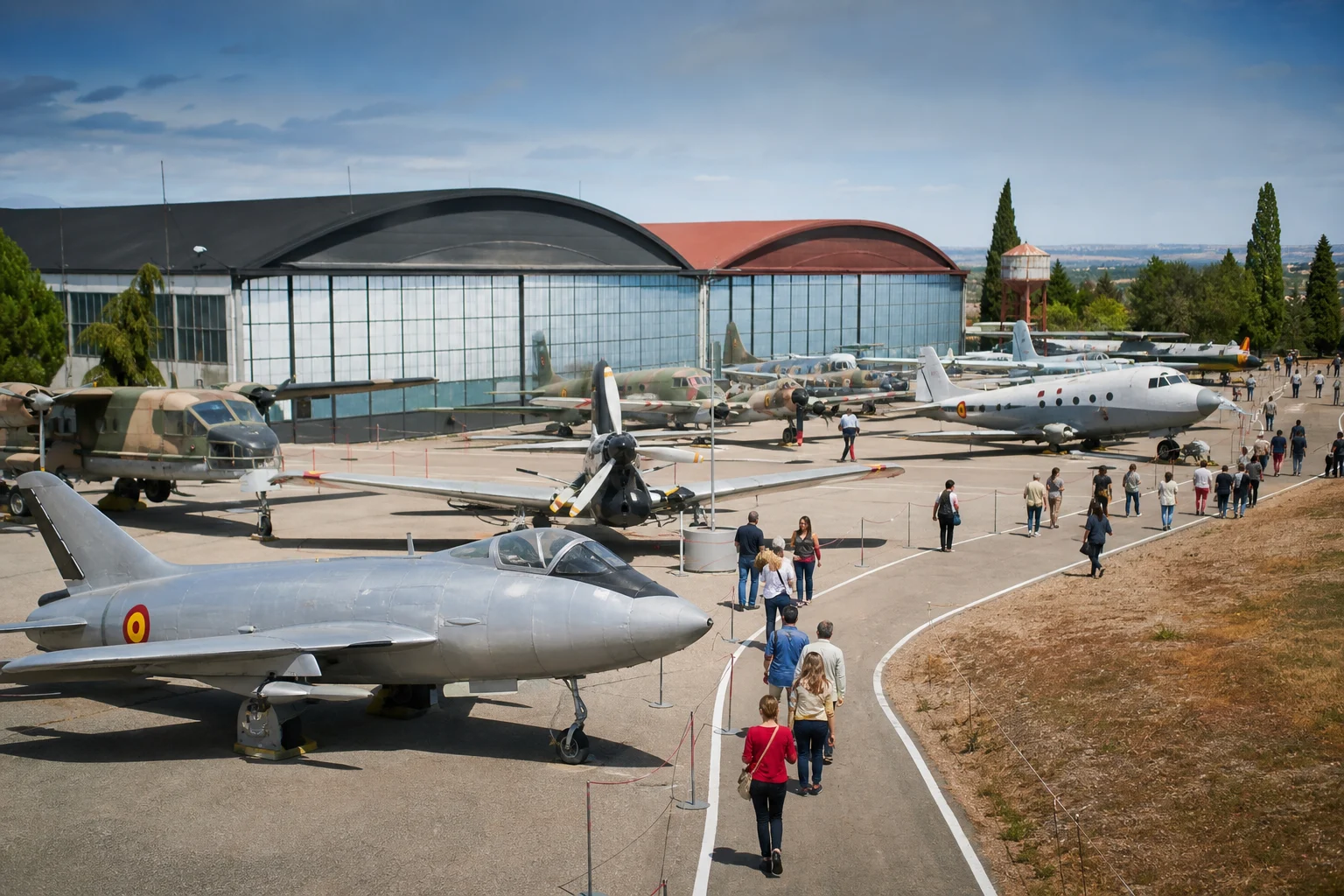
The Museum of Aeronautics and Astronautics at Cuatro Vientos, Madrid, states that its purpose is to acquire, preserve and display the assets that make up Spain’s Historic Aeronautical Heritage. Its scale makes it possible to organise a visit by theme rather than only by chronology: it combines an outdoor exhibition with seven hangars. This is an important practical difference, as the route can alternate between observing complete aircraft and specialised collections.
Hangar 2 is a useful stop for anyone wishing to understand systems as well as airframes. The museum devotes it to space, simulators, jet engines and communications. It is therefore an opportunity to see how aviation history links aircraft, training, propulsion, information transmission and space activity.
The published official information states that it is open daily from 10:00 am to 2:00 pm, except on Mondays, with admission until 1:30 pm. However, opening hours should not be treated as fixed: check the Museum of Aeronautics and Astronautics visitor page on the same day, or before arranging your journey. According to that source, individual visits do not require advance booking and have open access; guided group visits are arranged by application.
For public transport, the institution warns that the Cuatro Vientos Metro and Renfe stations are around one kilometre from the entrance. Allow for this walking section when calculating travel times, particularly if visiting with children, people with reduced mobility, or intending to arrive close to the admission cut-off time.
- Check current opening hours and notices before leaving; the published reference is 10:00 am to 2:00 pm, with final admission at 1:30 pm, except on Mondays.
- For an individual visit, verify the no-advance-booking and open-access conditions on the official website.
- If travelling as a group and seeking a guided visit, submit the request sufficiently far in advance.
- Allow extra time for travel from the Metro or Renfe station and for the outdoor exhibition.

Infante de Orleans Foundation: the collection and a flying day are not the same
The Infante de Orleans Foundation (FIO), in Madrid, requires a different reading from that of a static museum: it presents itself as a museum of historic aircraft in flight. Its website describes a collection of 43 examples representing 32 different models and states that they are in perfect flying condition. This operational character adds historical value, but it does not mean that every aircraft will fly or be available on a given date.
The crucial distinction is between the collection, the exhibition and the operational display. The collection is the heritage ensemble; the exhibition is the event that allows the public to see the aircraft in a scheduled setting; and operations depend on circumstances that should not be taken for granted. FIO announces monthly displays on the first Sunday of every month, except January and August. Even so, the specific announcement is the source that should guide planning.
The main planning mistake is turning up on the basis of an old calendar or interpreting a monthly pattern as confirmation of flying activity. The foundation says that a weather-related cancellation would be communicated on its website and social media on the Sunday morning itself. The practical measure is to check official channels before travelling and again on the day of the display.
Collection records allow a visit to become a technical observation. The record for the Bücker Bü 131 Jungmann identifies the model and the year 1934, describes aspects of the fuselage and skinning, and specifies an ENMASA Tigre engine rated at 125 HP and a two-seat crew. It is a good example of how a record provides verifiable data without requiring visitors to infer specifications from the aircraft’s appearance.
- Check FIO’s current announcement, not only its general frequency.
- The first Sunday of each month, except January and August, does not guarantee that every aircraft will fly.
- Check the foundation’s website and social media on the morning of the activity for potential weather cancellations.
- Use the collection records to identify the designation, year, construction, engine and number of seats.
Málaga and Barcelona-El Prat: look at the airport too
Not all aviation heritage is organised around a military aviation collection or historic aircraft in flight. Málaga’s National Museum of Airports and Air Transport provides the counterpoint of civil aviation and airport culture. Aena explains that the centre preserves historic airport heritage and brings together aviation professions in their original buildings.
Málaga’s museum displays 10 aircraft, but its interest also lies in the elements that make an air operation possible. Its technology building includes radar, communications, airfield lighting, meteorology, classic airport vehicles and engines. This combination is particularly useful for families and visitors who want to understand that an airport is not just a runway and a terminal: coordinated systems, equipment and professionals are involved.
For individual visitors, Aena publishes free admission and parking, self-guided visits, and no need for advance booking. The same source states that guided groups must check availability. The stated opening times are Tuesdays from 10:00 am to 8:00 pm and Wednesdays to Sundays from 10:00 am to 2:00 pm, with public-holiday exceptions; they should therefore always be confirmed on the official page before travelling.
At Barcelona-El Prat, Aena reports an exhibition on the airport’s history created jointly with the Fundació Parc Aeronàutic de Catalunya at the Aeronautical Cultural Centre. It is a case that illustrates why not every regional collection should be treated as a museum with walk-in access: opening times are by arrangement and a visit requires booking through contact. The institution, collaborating association, type of exhibition and admission conditions are details that must be checked one by one.
- In Málaga, combine viewing the aircraft with looking at radar, communications, airfield lighting and airport vehicles.
- For groups in Málaga, check guided-visit availability before setting travel dates.
- Check public holidays and current opening hours, even if a regular time slot is published.
- At Barcelona-El Prat, arrange a booking: Aena states that opening times for this activity are by arrangement.
How to read an information panel and prepare a visit without surprises
An aircraft information panel will not always include every field, but it can be useful to read it in a fixed order. Start with the manufacturer and model, which can help identify the aircraft concerned. Then look for the year or period, origin and role, which can explain its place in the collection. Finally, review its construction, skinning, engine, power and crew if the institution provides them. Do not fill gaps with information that is not displayed, and do not confuse a registration with a model designation: they are different identifiers.
Before leaving, separate permanent information from variable programming. The existence of a collection, a building or a permanent exhibition is usually relatively long-lasting information; opening hours, access, booking, guided activities and displays depend on each institution and may change. This distinction reduces wasted journeys and helps you choose a place according to your aim: seeing complete aircraft, studying engines and simulators in greater depth, attending an operational day or discovering airport technology.
Visitor behaviour is also part of conservation. At Cuatro Vientos, touching displayed material or leaving marked routes is not permitted. This rule can be applied as a general standard of respect: do not enter closed areas, cross barriers, or disregard staff instructions and the signage at each institution. In a collection with aircraft maintained in flying condition, this precaution is even more relevant.
- Pre-visit checklist: current opening hours, final admission time, booking or contact requirements, individual or group arrangements, and transport to the entrance.
- If you are looking for a special activity, confirm the date, announcement and any possible cancellation notices on the same day.
- Wear suitable footwear and allow sufficient time for outdoor displays and walking routes.
- During the visit, do not touch items, respect the routes and do not enter restricted areas.
- Always consult the information published by each institution: it is the reference for access, conditions and programme changes.
Do I need to book to visit the Museum of Aeronautics and Astronautics at Cuatro Vientos?
Official information states that individual visits do not require advance booking and have open access. Guided group visits are arranged by application. Confirm the current conditions before attending.
When are the Infante de Orleans Foundation displays held?
FIO announces monthly displays on the first Sunday of every month, except January and August. The current announcement and notices on the morning of the event confirm whether it will take place, as weather-related cancellations are possible.
What can be seen at Málaga’s National Museum of Airports and Air Transport?
Aena states that it displays 10 aircraft and that its technology building includes radar, communications, airfield lighting, meteorology, classic airport vehicles and engines.
What basic rule should I follow inside an aviation museum?
Respect routes, barriers and restricted areas. At Cuatro Vientos, touching displayed material or leaving marked routes is expressly prohibited.