Snow Chains, Textile Covers or Winter Tyres: What to Choose
Metal snow chains, textile covers and special tyres are not intended for the same use and do not have the same regulatory status. This guide explains what to check before buying and how to interpret snow restrictions in Spain.
Key points
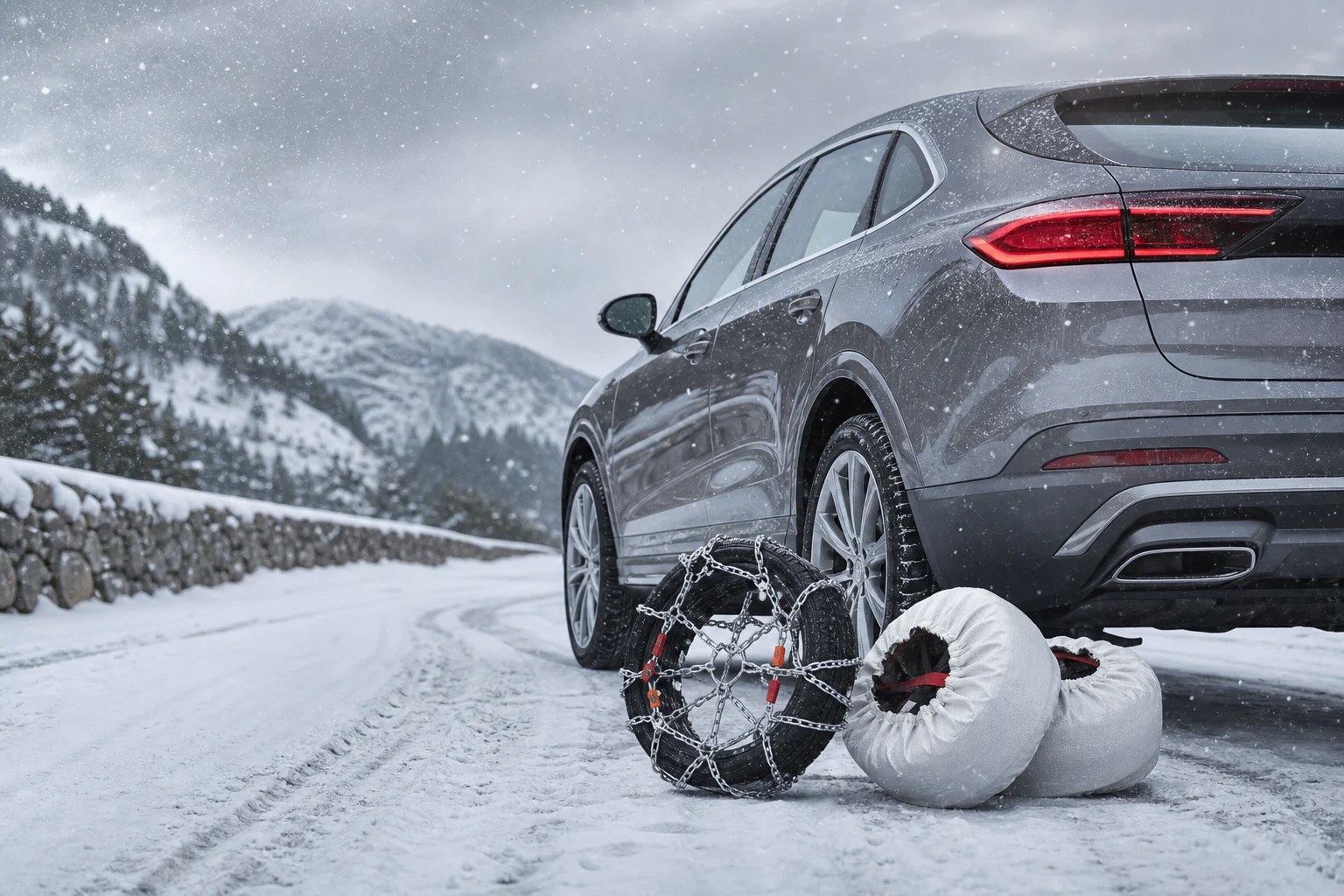
As a planning guideline, for occasional snow you can carry an authorised anti-skid system compatible with your car; for repeated winter exposure, consider special tyres for severe snow marked M+S and 3PMSF on every axle. In both cases, road signs, actual road conditions and the vehicle manual take priority.
Quick answer: choose by frequency, compatibility and road sign
There is no universal answer between metal snow chains, textile covers and winter tyres. The first decision is not the price or appearance of the accessory: it is checking what the manufacturer permits for the exact tyre size, on which axle and with what clearance in the wheel arch. A system not authorised for the car may not be a valid option even if it states the correct size.
As a planning guideline, if journeys in snow are exceptional, you can prepare an authorised anti-skid device that is compatible with the vehicle and keep its documentation. Textile covers require an additional check: regulations do not name them as a category in their own right, but refer to “other authorised anti-skid devices”. You should therefore not assume that any commercially available cover will be accepted under a restriction without confirming its applicable authorisation and the car manual.
As a planning guideline, if you regularly drive on roads with winter conditions, you can consider special tyres for severe snow to avoid fitting an accessory at the time. For passenger cars up to 3,500 kg, the regulations consulted require 3PMSF-certified tyres on every axle to comply with winter mobility restrictions by this route. In addition, the current definition requires both M+S—or its variants—and the 3PMSF pictogram.
Metal snow chains cannot be recommended or ruled out without consulting the vehicle manual and the documentation for the exact version. Documentation for some cars restricts both the installation axle, the permitted sizes and the maximum amount by which links, including the fastening, may protrude. In cars with particularly tight wheel arches, this check may determine the purchase.
Section references: Reglamento General de Circulación: señal R-412 y R-412b ↗ · Reglamento General de Vehículos consolidado: neumáticos especiales y equipamiento ante restricciones invernales ↗ · Manual oficial SEAT Ibiza: límites de medida y montaje de cadenas ↗
- As a planning guideline for occasional use: an authorised anti-skid device matched to the exact size and permitted by the manufacturer.
- As a planning guideline for frequent use in a winter environment: consider special tyres for severe snow with M+S and 3PMSF on every axle.
- Limited wheel-arch clearance: do not choose by instinct; check the specific limit in the manual.
- Road closed: no equipment authorises you to continue.
What a snow restriction in Spain may require
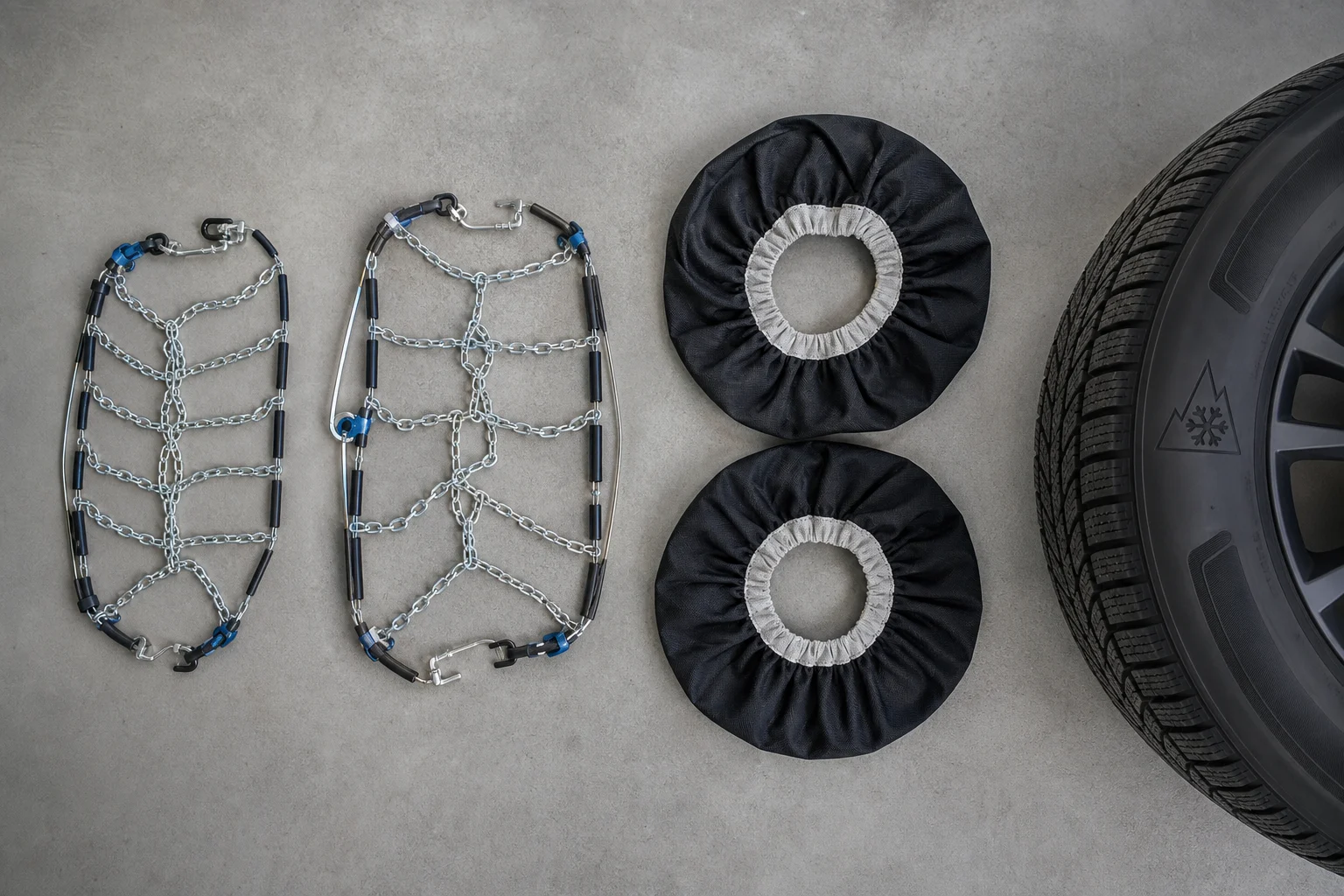
It is advisable to distinguish between equipment carried in the boot and the order governing the road section. As of 10 September 2026, sign R-412 requires drivers not to proceed without snow chains, other authorised anti-skid devices or special tyres for severe snow. If complying through chains or a device, it must act on at least one wheel on each side of the same driven axle.
R-412b is not equivalent to R-412. The former sign requires special winter tyres as defined by the regulation and does not present chains or other devices as an alternative. Therefore, having textile or metal chains does not meet a restriction marked R-412b: you must follow the specific sign rather than a general interpretation of “carrying chains”.
It is also essential to distinguish a restricted road from a closed road. Winter road management rules classify sections as open, closed or restricted; within the latter situation, a chains requirement may apply to light vehicles. A closed section does not become passable because you have chains, covers or special tyres for severe snow.
The DGT incident map is useful for planning a journey and can be supplemented by calling 011. However, the DGT itself warns that this information is for guidance only and never replaces road signage managed by the road authority. Once you reach the section, the signs and instructions in force determine whether you may continue.
Section references: Reglamento General de Circulación: señal R-412 y R-412b ↗ · Información e incidencias de tráfico ↗ · Norma 8.1-IC: señalización de vialidad invernal ↗
- R-412: chains, an authorised anti-skid device or special tyres for severe snow may allow you to proceed, subject to the terms of the sign.
- R-412b: special winter tyres as defined by the regulation are required.
- Closed: stop or reconsider the journey; equipment does not lift the closure.
- Before setting off: check incidents and the forecast, and during the journey follow physical road signage.
Snow chains, textile covers and special tyres: a useful comparison before buying
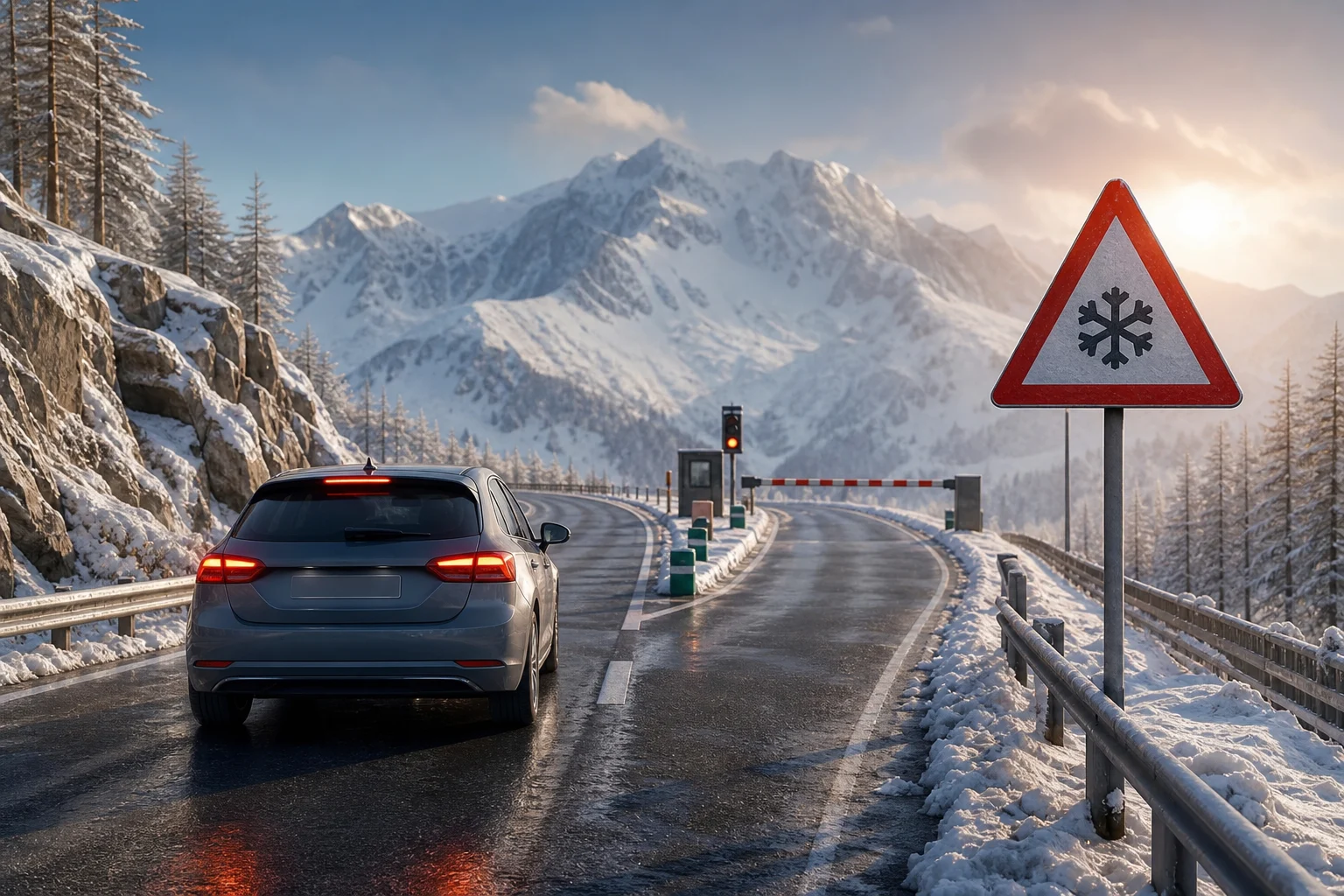
The three options must be assessed from two perspectives. The regulatory perspective answers what the restriction on the road section accepts; the technical perspective answers what the manufacturer allows on that vehicle. Metal snow chains and textile covers should not be treated as legal synonyms: the former are chains, while the latter can only be considered “other authorised anti-skid devices” when they meet the applicable authorisation. Special tyres for severe snow, meanwhile, have their own required markings.
The main operational advantage of special tyres for severe snow is that they are already fitted when a compatible restriction appears; in return, the indicated compliance requires them on every axle and requires both markings. Chains and authorised devices can meet an R-412 requirement if they are fitted to the driven axle, but they do not replace special winter tyres as defined by the regulation where an R-412b has been installed.
Do not buy a textile cover simply because its packaging says it covers a similar range of sizes. Nor should you buy metal snow chains because they are low-profile without checking the limit set by your car. In the documented manual for a SEAT Ibiza, for example, chains are only allowed on the front wheels and permitted protrusion varies by size: 15, 9 or 7 mm including the fastening. This shows why those figures cannot be transferred to another model, generation or wheel.
| Solution | What to check before buying | Fit under R-412 | Decisive limitation | Indicative profile |
|---|---|---|---|---|
| Metal snow chains | Exact size, authorised axle and maximum system protrusion | May be used if they act on one wheel on each side of the driven axle | They cannot be used if the manual prohibits them or limits that size | Occasional use, with confirmed compatibility |
| Textile covers | Exact size, manual permission and applicable authorisation as a device | Only if they are an authorised anti-skid device | Do not assume every commercially available cover is accepted | Use with confirmed authorisation and compatibility |
| Special tyres for severe snow | M+S and 3PMSF, fitted on every axle | Alternative provided for by R-412 | R-412b requires special winter tyres as defined by the regulation, not chains | Repeated use in winter conditions |
Section references: Reglamento General de Circulación: señal R-412 y R-412b ↗ · Reglamento General de Vehículos consolidado: neumáticos especiales y equipamiento ante restricciones invernales ↗ · Manual oficial SEAT Ibiza: límites de medida y montaje de cadenas ↗ · Manual oficial SEAT León: rueda de emergencia y cadenas ↗
- Metal snow chains: check the exact size, authorised axle and maximum permitted protrusion.
- Textile covers: check the exact size, authorisation as an anti-skid device and express permission in the manual.
- Special tyres for severe snow: check M+S and 3PMSF, and that they are fitted on every axle.
- Four-wheel drive: do not assume it gives freedom of installation; the manufacturer's instructions on permitted axles and systems take precedence.
How to read M+S and 3PMSF without confusing markings and permissions
The M+S marking should not by itself be interpreted as an automatic pass for any winter restriction in Spain. The current definition of a special tyre for severe snow requires M+S—or variants of that inscription—together with the 3PMSF pictogram: a three-peak mountain with a snowflake. For passenger cars and vehicles up to 3,500 kg, the cited requirement applies to every axle.
3PMSF identifies tyres intended for severe snow conditions that have passed a specific snow-grip test and are type-approved under UN Regulation No. 117. It is relevant when comparing winter or all-season tyres, but it does not remove other conditions: the state of the road, the specific sign and any closure remain decisive.
Before ordering tyres, check the approved size for your car and the documentation for the exact version. Checking the size remains essential for both tyres and accessories; this guide to tyres compatible with your car helps organise that document review.
Section references: Reglamento General de Vehículos consolidado: neumáticos especiales y equipamiento ante restricciones invernales ↗ · Explicación oficial del marcaje 3PMSF ↗
- Look for both elements: the M+S marking—or equivalent—and the 3PMSF pictogram.
- Check every axle, not only the driven axle, if you intend to comply as a special tyre for severe snow.
- Do not confuse a tyre marking with permission to disregard a closure or a different sign.
- Always check the size and instructions for the specific vehicle version.
Pre-departure checklist and mistakes that can undermine your preparations
The purchase does not end when the accessory arrives. Before the winter season, gather the car manual, the tyre-size information and the product documentation. Check that the intended system exactly matches the fitted wheels, can be installed on the axle specified by the manufacturer and retains any proof of authorisation required. If the vehicle uses a temporary spare wheel, check its restrictions too: a documented SEAT Leon manual prohibits fitting chains to it for technical reasons.
Before every journey, consult the DGT incident map and call 011 for additional information, check the forecast and confirm the condition of the route. These checks help you decide whether to postpone the trip when the scenario is not compatible with the vehicle or available equipment.
The most common mistake is buying for an approximate size. This is followed by fitting equipment on an unauthorised axle, believing M+S always means a special tyre for severe snow, treating every cover as an authorised device and relying on equipment to cross a closed section. The correction is always the same: verify the documentation, signage and current conditions before continuing.
Section references: Información e incidencias de tráfico ↗ · Medidas de vialidad invernal y planificación del viaje ↗ · Manual oficial SEAT León: rueda de emergencia y cadenas ↗
- Consult the manual for the vehicle's exact version and market.
- Match the fitted tyre size against that of the accessory or tyre purchased.
- Confirm the fitting axle and wheel-arch clearance limit.
- Check road conditions with the DGT; 011 is available for additional information.
- Follow the signage on the road section, especially when the road is closed.
Do textile covers count the same as snow chains in Spain?
You should not assume so. Regulations refer to chains or “other authorised anti-skid devices”, without naming textile covers as a separate category. Confirm that the product has the applicable authorisation and that your car manual permits its use.
Can I comply with an R-412 using M+S tyres?
Not automatically. The current definition of a special tyre for severe snow requires M+S—or its variants—and the 3PMSF pictogram, and for passenger cars they must be present on every axle.
Where should snow chains or an anti-skid device be fitted?
To comply with R-412, they must act on at least one wheel on each side of the same driven axle. Even so, the specific axle and system must match your vehicle manufacturer's instructions.
Can I drive if the road is closed and I have winter tyres?
No. Winter road management classification distinguishes closed sections from restricted sections. Equipment may be relevant under a restriction, but it does not make a closed road passable.