Series, parallel or power-split hybrid: what changes under the bonnet
Not all hybrids transmit power in the same way. We explain the differences between series, parallel and power-split systems, and how they differ from mild, full and plug-in hybrids.
Key points
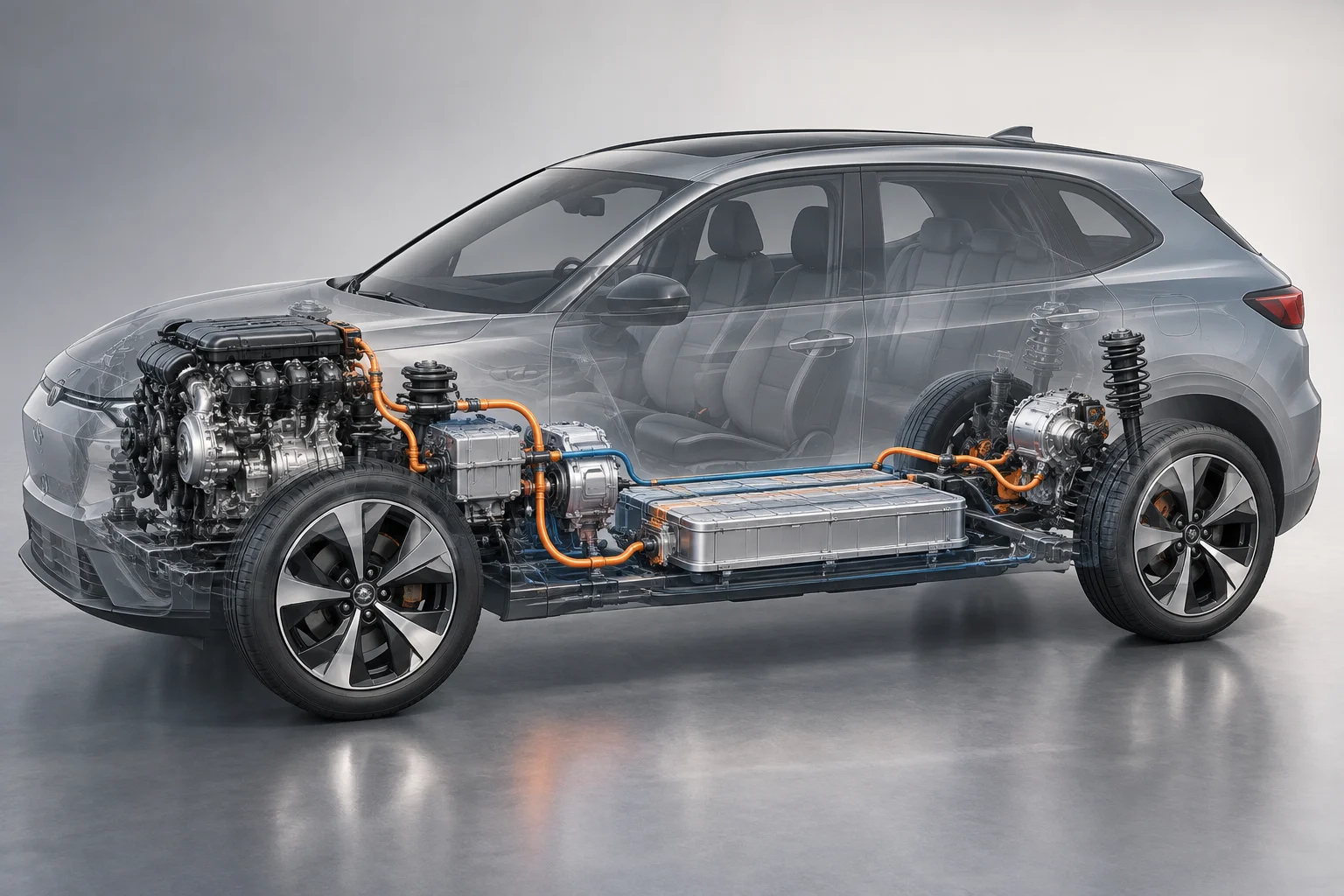
Series, parallel and power-split describe how power reaches the wheels; mild, full and plug-in refer to other aspects of the system. To compare cars, check the specifications for the exact version: the marketing name alone does not tell you how it works or what it consumes.
Two different questions: how it moves and how it recharges
The labels “series hybrid”, “parallel hybrid” and “power-split hybrid” describe how energy is transmitted to drive the wheels. By contrast, terms such as mild hybrid, full hybrid and plug-in hybrid refer to the degree of electrification and whether the battery can be charged from an external power source. These are not interchangeable categories: a hybrid can combine a particular architecture with a given level of electrification.
The practical difference is that you should not assume two cars labelled “hybrid” work in the same way. In one, the wheels may receive power directly from the combustion engine; in another, the electric motor drives them while the combustion engine generates electricity. Some systems also combine mechanical and electrical routes. The marketing name alone does not spell out all these details.
Section references: Hybrid Electric Vehicles: arquitecturas y grados de hibridación ↗ · Plug-In Hybrid Electric Vehicles: arquitecturas y recarga ↗
- Architecture: the route by which power reaches the wheels.
- Degree of hybridisation: the system’s electric propulsion capability.
- External charging: whether the battery can be connected to an electricity supply.
Series: the electric motor drives the wheels
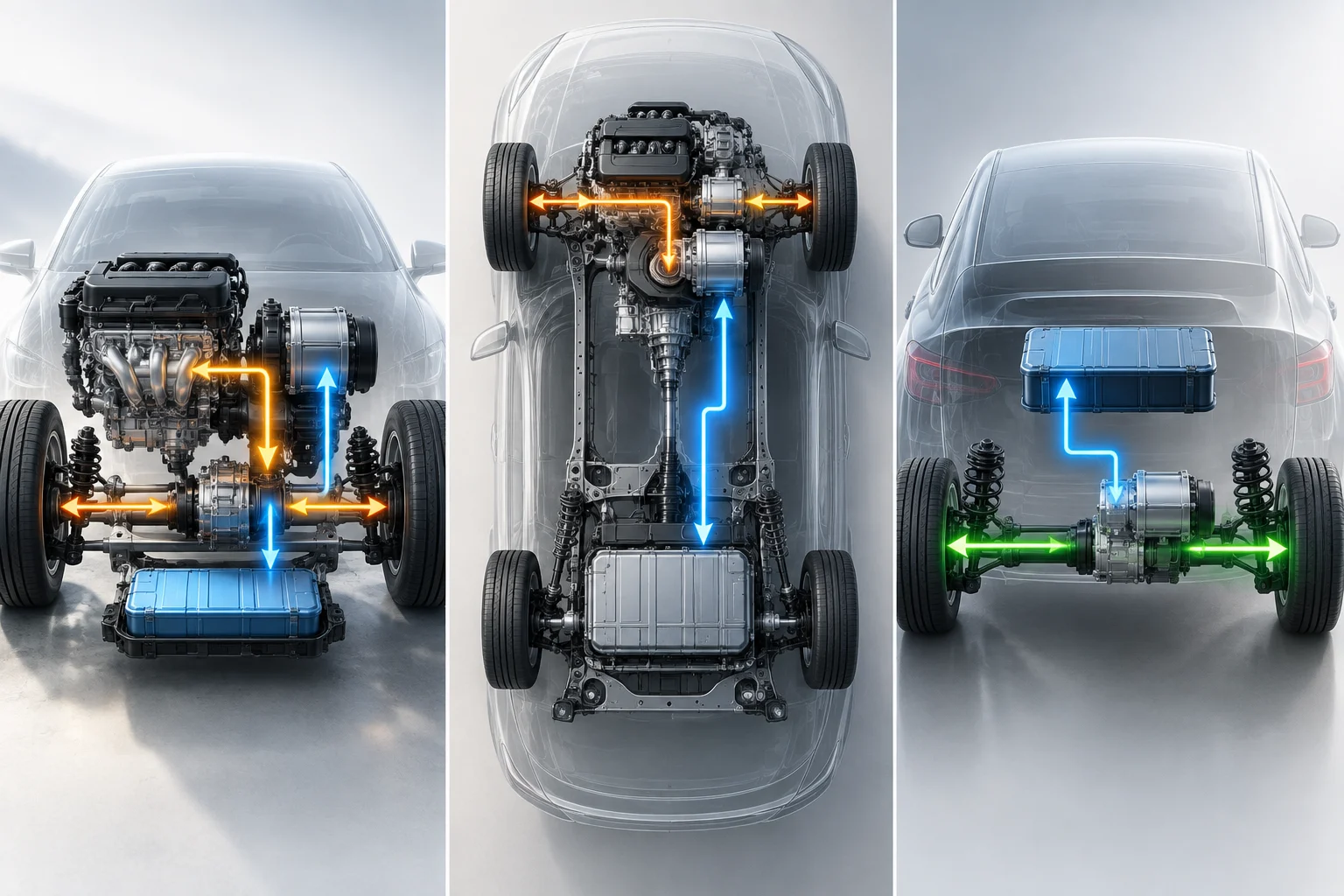
In a series configuration, the electric motor is what moves the wheels. In the operation described for this architecture, the combustion engine does not drive them directly: it can power a generator and produce electricity for the system. The combustion engine and electric motor therefore perform different roles in the propulsion chain.
This description helps explain the basic idea, but it should not be turned into a rule for every model advertised as a series hybrid. Some designs may switch to parallel-type operation in certain conditions, such as highway speeds. When comparing cars, it is therefore more reliable to check the technical explanation for the specific version than to infer how it behaves from a brief label.
A useful question to ask when reviewing the documentation is: can the combustion engine transmit power mechanically to the wheels, or does it only generate electricity in the mode described? The answer helps distinguish the general concept from the details of each design.
Section references: Plug-In Hybrid Electric Vehicles: arquitecturas y recarga ↗
- Identify which motor drives the wheels in each operating mode.
- Check whether the combustion engine has a mechanical connection to the wheels under any conditions.
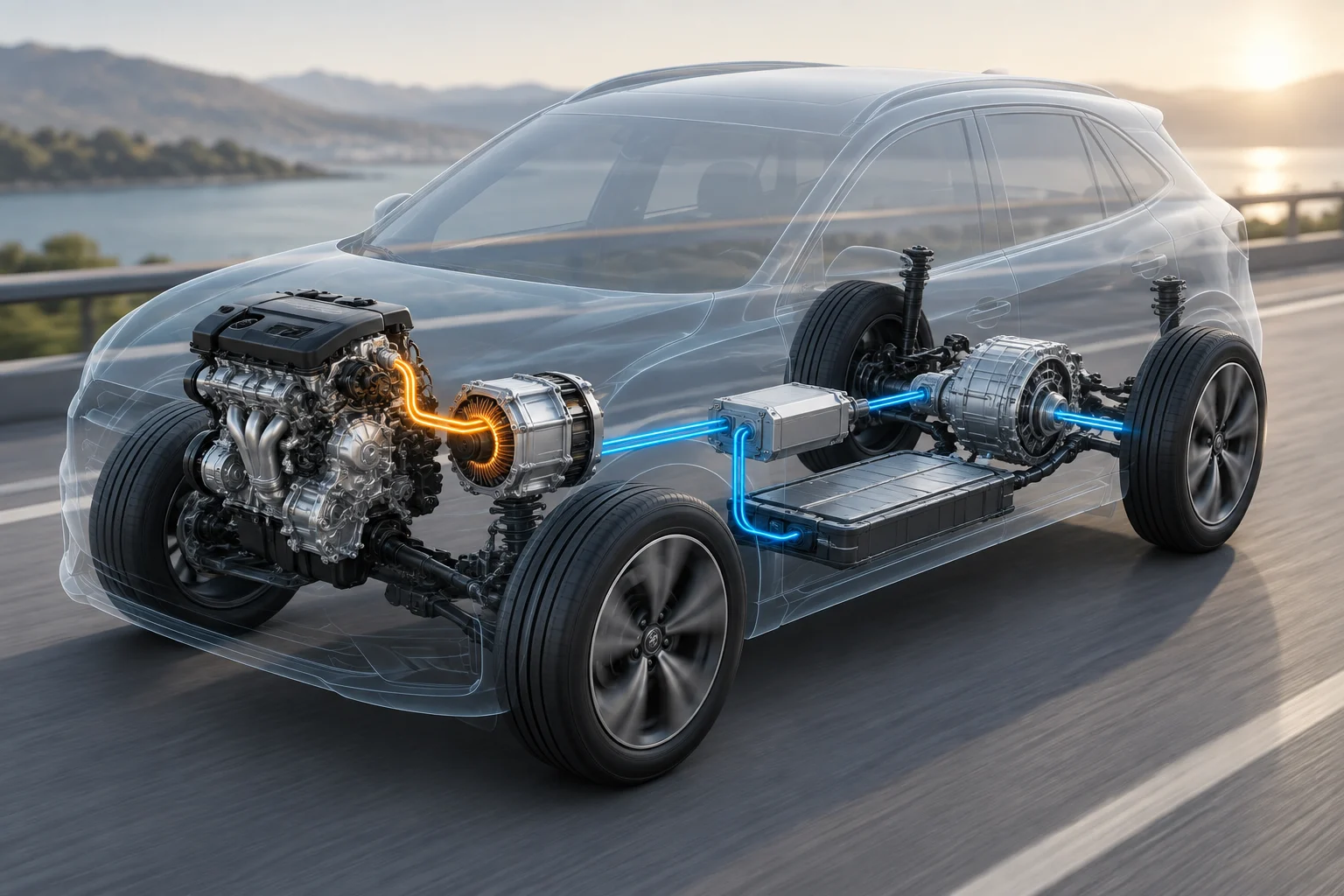
Parallel: both motors can propel the car
In a parallel hybrid, both the combustion engine and the electric motor can transmit power directly to the wheels through a mechanical connection. Depending on how the system operates, either one may provide propulsion, or they may do so together. The defining feature of this architecture is that both have a mechanical route for driving the vehicle.
When reviewing a model, knowing that it combines two motors is not enough: check what the manufacturer says about its operation and the role assigned to each motor. The architecture alone also does not tell you whether the car can run on electricity alone, how much capacity its battery has or whether it needs to be plugged in. Those questions concern other characteristics of the system.
Section references: Plug-In Hybrid Electric Vehicles: arquitecturas y recarga ↗
- Check whether both motors can drive the wheels directly.
- Do not infer electric-only capability or charging method just because it is a parallel hybrid.
Power-split: combined mechanical and electrical routes
A power-split system combines more than one route. Power from the combustion engine can reach the wheel axle mechanically while some of its energy also passes through a generator to power the electric motor. It can therefore combine “parallel-like” and “series-like” operation, rather than fitting neatly into a single label.
Toyota’s historical documentation describes its original hybrid system as a series-parallel combination with a power-split device linked to an electric motor and a generator. This is an example of how an architecture can be explained, not a complete description of every current vehicle from the brand or every version.
For a quick comparison, this table summarises the propulsion route that distinguishes each configuration. It is not a substitute for the technical specifications: a particular system may have additional operating modes.
| Architecture | Main route described | What to confirm |
|---|---|---|
| Series | The electric motor drives the wheels; the combustion engine can generate electricity. | Whether the design switches to another mode under certain conditions. |
| Parallel | The combustion engine and electric motor can drive the wheels mechanically. | How each motor contributes in different modes. |
| Power-split | Combines mechanical transmission with electricity generation for the electric motor. | How energy is distributed in the specific version. |
Section references: Advanced Vehicle Technology Analysis and Evaluation Activities, FY 2007 Annual Report ↗ · Development of Prius and Hybrid Strategy ↗
Mild, full and plug-in: a different classification
Mild hybrid and full hybrid describe degrees of hybridisation, not architectures. In general terms, full hybrids tend to have a larger battery and a more powerful electric motor than mild hybrids, and they can move the vehicle on their own over short distances and at low speeds. The exact capability depends on the system.
The mild label should not be the sole basis for concluding whether a car can move on electricity alone. The US Department of Energy’s general description says these systems cannot propel the vehicle using electricity alone; the ICCT, on the other hand, documents mild systems with very limited electric capability, at very low speeds and over short distances. This difference reinforces the need to check the model’s specifications rather than infer capability from its name.
Plug-in answers a different question: whether the battery can be charged from an external power source. Non-plug-in hybrids obtain energy through the vehicle’s system, including regenerative braking and the combustion engine; plug-in hybrids allow external charging. So “plug-in” does not indicate whether the architecture is series, parallel or power-split.
Section references: Hybrid Electric Vehicles: arquitecturas y grados de hibridación ↗ · Plug-In Hybrid Electric Vehicles: arquitecturas y recarga ↗ · White paper: Mild-hybrid vehicles ↗
- Mild or full: degree of electrification and electric capability, which should be checked for each version.
- Plug-in or non-plug-in: whether the battery can be charged from an external power source.
- Series, parallel or power-split: how energy is transmitted to the wheels.
What to check before comparing two models
The architecture explains how the propulsion routes are combined, but it does not by itself tell you which car will consume less on every journey. A technical description should not be turned into a universal promise of efficiency: a useful comparison starts with the version, intended use and corresponding official figures.
In Spain, check the technical specifications and manufacturer’s documentation for the exact version and model year. WLTP figures may include fuel consumption and emissions, and, where applicable, electricity consumption and electric range. Compare the same type of figure between vehicles, and avoid comparing numbers that refer to different versions or conditions.
If you are looking at a used car, ask for the documentation for that specific vehicle and check that the marketing name, powertrain and version match. Do not infer its architecture from a hybrid badge, or assume that every hybrid can be plugged in or driven in electric mode. These are common misconceptions that can lead you to compare cars with different capabilities.
Section references: Hybrid Electric Vehicles: arquitecturas y grados de hibridación ↗ · Plug-In Hybrid Electric Vehicles: arquitecturas y recarga ↗ · UN Regulation No. 154 (WLTP), 2026/1130 ↗
- Note the exact version and check how the manufacturer describes the energy route to the wheels.
- Confirm explicitly whether it supports external charging.
- Compare WLTP fuel consumption, electricity consumption and electric range only when those figures are available and refer to the same version.
- Do not choose an architecture as a guarantee of lower consumption: consider the data for the specific vehicle and how you will use it.
Is a plug-in hybrid necessarily a series or parallel hybrid?
No. Plug-in means the battery can be charged from an external power source; series and parallel describe how power is transmitted to the wheels. You need to check the architecture of the specific model.
Can a mild hybrid run on electricity alone?
Do not infer this from the label alone. General descriptions differ on whether mild systems have very limited electric capability; check the specifications for the specific version.
Is power-split the same as a series hybrid?
Not exactly. Power-split can combine a mechanical route from the combustion engine with an electrical route that passes through a generator and powers the electric motor.