Outboard, inboard or sterndrive engine: what changes when choosing a boat
Choosing propulsion for a motorboat, RIB or cruiser means looking beyond horsepower. We compare space, access, maintenance, documentation and key checks when buying used.
Key points
Outboard, inboard and sterndrive propulsion differ in more than power: they affect available space, access to the propulsion system and maintenance checks. Before buying, compare the layout with the manual, intended use, home port and maintenance history.
The short answer: do not choose by advertised horsepower
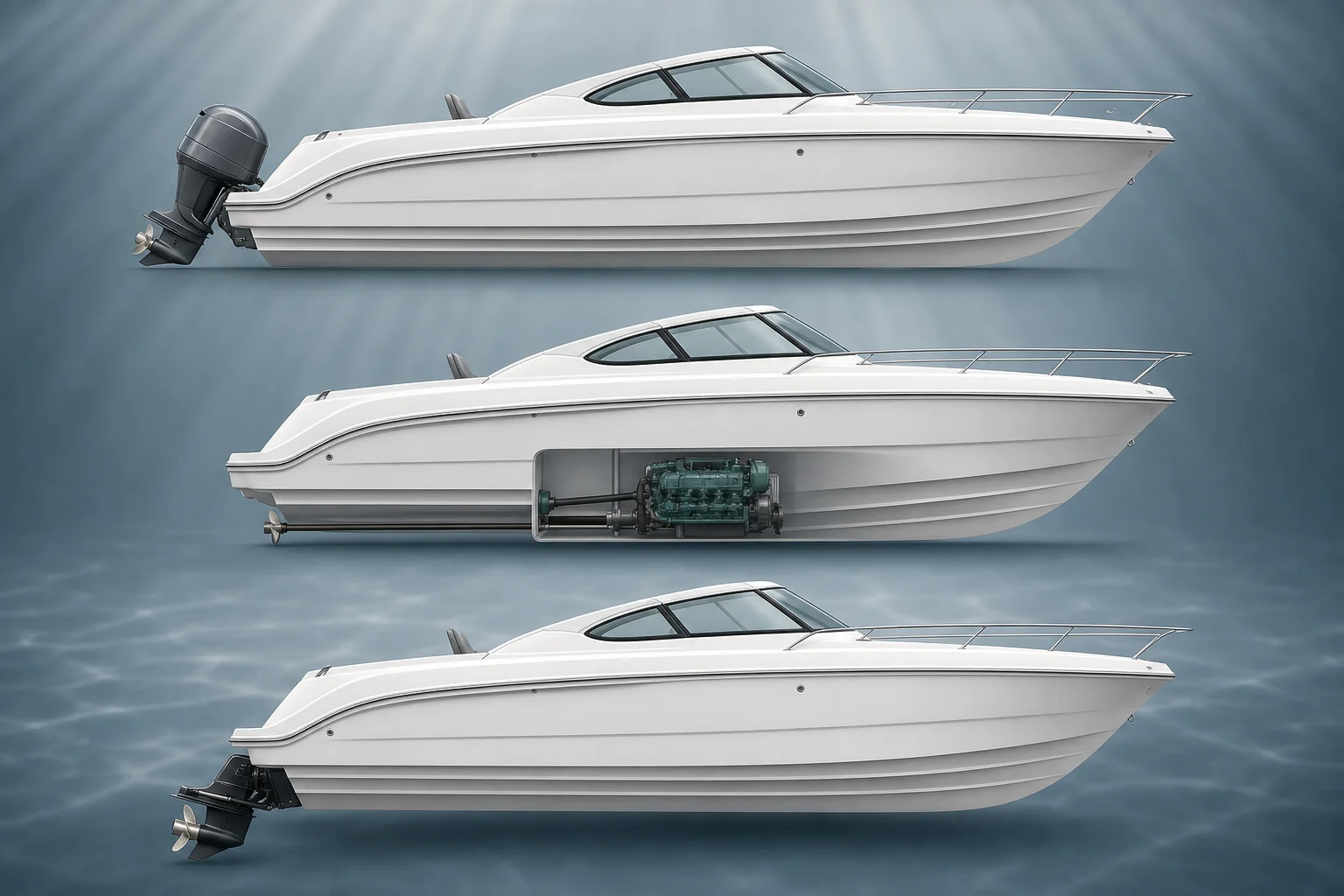
There is no universally superior layout. An outboard is identified by the propulsion unit being mounted on the transom and, if it has a tilt system, it can be raised; an inboard reserves space inside the hull for the engine; and a sterndrive may include model-manual-documented maintenance components, such as anodes and bellows.
The decision changes the boat’s layout, the technician’s access to components requiring inspection and the maintenance work you should be able to substantiate on a used boat. The right question, therefore, is not which one delivers more power, but which suits the specific hull, cruising programme, berth or home port, and support available for that installation.
Power remains an essential check, but it is not sufficient reason to decide. European rules require the manufacturer to ensure satisfactory handling characteristics with the highest-power engine for which the craft was designed and built. In addition, the maximum rated engine power must be stated in the owner’s manual. Always compare the advertised engine with the maximum rated engine power declared in the owner’s manual, not with a figure heard from the seller.
Section references: Directiva 2013/53/UE sobre embarcaciones de recreo ↗ · Manual Yamaha: mantenimiento de fueraborda ↗
- Prioritise a boat whose manual, declaration of conformity and engine installation are consistent with one another.
- Assess actual access to the engine and wear components, not merely a photograph of the cockpit or bathing platform.
- If the boat will regularly operate in salt water, include the manufacturer-specified washing and anticorrosion work in both the budget and the maintenance history you require.
- Do not accept that a propulsion layout alone can make up for an unsuitable hull, layout or maintenance record.
How to identify outboard, inboard and sterndrive systems in an advert
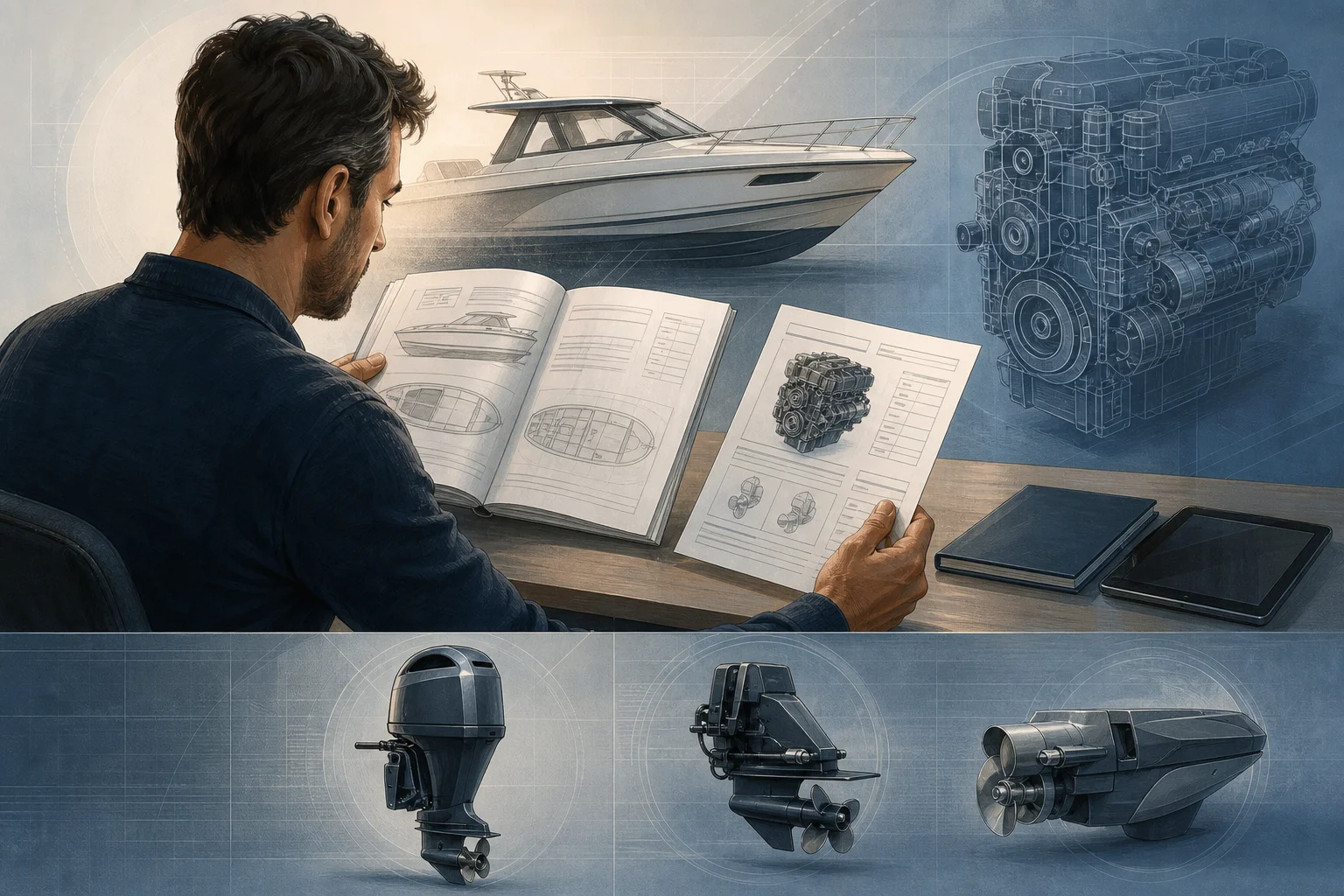
For an outboard, look for the complete engine installed on the transom. If it has a tilt system, it can be raised and held up with a tilt support, which is a useful visual clue during a visit. Also ask for a clear image of the identification plate and model number: the maintenance procedure depends on that specific engine.
For an inboard, the engine must be in an enclosure separate from accommodation spaces. This necessarily affects the layout: there is an engine compartment to inspect, and it takes up space within the boat. Opening it for a few seconds is not enough; it is advisable to check whether service points can be accessed reasonably and whether manuals and instructions are kept on board.
With a sterndrive, do not rely on the commercial label in the advert. Request the exact model identification and photographs of the components whose inspection is specified in its manual. On certain MerCruiser units, the manual identifies anodes on the ventilation plate, trim cylinders and gear housing; Volvo Penta Aquamatic maintenance catalogues include anodes and drive-joint bellows.
Section references: Directiva 2013/53/UE sobre embarcaciones de recreo ↗ · Manual Yamaha: mantenimiento de fueraborda ↗ · Catálogo de mantenimiento Aquamatic sterndrive ↗
- Request recently taken photographs, not just promotional or old images.
- Record the engine make, model and serial number and, for a sterndrive, the exact identification of the installed model.
- Request the owner’s manual before travelling to view the boat.
- Compare the maximum rated engine power declared in the manual with the installed engine.
On-board space and use: decide by the layout, not the label
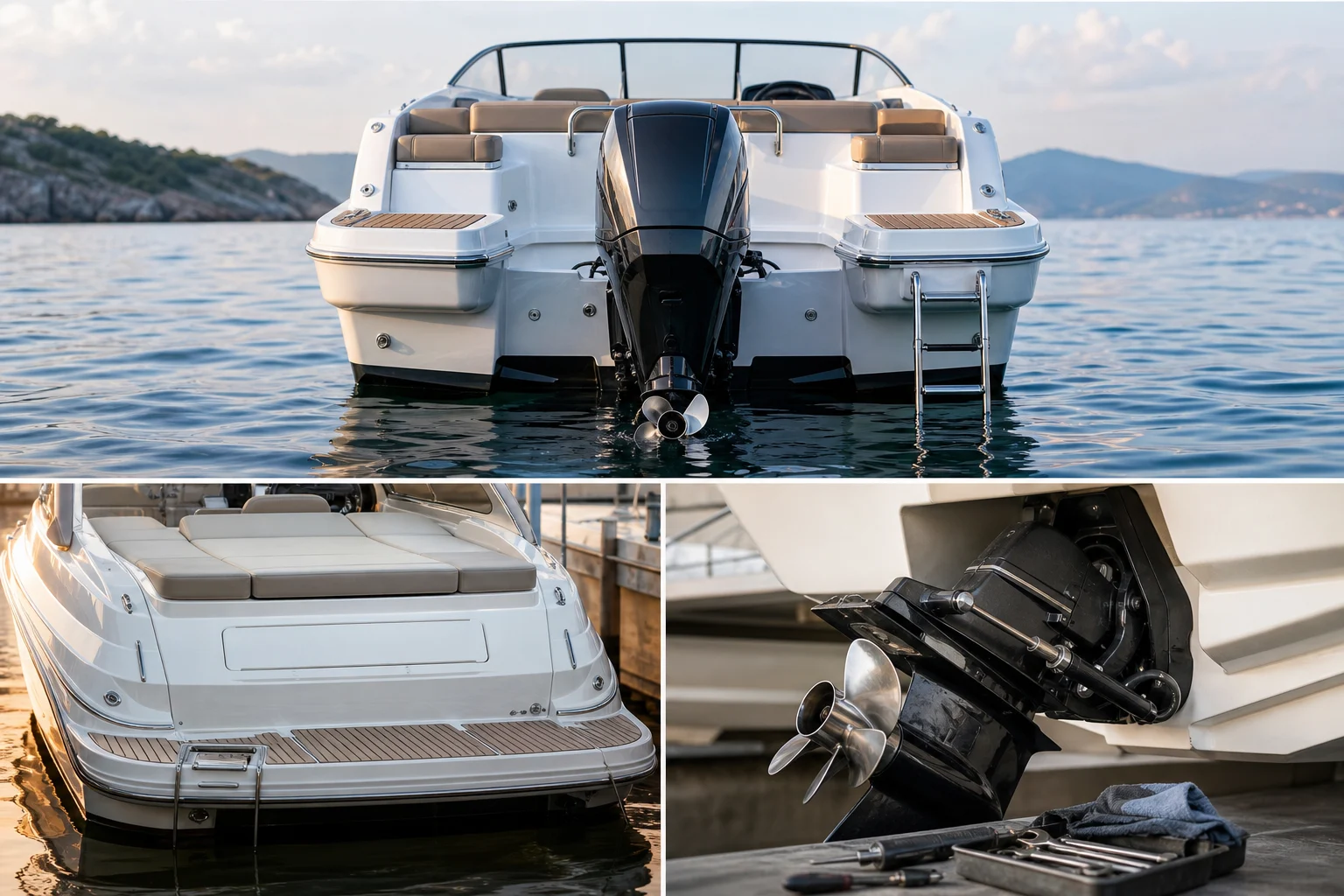
The space difference is structural. By requiring an engine enclosure separate from living spaces, an inboard reserves a volume of the hull for that compartment. On a compact boat, you need to assess what this means for stowage, access to the machinery and cockpit or cabin layout. By contrast, an outboard concentrates the propulsion unit on the transom, so it does not occupy an equivalent internal engine compartment.
For a sterndrive, consult the documentation for the specific model and inspect the boat’s layout before assessing available space. The appearance of the deck should not make you forget that inspection and replacement work will need access and a verifiable service history.
For day trips, tow sports, fishing, passages or overnight stays, start with a specific list of needs: usual number of occupants, equipment you will carry, stowage requirements, resting areas and the ability to spend time below deck. Then visit comparable boats with each layout. The same solution can be satisfactory or restrictive depending on hull design; it cannot be judged by propulsion type alone.
Section references: Directiva 2013/53/UE sobre embarcaciones de recreo ↗
- Open every locker and the engine compartment before assessing liveability.
- Check that access to maintenance components is not blocked by furniture, tanks or normal stowage.
- Assess use with a realistic load: people, fenders, safety equipment and the belongings needed for a day or a night aboard.
- Ask where servicing will be carried out and whether the berth allows the necessary periodic work.
Maintenance and preservation: the manual is authoritative
The layout does not remove maintenance requirements; it changes which components you must monitor and how you demonstrate that they have been attended to. The European Directive states that the owner’s manual must include the information necessary for safe use, including installation, maintenance and regular operation. For inboard and sterndrive systems without integrated exhaust, the boat manual must also provide information for keeping the boat and exhaust within applicable noise limits.
With an outboard, do not turn an instruction in one manual into a universal rule. For example, one Yamaha manual assumes 100 hours per year and regular flushing of cooling passages, and requires the schedule to be adjusted in adverse conditions. For salt, turbid or acidic water operation, that manual says to flush with clean water after every use. Another Yamaha F80A/F100A manual describes flushing for around 15 minutes with the engine stopped. The applicable reference will always be the manual for the installed model number.
For documented sterndrive systems, anticorrosion protection and watertightness deserve greater documentary attention. MerCruiser identifies several sacrificial anodes, including those on the ventilation plate, trim cylinders and gear housing. Volvo Penta includes zinc anodes and drive-joint bellows in Aquamatic kits. On certain MerCruiser units, the U-joint bellows prevent water entering the bell housing. Do not diagnose their condition by appearance alone: ask for invoices, part references and the maintenance schedule applicable to the specific assembly.
Section references: Manual Yamaha: mantenimiento de fueraborda ↗ · Manual Yamaha F80A/F100A: lavado del circuito de refrigeración ↗ · Manual MerCruiser 4.5L: protección anticorrosión del sterndrive ↗ · Catálogo de mantenimiento Aquamatic sterndrive ↗ · Kit de fuelle de junta cardán para sterndrive ↗
- Keep the engine and boat manuals, not just generic invoices.
- Record operating hours, boating environment and work carried out.
- Check anode wear and ask for evidence of replacement in accordance with the applicable manual.
- For a sterndrive, explicitly ask for the history of bellows and components specified for the particular model.
- If documents are missing or discrepancies exist, make the purchase conditional on an independent professional inspection.
Costs and buying used: budget for checks, not promises
It is not responsible to compare costs using a fixed figure without knowing the model, hours, condition, home port and scope of work. You can, however, create a realistic itemised budget: manufacturer-prescribed servicing, wear parts, anticorrosion measures, flushing where applicable, haul-out or dry inspection, and availability of a service provider familiar with that installation. Request a written estimate from the chosen service provider using the exact engine identification and, where applicable, the sterndrive model.
When buying used in Spain, documentation carries as much weight as exterior appearance. Periodic inspections include dry inspection of the hull and equipment, as well as checks on certificates, logbooks, manuals and instructions kept on board. For CE-marked craft, the certificado de navegabilidad (certificate of navigability) requires the declaration of conformity for the boat and engine issued by the builder or its authorised EU representative. The transfer of ownership must be notified to the Maritime District.
A viewing does not replace a professional inspection. It helps identify inconsistencies, request paperwork and decide whether it makes sense to proceed. If the seller does not provide the manual, cannot identify the installed assembly or does not provide a history for relevant parts, the risk is not that the system is outboard, inboard or sterndrive: it is that you cannot verify its maintenance.
| Aspect | Outboard | Inboard | Sterndrive |
|---|---|---|---|
| Location to verify | Assembly mounted on the transom and tilting if fitted with a tilt system. | Engine inside an enclosure separate from accommodation spaces. | Exact sterndrive model and maintenance components specified in its documentation. |
| Main effect on space | Does not require an equivalent internal engine compartment. | Reserves interior volume for the engine enclosure. | No general rule is established here: check the documentation and layout of the specific model. |
| Notable maintenance point | Model-specific plan and flushing of the circuit where prescribed by the manual. | Access to the compartment, boat manual and exhaust maintenance where applicable. | On documented models, anodes and bellows; confirm the components applicable to the installed assembly. |
| Before buying used | Manual, exact model, maximum rated engine power and service history. | Access to the enclosure, manuals, documentation and hull and equipment inspection. | Model identification, history of the components specified in its manual and professional inspection. |
| Decision criterion | Desired layout and ability to comply with maintenance for the model. | Liveability compatible with the engine compartment and service access. | Ability to verify and maintain the components specified in the model manual. |
Section references: Directiva 2013/53/UE sobre embarcaciones de recreo ↗ · Real Decreto 1434/1999: reconocimientos e inspecciones de embarcaciones de recreo ↗ · Real Decreto 1435/2010: abanderamiento y matriculación en listas sexta y séptima ↗
- Before placing a deposit, gather manuals, declarations of conformity, the certificado de navegabilidad (certificate of navigability) and available invoices.
- Ask for an inspection to include the hull out of the water, equipment and documentary checks.
- Check that the engine, declared power, documentation and advert all match.
- For a sterndrive, request proof of maintenance for the components specified by the applicable manual; for an outboard, request proof of the service and flushing plan stated for that model.
- Complete the change of ownership correctly with the Maritime District.
Does an outboard always leave more usable space on board?
Because it is mounted on the transom, it does not require an internal engine compartment equivalent to that of an inboard. However, final usable space depends on the overall hull design, stowage and layout of each boat; it should be checked in person.
Which document states a boat’s maximum rated engine power?
The owner’s manual must state the maximum rated engine power. Compare it with the installed power and the engine documentation before buying.
What should I request if the boat has a sterndrive?
In addition to manuals and the exact model identification, request invoices or records for maintenance specified for the installed assembly. Documented sterndrive installations include components such as anodes and bellows, whose part reference must be compatible with the specific model.
Is it compulsory to flush an outboard after operating at sea?
The manual for the installed model must be followed. One Yamaha manual advises flushing with clean water after each use in salt, turbid or acidic water, but that instruction should not automatically be applied to every engine.
What should I check in Spain before transferring a used boat?
Gather the certificado de navegabilidad (certificate of navigability), manuals, records and declarations of conformity where applicable. The transfer of ownership must be notified to the Maritime District, and a professional inspection should not be replaced by a simple viewing.