Plug-in Hybrids: Check Driving, Charging and the Environmental Label
Before deciding between a conventional hybrid, plug-in hybrid or EV, review your journeys, the charging you will actually be able to use, the vehicle documentation and the environmental label for the specific car.
Key points
Before choosing a conventional hybrid, plug-in hybrid or EV, verify your journeys, the charging you can use, the vehicle documentation and its environmental category. Compare the type-approved WLTP electric range for the exact version with your routine without treating it as a daily guarantee.
Short answer: check charging, driving and the environmental label
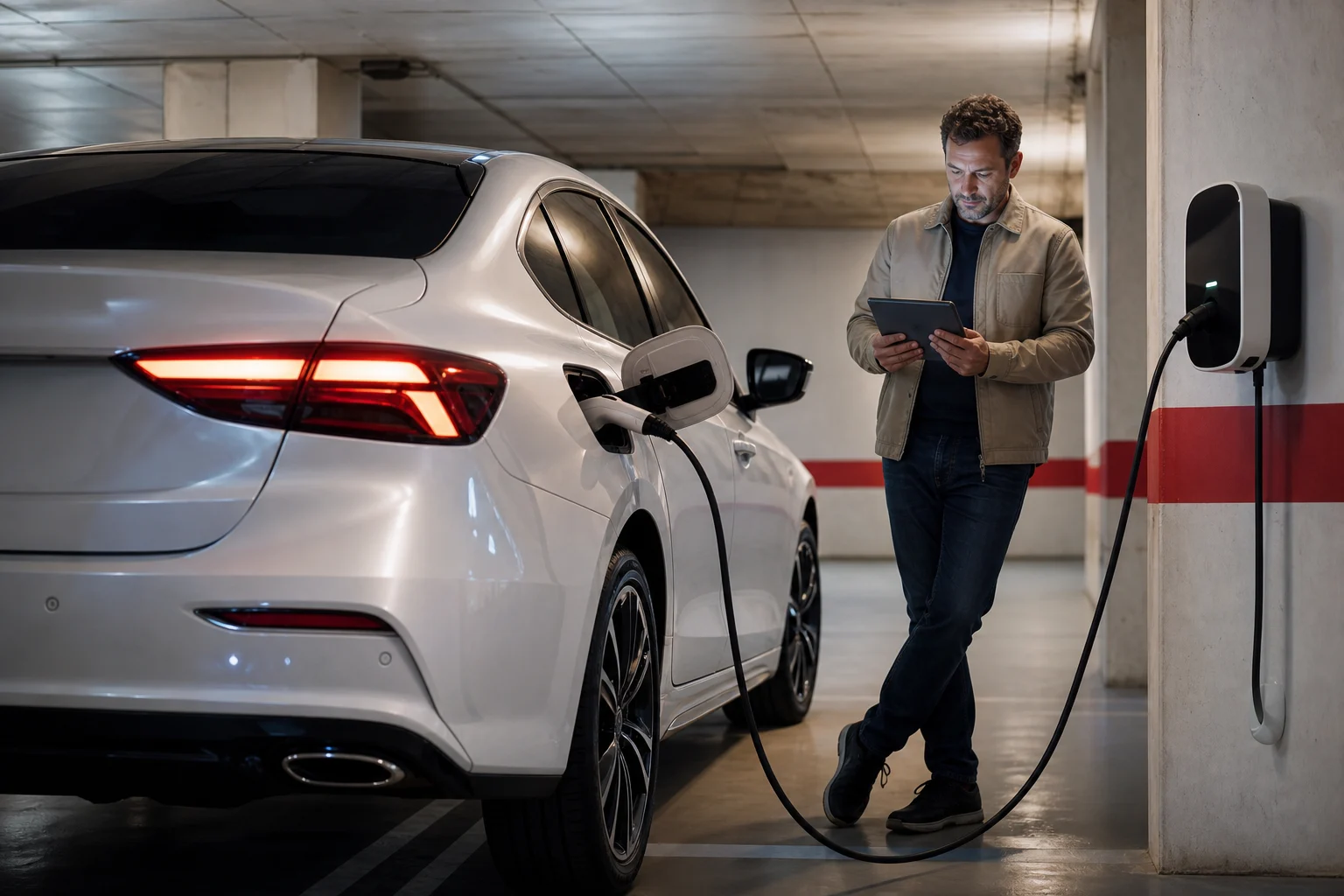
Before looking at prices, trims or advertised range, identify where the car will usually be parked and confirm whether you will be able to charge it there repeatedly. If that answer relies on an unverified socket, someone else’s parking space or an installation that is still uncertain, verify the arrangement before deciding.
Also compare the type-approved WLTP electric range for the exact version of the vehicle you are considering with your everyday journeys. That figure is useful for comparing cars under a common procedure, but it is not a promise of daily kilometres: consumption, emissions and range values are type-approved through WLTP. It is worth comparing it with your usual journeys and leaving a margin, rather than buying on the assumption that the published figure will always be repeated.
Nor is it enough for a car to be plug-in. A sensible purchase starts by verifying charging, use, environmental category and the documentation of the specific vehicle.
Section references: Distintivo ambiental: categorías 0 Emisiones y ECO ↗ · Ensayo WLTP y valores de consumo y emisiones homologados ↗
- Check whether you have verifiable regular charging and know the type-approved WLTP electric range of the exact version.
- Verify the installation if you only have a nearby socket without having checked it.
- Do not decide by the label: first confirm how the specific vehicle is listed in the DGT Vehicle Register.
Conventional hybrid, plug-in hybrid and EV: split the decision into three questions
A useful comparison is not about automatically assigning an advantage to each alternative, but about organising what you need to check. For a conventional hybrid, verify the environmental category that applies to the vehicle. For a plug-in hybrid, also check the type-approved WLTP electric range for the exact version. For an EV, review the vehicle’s type-approved data.
The DGT includes non-plug-in hybrids (HEVs) among vehicles that may fall within the ECO category under its criteria. For plug-in vehicles, the relevant threshold is a minimum electric range of 40 km: with it, the Zero Emissions label is considered; below 40 km, the DGT expressly differentiates them. Therefore, do not take the label in an advert for granted or extrapolate it between model years, trims or versions.
The technical data sheet or ITV card proves that the car is type-approved to drive in Spain. Use it together with official DGT information to identify the vehicle you are buying correctly.
| Alternative | Question you should not skip | Documentary check |
|---|---|---|
| Conventional hybrid | Does its environmental category work for the places where you drive? | Check the DGT classification that applies to that vehicle. |
| Plug-in hybrid | Where and when will it be charged repeatedly? | Verify the type-approved WLTP electric range for the exact version and registration category. |
| EV | Does the available charging cover your routine and journeys? | Review the charging solution and the vehicle’s type-approved data. |
Section references: Distintivo ambiental: categorías 0 Emisiones y ECO ↗ · Documentación de un vehículo ↗
First filter: map out your real week, including long journeys
For two or three weeks, note the mileage for each day, destinations, how long the car remains parked and how many long journeys you make. Separate normal days from exceptions: an occasional visit should not alone determine a car you will use every day, but frequent or essential trips should not be ignored either.
Then compare that record with the type-approved WLTP electric range for the exact version of the PHEV candidate. Identify which part of your routine could fit within it and whether there will be an opportunity to charge between uses. If the outcome relies on optimistic estimates, treat the fit as uncertain.
Section references: Ensayo WLTP y valores de consumo y emisiones homologados ↗
- Record: daily mileage, length of stops and travel days.
- Distinguish: home, work, second home and public car parks.
- Always compare the exact version: type-approved data belong to the specific vehicle.
- Keep a margin: WLTP is a type-approved figure, not a guarantee of an individual result.
Check charging before signing: parking space, installation, connector and cable
Having a garage space or finding a nearby socket does not in itself confirm that you can charge. ITC-BT-52 regulates charging infrastructure and covers different installation arrangements. Feasibility depends on the building’s electrical configuration and the solution validated by the installer; this is why the check must be carried out for your specific space, not from a photograph or a verbal promise.
Ask the seller or manufacturer for the supported charging power, connection type, charging mode and which cable is supplied with the vehicle. Do not assume them because it is a PHEV: the standard differentiates between single-phase or three-phase supply, charging modes and configurations. For AC charging above 3.7 kW and up to 22 kW, ITC-BT-52 establishes type 2 connectors or socket-outlets as a minimum, but that rule does not replace checking compatibility between the car and the charging point.
If you are buying used, you may also inspect the included cables and, if available, observe charging at a suitable installation.
Section references: ITC-BT-52: infraestructura para la recarga de vehículos eléctricos ↗
- Confirm in writing whether the space is owned, rented or communal, and who authorises the work.
- Ask an installer for a quote and validation for the exact parking space.
- Check the supported power, connector, charging mode and supplied cable.
- Do not buy based on the statement, “there is a socket nearby.”
Zero Emissions label and parking: confirm Madrid rules and the specific car, not the registered keeper
The label can matter. The DGT links the Zero Emissions label for a PHEV to a minimum electric range of 40 km. Before buying, check the category that applies to the specific vehicle, especially for used examples, rather than relying on the commercial description.
In Madrid, its official website states that vehicles classified as Zero Emissions in the DGT Vehicle Register may park in SER green and blue spaces without authorisation, with no time limit and free of charge, unless another general or specific rule prohibits it.
If you frequently park in regulated areas of Madrid, add this check to the pre-purchase stage. Confirm the current SER rules and the car’s DGT classification.
Section references: Distintivo ambiental: categorías 0 Emisiones y ECO ↗ · SER: vehículos Cero Emisiones ↗
- Verify the classification of the specific vehicle, not only that the model is sold as a PHEV.
- Check Madrid’s current SER regulations if you regularly park in its regulated spaces.
- Read the exceptions: parking may be prohibited by another general or specific rule.
Buying used: history, documentation and final checklist
For a used PHEV, the administrative review is as important as checking that the cable and documentation are present. Request a full DGT vehicle report before completing the transaction. It lets you check ITV history, mileage, number of registered keepers, encumbrances, technical data, outstanding recall campaigns and maintenance reported by affiliated workshops. The DGT expressly recommends requesting it before acquiring a vehicle to detect attachments (embargos), holds (precintos), insolvency proceedings and other administrative or judicial encumbrances.
Cross-check the vehicle identification number, technical data sheet and advert information. Ask for the type-approved WLTP electric range for that version, which cables are included and any known charging issue. If you wish to assess the battery condition or the range of the individual vehicle, you may request available documentation or consider an independent professional inspection.
You should be able to explain the final decision with verifiable answers. If an essential answer is missing—charging, environmental category, documentation or encumbrances—postpone the purchase until you obtain it.
Section references: Informe de un vehículo ↗ · Documentación de un vehículo ↗
- What are the type-approved WLTP electric range for this exact version and DGT classification of this vehicle?
- What charging power, connector and charging mode does this exact version support?
- Which cables are supplied, and can they be inspected visually?
- Has the charging installation in my parking space been confirmed by an installer?
- Do the technical data sheet, vehicle identification number, advert and equipment match?
- Have I requested the full DGT report and reviewed ITV, mileage, registered keepers, encumbrances and campaigns?
- Have I checked the local rules affecting my usual journeys?
Does a plug-in hybrid always have a Zero Emissions label?
No. The DGT considers the Zero Emissions label for PHEVs with a minimum electric range of 40 km. For PHEVs with less than 40 km of electric range, check the classification of the specific vehicle before buying.
Will I achieve the WLTP electric range every day?
It should not be interpreted as an individual promise. It is a type-approved WLTP value useful for comparing vehicles; compare it with your journeys and your actual ability to charge.
Can I decide to buy if there is a socket near my parking space?
Not without confirming it. Feasibility depends on the installation and the building’s configuration. Consult an installer and also verify compatibility between the charging point, car, connector and cable.
What should I ask for when buying a used PHEV?
Ask for the technical data sheet, included cables, charging data for the version and a full DGT report. This report lets you review ITV, mileage, registered keepers, encumbrances, technical data, campaigns and reported maintenance.