Will It Fit in Your Garage? A Guide to Choosing a Car for Your Parking Space
Measure the usable space, obstacles and access route, then compare them with the full dimensions and real manoeuvre of the car you want to buy.
Key points
To find out whether a car will fit in your garage, it is not enough to compare the parking space with the length and width on the specification sheet. You need to measure the genuinely free space, the entry route, pillars and the vehicle’s dimensions with mirrors, tailgate and published turning circle. The most reliable decision comes from reproducing the manoeuvre with the specific car before signing. The Clio and Duster dimensions cited are dated examples from specific sources, not references applicable to every version, model year or trim.
The short answer: compare the complete car with the usable garage space
Before reserving a new or used car, note down the dimensions that limit your parking space and compare them with the specification sheet for the exact version. In this guide, “garage” means a Spanish shared parking garage, while “parking space” means an individual bay within it. At a minimum, check length, width with the mirrors extended, height, height with the tailgate open and turning circle if the manufacturer publishes it.
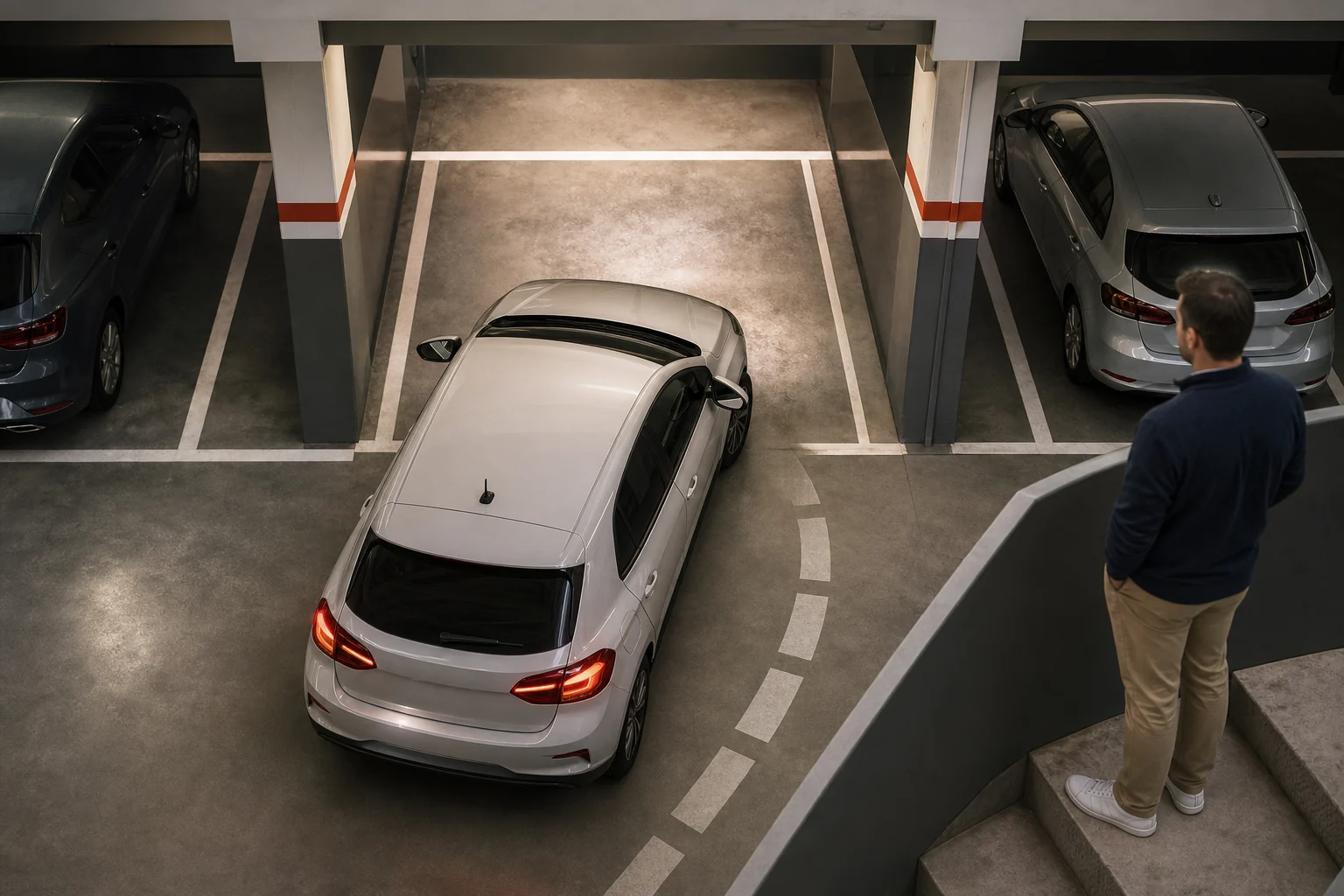
Do not look for a universal figure for a “large enough space”. Two spaces with the same nominal dimensions can be radically different: a pillar may prevent a door from opening, a wall may force you to enter at a particular angle, and a preceding bend may leave a car poorly positioned on arrival. The useful reference is not just the painted rectangle, but the entire volume and route you can use every day.
The outcome should answer three separate questions: whether the vehicle can enter; whether you can park it without relying on an exceptional manoeuvre; and whether, once stopped, you can get out, open the necessary doors and use the trunk. A body fitting in does not guarantee the latter two.
- Measure the parking space, access route and fixed obstacles first.
- Check the official dimensions for the specific configuration, not just a generic width figure.
- Test the real route before committing to a purchase when the dimensions are tight.

Why catalogue length and width alone do not settle the purchase
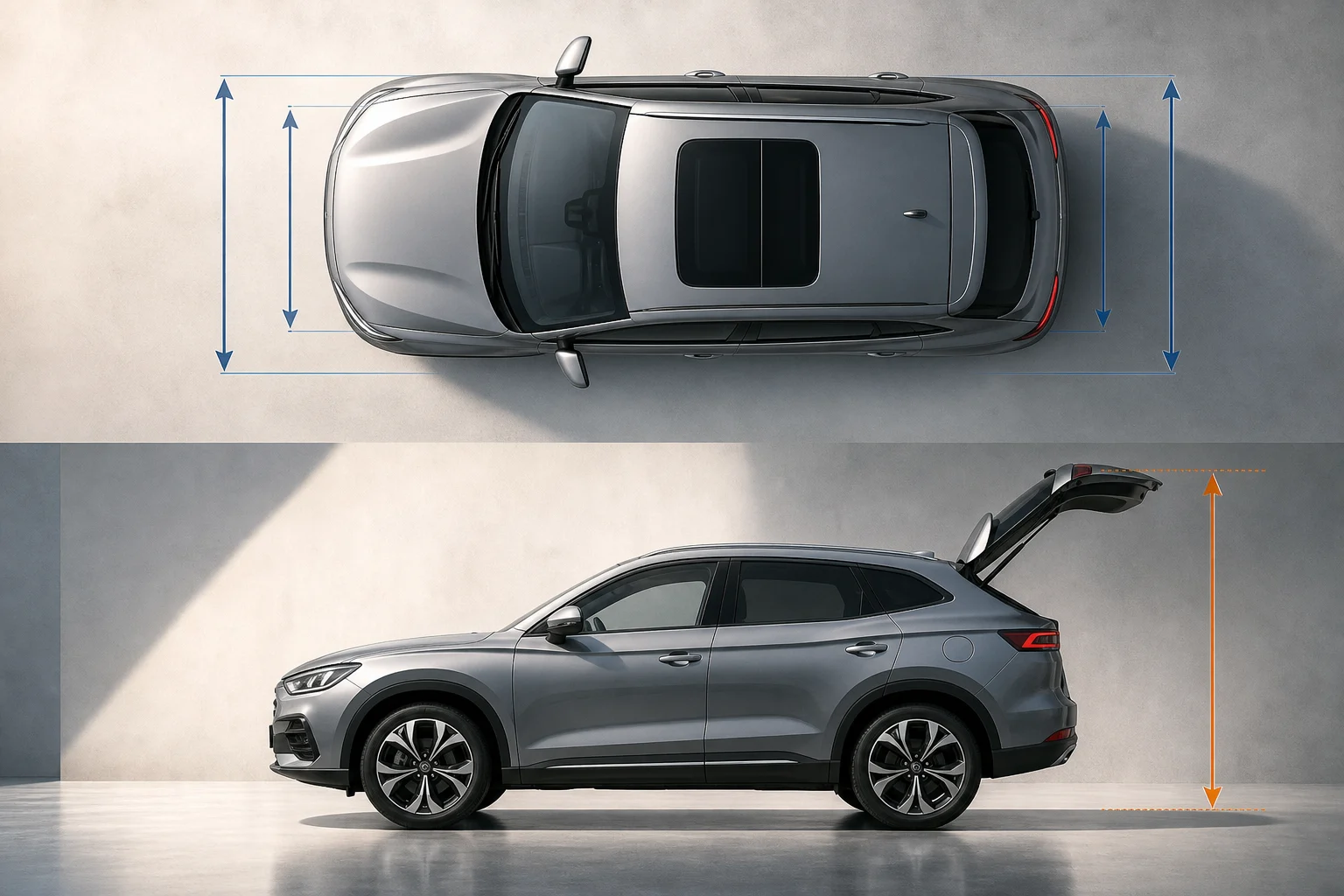
Width without mirrors can hide a decisive difference. The Renault Clio dossier published in 2023 states 1,798 mm without exterior mirrors and 1,988 mm with them extended: a 190 mm difference. For the New Dacia Duster, the Spanish specification sheet declares an overall width of 1,921 mm and 2,069 mm including the exterior mirrors. To pass through a narrow entrance or avoid a pillar, the second figure is the one that must be compared.
Length affects how far the vehicle protrudes within a short space and the position from which you can close the door or access the trunk. Height matters especially beneath beams, pipes, up-and-over doors or in spaces with overhead storage. In addition, an open tailgate requires different vertical clearance from a closed car: Renault states 1,978 mm for the Clio with the tailgate open and Dacia states 2,092 mm for the Duster.
Wheelbase — the distance between the axles — and turning circle help interpret a bend or change of direction before the parking space, but they do not replace a physical check: the route, pillars and position of neighbouring cars change the available room. As a documented reference, the Spanish Clio catalogue from August 2025 publishes a 10.42 m kerb-to-kerb turning circle; the Duster specification sheet states 10.86 m kerb-to-kerb or wall-to-wall.
Nor should a marketing drawing be confused with the real door opening. It depends on where the car is parked, the nearest wall or pillar and the adjacent vehicle. If you regularly need to fit a child seat, help a passenger or load items, those tasks must be part of the test.
Section references: Ficha técnica Nuevo Dacia Duster ↗ · Catálogo Renault Clio, agosto de 2025 ↗ · Dossier de prensa Nuevo Renault Clio ↗
- Use the width with mirrors extended for passing through and approaching obstacles.
- Compare the height with the tailgate open if you load the trunk inside the garage.
- Treat the turning circle as comparative data, not as a guarantee that a particular bend can be negotiated.
How to measure your parking space and route without confusing them with the deeded dimensions
Start with a tape measure, a simple sketch and a notebook or your phone. Measure in millimetres or centimetres, but use the same unit for all your notes. Do not rely only on a possible measurement in the property documentation: the Horizontal Property Act provides for the description of the property element to include its area and boundaries, as well as appurtenances such as the garage. To park, however, you must check what is physically free between walls, pillars, doors, cupboards, pipes and other existing elements.
Measure the clear width at the entrance to the parking space and at several points further in. Do the same with the available length, from the obstacle at the front to the rear limit you must not encroach upon. Record the clear height at the access point, above the space and where you intend to open the tailgate. If there is a pillar, draw its position and measure both its width and its distance from the edges of the space.
Then walk through the manoeuvre you make: ramp, approach turn, aisle, bend and entrance to the space. Note the narrowest point and any corner that forces you to turn. In a perpendicular parking space, mark the side on which you expect to get out of the car. In a space between pillars, identify which will be beside the driver’s door and which beside the doors passengers will use.
Repeat the measurement when the usual elements are present. An empty parking space may seem manageable, but the daily manoeuvre takes place with neighbouring vehicles parked, doors closed, bins or permitted garage items in their normal positions.
Section references: Ley 49/1960, de 21 de julio, sobre propiedad horizontal, texto consolidado ↗
- Clear access width and clear parking-space width at several points.
- Usable length up to a wall, door, cupboard or fixed obstacle.
- Clear height along the route and at the point where the tailgate will open.
- Position, width and clearance of every pillar.
- Minimum width of the aisle, bend and ramp before reaching the parking space.
- Planned side for the driver to get out and for loading the trunk.
The comparison table: which car data to request and what decision it helps you make
Once you have completed the sketch, ask the seller for, or consult in the official documentation, the dimensions of the exact version. The table does not provide preset clearances: it helps you decide which operation you need to verify in person when the comparison is close or there is an obstacle.
As examples of different formats, the Clio in the 2023 dossier is 4,053 mm long, 1,439 mm high and has a 2,583 mm wheelbase. The Spanish specification sheet for the New Duster states 4,343 mm in length, 1,616 mm in height and a 2,657 mm wheelbase. In these specific sources, the Duster publishes greater length, height, wheelbase and open-tailgate height figures than the cited Clio. They are dated examples and not references applicable to every version, model year or trim of those models; the result always depends on your garage.
| What you measure in the garage | Equivalent car figure | Decision it helps you make |
|---|---|---|
| Usable length of the parking space | Overall length | Check whether the vehicle can remain within the space without reaching the front or rear obstacle. |
| Narrowest passage and width beside pillars | Width with exterior mirrors extended | Assess whether it can pass through the access and be positioned while avoiding pillars or walls. |
| Access height and ceiling above the loading area | Overall height and height with the rear tailgate open | Check entry and whether the tailgate can open where the trunk is loaded. |
| Preceding bend, ramp and aisle | Published turning circle; wheelbase | Identify a manoeuvre that requires a real test before buying. |
| Lateral room on the driver and passenger sides | Actual door opening in the parking space | Verify that you can get in, get out and meet usual needs. |
| Space behind the car | Rear tailgate travel | Confirm that you can access the trunk without striking a wall, door or another vehicle. |
Section references: Ficha técnica Nuevo Dacia Duster ↗ · Dossier de prensa Nuevo Renault Clio ↗
Situations that deserve a specific check
In a space between pillars, measure from each pillar to the usable edge, not just the distance between the two lines on the floor. The problem usually appears when opening the driver’s door or entering with the car slightly off-centre. Also decide which parking direction leaves the side used every day in the most practical area.
In a garage with a ramp or bend, the decisive constraint may be before the parking space. Compare the published turning circle of the candidates and reproduce the route with the vehicle during the visit. Where applicable, reverse slowly and, where necessary because of visibility, space or time, stop the vehicle before getting out to check the area, or follow another person’s directions while completing the manoeuvre. Do not turn a manoeuvre requiring constant vigilance into an everyday routine if there is an easier alternative.
In a perpendicular parking space, width alone does not determine whether you can get out. Park in the intended way and open the driver’s door to the point that lets you exit without hitting a pillar, wall or neighbouring car. Repeat the check on the side that passengers or a child seat will use, if applicable.
Section references: Reglamento General de Circulación, texto consolidado ↗
- Pillar: check the door, not just body clearance.
- Bend: test the turn and visibility on the real route.
- Perpendicular space: practise occupants getting out on both necessary sides.
- Ramp: carry out a practical test on the real route.
The final test before signing: a short, safe checklist
If the measurements leave any doubt, arrange a visit with the seller to perform the manoeuvre with the exact car. For a used vehicle, do not assume that another version of the same model has identical dimensions or turning behaviour. For a new car, check that the dimensions consulted match the body style and version you are going to order.
Request prior permission from the appropriate person to use the garage and check the applicable rules of the owners’ association or the constitutive title. The Horizontal Property Act allows the title to contain rules on the use or purpose of the building, its units, facilities and services. Check whether the applicable association rules allow the test without affecting aisles or access points.
Carry out the test calmly and exercise extreme caution during the manoeuvre. Where applicable, the Regulations require the vehicle to be stopped promptly if the proximity of another person, animal or vehicle is noticed while reversing. Where necessary because of visibility, space or time, reverse slowly, stop the vehicle before getting out to check the area, or follow another person’s directions while completing the manoeuvre.
The practical conclusion is simple: rule out a candidate if it only fits with the mirrors folded when you need to enter or exit with them extended, if the tailgate strikes something, or if you cannot leave the car as you will every day. The right car is not merely one that fits once, but one that lets you repeat the operation in a controlled way compatible with the use of your parking space.
Section references: Ley 49/1960, de 21 de julio, sobre propiedad horizontal, texto consolidado ↗ · Reglamento General de Circulación, texto consolidado ↗
- Take the sketch and compare the dimensions with the specific vehicle.
- Test entry, exit, parking and reopening the doors.
- Check the mirrors, tailgate and the side from which you will usually get out.
- Where applicable, reverse slowly and stop if any person, animal or vehicle approaches.
- Check the association’s usage rules before arranging the test.
- Do not sign based only on a catalogue measurement or a photo of the parking space.
Should I use the width with or without mirrors to find out whether it fits?
For access points, pillars and walls, use the width with the mirrors extended. Also check the width without mirrors, but do not replace the full figure with it when the mirrors need to pass through a narrow point.
Does the turning circle guarantee that I will be able to enter my parking space?
No. It is useful for comparing candidates when the manufacturer publishes it, but a ramp, bend, pillars and the position of nearby vehicles make a real-route test necessary.
What if the parking space is longer than the car but I cannot open the door?
The space is not functional for your usual use. Measure the available lateral room and test the opening of the driver’s door, any required passenger doors and access to the trunk before deciding.
Can I rely on the measurement stated in the deed or constitutive title?
Use it as a documentary reference, but measure the actual free space. Everyday use depends on boundaries, pillars, walls, doors and other obstacles in the garage.