How to Compare Two Car Boots: Litres, Shape and Payload
Litres are a useful guide, but seat configuration, geometry and payload determine whether a boot really works for family use, trips and everyday equipment.

Key points
To compare two boots, choosing the higher litre figure is not enough: you need to match seat configuration, measurement reference and usable dimensions. Then check the opening, loading lip, shape and payload of the exact version with your own luggage.
The quick answer: match the specification and check the real space
The most useful way to compare the boot space of two cars is to place their technical specifications side by side, but only after making sure that both figures describe the same configuration. A volume with the rear seat in use is not comparable with one published with the seats folded; in a seven-seat vehicle, the five-seat figure is likewise not equivalent to the figure with every seat available.
Litres are an initial filter, not a guarantee that the things used every day will fit. Two boots with similar volumes may offer different lengths, different widths between the wheel arches, or a loading opening that is more or less convenient to use. The final decision should therefore include load-area measurements and a check using your own items.
For a family, the recommended order is straightforward: first establish how many seats need to be operational in normal use; second, compare declared volumes using the same reference; third, compare the available length and width; and finally, check the specific car with the luggage that determines the purchase. This sequence avoids choosing on the basis of an isolated figure.
Section references: Nuevo Peugeot 5008: el espacio SUV entra en una nueva dimensión ↗ · Technical data / dimensions — Golf R Estate ↗
- Do not compare a figure with the rear seats up against one with the seats folded.
- Always note whether the manufacturer identifies the volume using a reference such as VDA.
- Separate the boot's physical capacity from the weight the vehicle can carry.
- Prioritise the items that truly determine your use: a pushchair, suitcases, a folding chair or sports equipment.
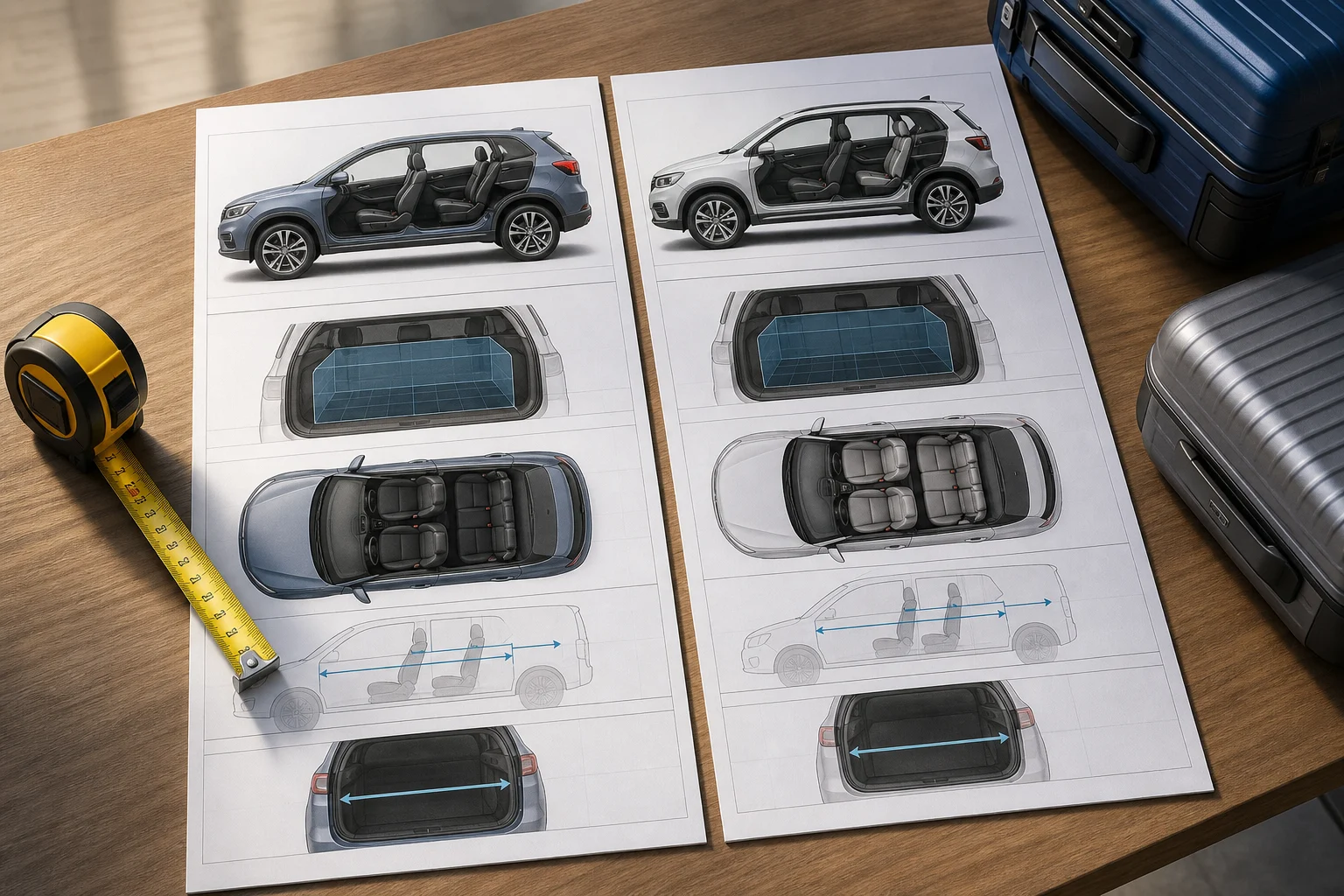
What litres show and when the VDA reference is useful
The volume figure summarises a three-dimensional space, but does not in itself describe its floor plan, narrow sections or access. It should therefore be read together with the designation that accompanies it in the official documentation. Manufacturers may identify the value with references such as VDA; for example, Peugeot states “556 dm³ VDA 210” for the 308 SW. That label is part of the figure and should be retained in the comparison.
There is no universally sufficient capacity for a family. Someone carrying a bulky pushchair needs to check the floor area, access and available height above all; someone travelling with hard-shell suitcases may place more importance on width and length. Litres help rule out options, but dimensions and a test using your own load resolve the buying question.
Section references: Nuevo Peugeot 308 SW: un break tan atractivo como espacioso ↗
- Write down the VDA reference exactly if it appears in the specification.
- Do not assume that two similar figures represent a similarly shaped boot.
- If the specification does not explain the configuration, ask the dealer to clarify it before using the figure to decide.

Five seats, seven seats and folded seats: always compare the same scenario
The linked Golf R Estate technical document separates the volume with the rear bench up from the volume with the rear bench folded. Both figures address different needs: the first represents use with the rear seats available, while the second represents carrying long or bulky items at the cost of those seats.
In seven-seat SUVs, the distinction is even more important. The linked Peugeot 5008 release distinguishes between the volume in a five-seat configuration and the figure with the second and third rows folded. Neither figure, by itself, describes the boot when seven people are travelling. If all seats are needed frequently, that is the scenario you should request, inspect and compare.
The common mistake is to compare the maximum volume of one car with the normal-use volume of another. To avoid this, create one row for each scenario: seats that need to be available every day, seats required for holidays and seats needed when carrying a long item. This distinguishes everyday family space from occasional capacity.
| Item to compare | Car A | Car B | What to check |
|---|---|---|---|
| Volume with usual seats available | Note the figure and reference | Note the figure and reference | Same seat configuration and same volume description |
| Volume with seats folded | Note the figure and folded rows | Note the figure and folded rows | How many seats are lost to achieve it |
| Load length | Note with rear bench up and folded | Note with rear bench up and folded | Whether your longest item fits |
| Width between wheel arches | Note in millimetres | Note in millimetres | Whether a pushchair, suitcases or boxes fit between the narrow sections |
| Loading opening and lip | Check in person | Check in person | Access, height to lift over and manoeuvring with your items |
| Payload of the version | Check the specification for the actual vehicle | Check the specification for the actual vehicle | Do not infer it from boot volume |
Section references: Nuevo Peugeot 5008: el espacio SUV entra en una nueva dimensión ↗ · Technical data / dimensions — Golf R Estate ↗
- Everyday use: compare both cars with all seats that are normally occupied.
- Family trip: check the seat arrangement intended for the actual passengers.
- Long load: note which row or rows must be folded and how many seats are lost.
- Seven seats: do not use a volume declared for five seats as though it applied when travelling with seven occupants.
The geometry that litres do not show
As well as volume, look for the dimensions of the load area. The linked Golf R Estate technical specification lists the length with the rear bench up or folded and the width between the wheel arches as separate fields. It is a good example of why the litre figure should be accompanied by linear measurements: an item may theoretically have enough volume to “fit” but may not pass through a narrow point in the boot.
Width between the wheel arches is especially relevant for rigid bases, such as a pushchair, a box or a large suitcase. Length with the rear seats available helps assess everyday loads; length with the rear bench folded helps anticipate occasional transport of long items. If the manufacturer provides these dimensions, compare them in millimetres rather than by visual impression.
A physical check completes the specification. Open the tailgate and observe the width and height of the opening, the height of the loading lip, the depth to the seatbacks, the wheel arches, and the available height to the parcel shelf or roof. Take a measuring tape and, if that item determines the purchase, the folded pushchair or a representative suitcase. Do not force the seatbacks, parcel shelf or mechanisms: follow the instructions in the vehicle handbook.
Section references: Technical data / dimensions — Golf R Estate ↗
- Measure the item that determines your choice in length, width and height before visiting the dealer.
- First check whether it passes through the loading opening; then whether it can be positioned between the wheel arches.
- Test the position you will actually use, with the required seats upright.
- Follow the vehicle handbook's instructions when placing luggage and closing the tailgate.
Volume does not mean weight: check payload and maximum mass
Having plenty of space does not mean you can load any weight. Commission Implementing Regulation (EU) 2021/535 defines payload as the difference between the technically permissible maximum laden mass and the sum of the mass in running order, passengers and optional equipment. In other words, available space and permissible weight are two different checks.
The specific version matters. The regulation distinguishes the actual mass of the vehicle as the mass in running order plus that of the optional equipment fitted. You should therefore not work out payload from the model name alone or from a catalogue version: check the figure for the chosen vehicle and account for occupants, luggage and options.
When the technically permissible maximum laden mass is reached, axle masses must also be respected. Distribution matters: the regulation covers both payload distributed uniformly in the load area and cargo positioned according to the manufacturer's instructions. In Spain, the DGT recommends placing loads preferably in the boot and not exceeding the Maximum Authorised Mass. If using a roof rack, the DGT states that the load must be prepared, protected and securely fastened, and warns of its possible effect on stability.
Section references: Transporte de cargas y animales en turismos ↗ · Reglamento de Ejecución (UE) 2021/535 — texto en español ↗
- Check the payload of the version and equipment you have actually chosen.
- Add passengers, luggage and accessories before assuming the weight is within the limit.
- Respect the Maximum Authorised Mass and axle-mass limits.
- Position loads according to the manufacturer's instructions; if using a roof rack, secure them properly.
Dealer checklist for deciding without surprises
A well-prepared visit turns an abstract comparison into a concrete decision. Ask to see both versions in the seat configuration you need, and keep their technical specifications to hand. If the volume figure does not clarify the method, folded rows or version, request that information before comparing.
Bring the items that most affect your use, provided that the dealer allows the test: for example, the folded pushchair, a hard-shell suitcase or a box of the usual dimensions. The test should involve placing them without forcing any parts and following the vehicle handbook's instructions for using the tailgate and loading the car. Record the result for both cars on the same day and with the same item.
Finally, complete the comparison with two separate decisions: which one best addresses the volume and geometry of your routine, and which retains enough payload margin for passengers, luggage and equipment. Choosing this way avoids confusing a large catalogue boot with one that is suitable for real family use.
Section references: Transporte de cargas y animales en turismos ↗ · Reglamento de Ejecución (UE) 2021/535 — texto en español ↗ · Technical data / dimensions — Golf R Estate ↗
- Take the official specification or link for each exact version.
- Confirm the volume, declared reference and seat configuration.
- Measure the opening, loading lip, depth, available height and width between wheel arches where possible.
- Test the item that determines the purchase, following the vehicle handbook's instructions.
- Check payload, maximum mass and limits applying to the specific version.
- Choose according to your usual scenario, not only the maximum capacity with seats folded.
Is a boot with more litres better?
Not necessarily. Litres are an initial indicator, but they must be compared using the same seat configuration and measurement reference. Load length, width between the wheel arches, the opening and the shape can all change real-world usefulness.
Can I compare maximum volume with the seats folded?
Only if both cars are compared with the same rows folded. Maximum volume means losing seats: Volkswagen, for example, differentiates the Golf R Estate's volume with the rear bench up and folded, while Peugeot publishes different figures for the 5008 depending on row configuration.
Which measurement is especially important for a pushchair?
As well as volume, check the width between the wheel arches, the loading opening and the depth with the necessary seats upright. The practical way to confirm it is to take the folded pushchair to the dealer, if the test is permitted.
Does a large boot let me carry more weight?
Not on its own. Payload depends on the technically permissible maximum laden mass, the vehicle's mass, passengers and optional equipment. Axle-mass limits and the manufacturer's instructions for distributing the load must also be respected.