Is a Child Car Seat Compatible With Your Car? ISOFIX, i-Size and Manual
A guide to checking whether a child car seat can be installed in a specific position: vehicle manual, approval, ISOFIX, i-Size, seat belt, top tether, support leg and Spanish regulations.
Key points
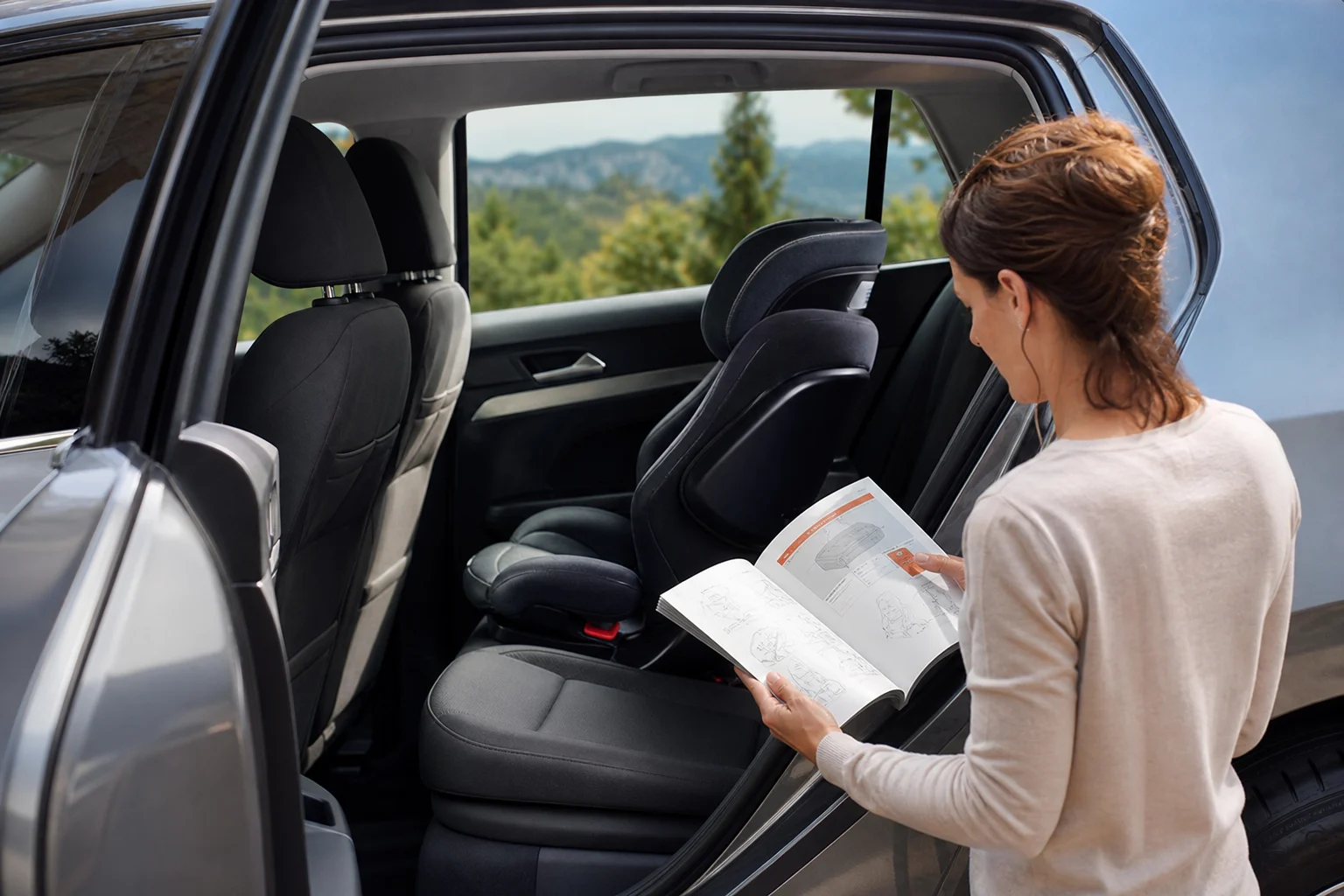
Having ISOFIX anchorages is not enough to confirm that a child car seat is compatible. Always check the specific seat position in the vehicle manual and the approved type of use in the car seat instructions or the manufacturer’s current vehicle list.
The quick answer: check the car seat and the seat position, not just ISOFIX
To find out whether a child car seat is compatible with your car, do not stop at checking that the vehicle has ISOFIX anchorages. You need to compare two documents: the vehicle manual, which states the suitability of each seat position for different child restraint systems (CRS), and the car seat instructions or, where applicable, its current list of approved vehicles.
The check must be carried out seat position by seat position. In the same car, the outer rear seats, the centre rear seat and the front passenger seat may have different conditions. A car seat suitable for an outer rear seat is not necessarily suitable for the centre seat or the front.
Before comparing, gather the car’s exact identification — model, generation, year and version —, the intended seat position and the CRS documentation. Also note the child’s height and weight: the DGT recommends choosing the system based on height and weight, not age alone. With these details, you can verify the specific solution instead of buying based on an ISOFIX label or a general recommendation.
Section references: Reglamento General de Circulación consolidado — artículos 117 y 119 ↗ · Con niños ↗ · Reglamento de Ejecución (UE) 2018/629 — información de compatibilidad en el manual del vehículo ↗
- The correct vehicle manual: look for the CRS and ISOFIX position tables or guidance.
- The car seat’s complete instructions: these must explain how and in which types of vehicles it can be used safely.
- The car seat manufacturer’s updated vehicle list, if the seat has vehicle-specific or semi-universal approval.
- The exact seat position you will use, plus the child’s current height and weight.
ISOFIX, i-Size, seat belt, top tether and support leg: what each means
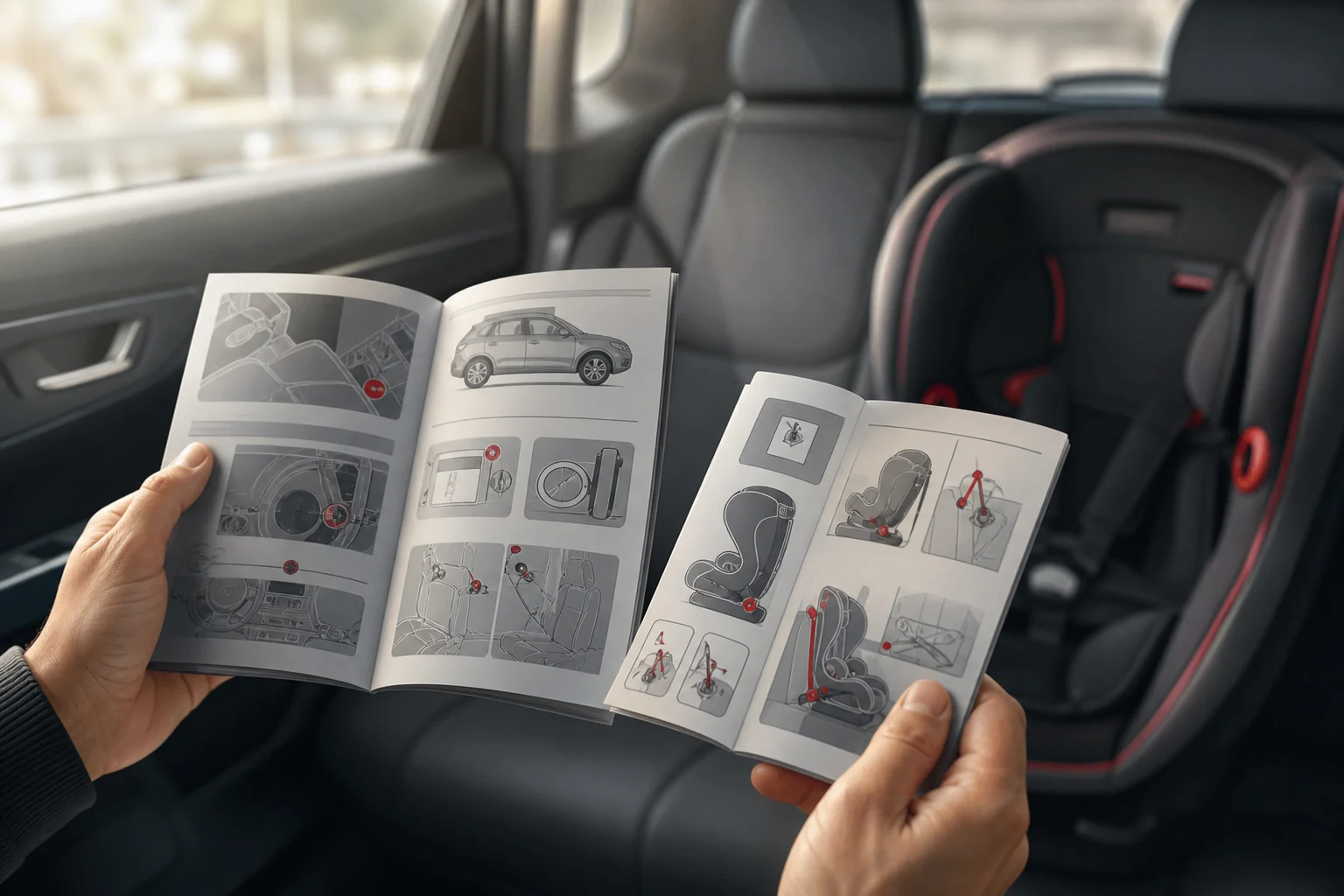
ISOFIX describes a system for anchoring the car seat to the vehicle; it is not an automatic statement that any ISOFIX seat is suitable for every seat with these anchorages. The vehicle compatibility information refers to specific seating positions, including the specified ISOFIX positions.
i-Size is a universal ISOFIX system, but its universal status applies to vehicle seating positions identified as i-Size suitable. If the position has ISOFIX but is not identified as i-Size suitable, the vehicle manufacturer’s information is necessary before using an i-Size seat there.
Vehicle-specific or semi-universal approved seats require an additional check: consult the car seat manufacturer’s current list. This list determines which specific ISOFIX positions are suitable. By contrast, a seat installed with the vehicle seat belt must be used according to its instructions and those of the car manufacturer; the conclusion reached for an ISOFIX seat must not automatically be applied to it.
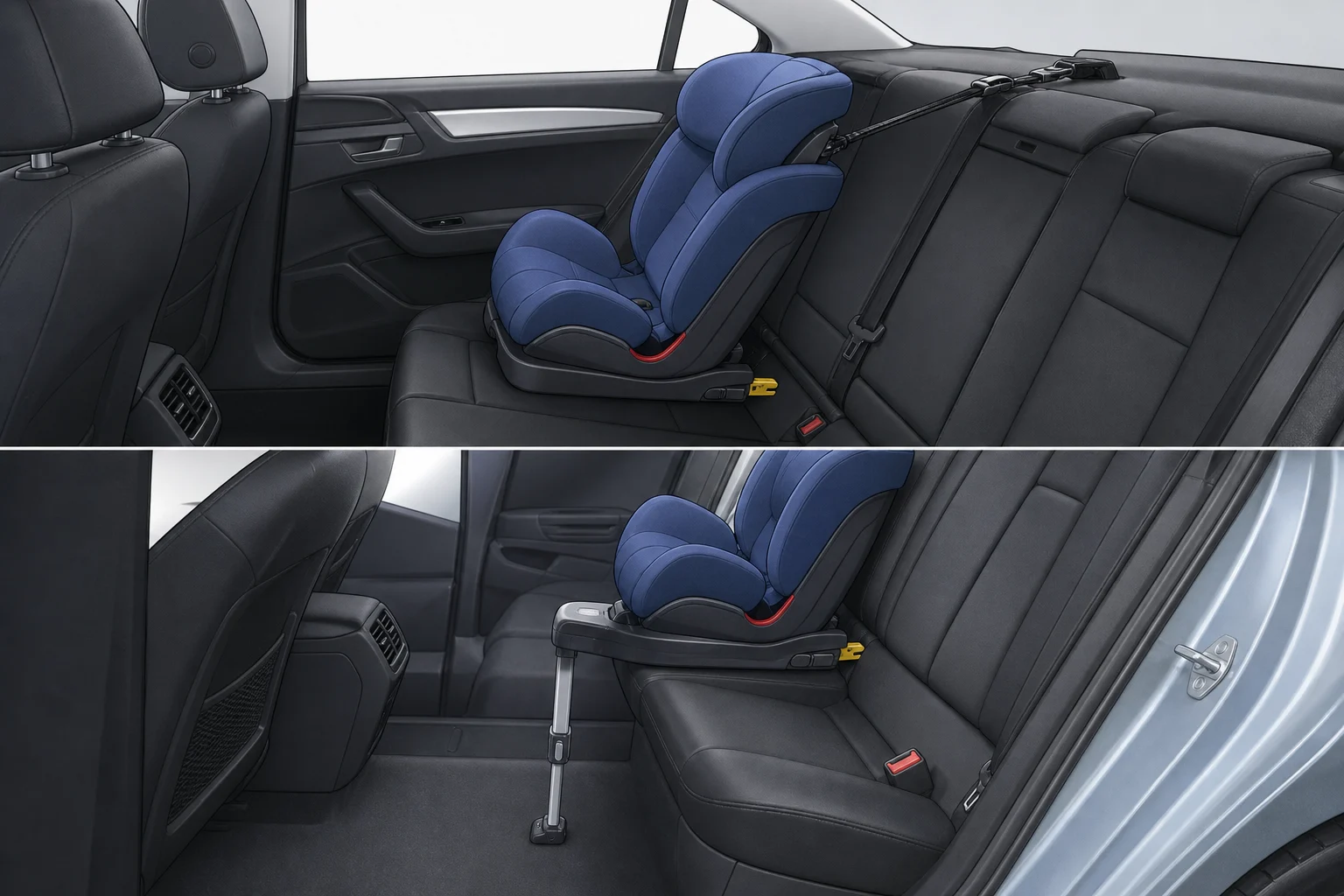
Top tether and support leg are not the same component either. In i-Size systems, one or the other may act as the third anchorage point. If the car seat uses a support leg, you must check, following the car seat instructions, that the leg rests on the vehicle floor. This makes it essential to inspect the selected seat and its floor in accordance with both manuals.
Section references: Reglamento ONU n.º 129: folleto oficial sobre sistemas de retención infantil ↗ · Reglamento de Ejecución (UE) 2018/629 — información de compatibilidad en el manual del vehículo ↗ · Reglamento ONU n.º 129, revisión aplicable a instrucciones de uso ↗ · Reglamento ONU n.º 44, disposiciones de instrucciones para SRI ISOFIX ↗
- ISOFIX: anchorages whose presence requires checking the suitability of both the seat position and the car seat.
- i-Size: universal use limited to positions declared suitable for i-Size.
- Seat belt: a different installation system, subject to the car seat and vehicle instructions.
- Top tether or support leg: possible third anchorage points; users cannot substitute one for the other.
How to read the vehicle manual without missing a restriction
Find the section on child safety, CRS, ISOFIX or i-Size. The aim is to locate the suitability information for every passenger position, not just the diagram showing where the anchorages are. Type-approval rules require manufacturers to provide information on each seating position’s suitability for universal, i-Size or other systems.
Start with the rear seat position that will normally be used. Check whether it is declared suitable for i-Size, for a particular ISOFIX system, for other CRS or for seat-belt installation. Then review the car seat instructions with that same position as the reference. If the CRS is vehicle-specific or semi-universal, also confirm that the car and seat position appear on the car seat manufacturer’s current list.
Do not overlook information about the front passenger seat. If, exceptionally, a child must travel in the front in a rear-facing car seat, the front airbag must be deactivated. The DGT also advises against placing the seat in that position if there is an airbag, unless it can be switched off. The presence of an anchorage or physical space does not remove this condition.
The most common mistake is to settle the question using only one source: only the vehicle manual, only the car seat’s sales sheet or only a visual inspection. A reliable answer requires the vehicle and CRS information not to contradict each other.
Section references: Reglamento General de Circulación consolidado — artículos 117 y 119 ↗ · Con niños ↗ · Reglamento de Ejecución (UE) 2018/629 — información de compatibilidad en el manual del vehículo ↗
- Look for the table by seating position, not just the ISOFIX symbol.
- Distinguish suitability for i-Size from suitability for a specific ISOFIX seat.
- If you consult a car seat vehicle list, make sure it is the current version.
- For a rear-facing child seat installed on the front passenger seat, the front airbag must be deactivated.
Checks by installation system
This table helps organise the checks before buying. It does not replace the instructions: the valid outcome is the one that applies to the specific seat position, the exact vehicle and the CRS you will use.
If the manual is missing or there is no clear indication, do not turn an assumption into an installation. Obtain the correct vehicle manual and the car seat’s current documentation before making a purchase decision.
| CRS type | What to confirm in the car | What to confirm for the car seat | Mistake to avoid |
|---|---|---|---|
| i-Size / universal ISOFIX | That the position is identified as i-Size suitable; if it is not, consult the vehicle manufacturer’s information. | The installation instructions and use of the intended third anchorage point. | Assuming that every ISOFIX position is suitable simply because it has anchorages. |
| Vehicle-specific or semi-universal ISOFIX | The specific intended ISOFIX position. | The manufacturer’s current vehicle list, which must state compatible ISOFIX positions. | Consulting an old list or confirming only the model, without the position, generation or year. |
| Seat-belt installation | The vehicle manual guidance for that position and CRS use. | The car seat instructions for seat-belt installation. | Applying to this seat the compatibility confirmed for an ISOFIX one. |
Section references: Reglamento ONU n.º 129: folleto oficial sobre sistemas de retención infantil ↗ · Reglamento de Ejecución (UE) 2018/629 — información de compatibilidad en el manual del vehículo ↗ · Reglamento ONU n.º 44, disposiciones de instrucciones para SRI ISOFIX ↗
Consider space, access and everyday use separately from compatibility
Documentary compatibility is the starting point. Space, access and everyday use are practical considerations; they do not confirm compatibility or replace the manuals.
You may consider access to the intended seat position, use of the front seat and the overall arrangement if other occupants or car seats will travel in the vehicle. These considerations concern the family’s day-to-day needs, rather than the approved compatibility of the CRS with the selected position.
These practical considerations do not replace checking the vehicle manual, the car seat instructions and, where applicable, the current vehicle list. If you change the seat position, car seat or vehicle, verify the specified seat position again in the relevant documentation.
A sensible sequence is: identify the car, seat position and child; read the vehicle manual; review the car seat instructions or vehicle list; and then consider access and space separately from compatibility verification.
Section references: Reglamento General de Circulación consolidado — artículos 117 y 119 ↗ · Reglamento ONU n.º 129: folleto oficial sobre sistemas de retención infantil ↗ · Reglamento de Ejecución (UE) 2018/629 — información de compatibilidad en el manual del vehículo ↗
- Take the car seat you intend to buy or use, along with its instructions.
- Consider access to the seat position the child will normally use.
- Consider the complete arrangement if other children or occupants will travel in the rear seats.
- Do not treat a space check as compatibility certification.
- Verify the documentation again if you change the seat position, car seat or vehicle.
Used cars and Spanish regulations: the final two filters
When buying a used car, request the correct manual before completing the purchase and physically check the vehicle components involved in installation. The inspection must focus on the seat position you will use and on the anchorages or points intended by the manufacturer. Their apparent presence in a visual check is not a statement that they are suitable for a particular car seat: suitability still depends on the vehicle and CRS documentation.
In Spain, in passenger cars and vehicles with up to nine seats, children 135 cm tall or shorter must use an approved CRS suited to their height and weight. As a rule, they must travel in the rear seats. The rules provide three situations in which they may travel in front: where the vehicle has no rear seats, where those seats are occupied by children, or where it is not possible to install all the CRS in them. When a rear-facing car seat is used in the front, the front airbag must be deactivated.
The regulations applicable on 7 September 2026 include an exception for taxis in urban traffic or urban areas of large cities: a person under 135 cm may travel without an appropriately adapted CRS when occupying a rear seat. This is a transport exception, not a criterion for choosing or fitting a car seat in the family car. In addition, Royal Decree 518/2026, published on 26 June 2026, enters into force on 1 October 2026; it is advisable to check the rules in force if the query is made after that date.
Section references: Reglamento General de Circulación consolidado — artículos 117 y 119 ↗ · Real Decreto 518/2026 — fecha de entrada en vigor ↗ · Reglamento de Ejecución (UE) 2018/629 — información de compatibilidad en el manual del vehículo ↗
- Request and keep the used car’s manual.
- Check the installation components in the selected position, without treating this as a substitute for the documentary check.
- Apply the rear-seat rule for children up to 135 cm, except in the legal situations.
- Check the rules in force if making your decision from 1 October 2026 onward.
If my car has ISOFIX, can I use any ISOFIX car seat?
Not necessarily. You must check the suitability of the specific seat position in the vehicle manual and follow the car seat instructions. If it is vehicle-specific or semi-universal, also consult the manufacturer’s current list.
Can an i-Size car seat be used in any ISOFIX position?
No. An i-Size car seat is universal for positions declared suitable for i-Size. If a position has ISOFIX but is not identified as i-Size suitable, information from the vehicle manufacturer is required.
What should I check in a used car before fitting a child car seat?
Request the correct manual and physically check the components of the position involved in fitting. Then compare that position with the car seat instructions or its approved vehicle list; a visual inspection does not certify compatibility.
Up to what height must a child use a child restraint system in Spain?
In passenger cars and vehicles with up to nine seats, children 135 cm tall or shorter must use an approved CRS suited to their height and weight. As a rule, they must travel in the rear seats.