Charging an electric motorcycle: plugs, power and times before you buy
What to compare between the motorcycle, the plug or charge point and the cable to know whether charging fits your routine, without confusing a station’s advertised power with what the vehicle can accept.
Key points
Before buying an electric motorcycle, confirm the charging power, connector and included cables in the documentation for the exact version. Also check your usual installation and the operator data for the public charge points you expect to use.
The quick answer: the charger’s power is not your motorcycle’s power
To charge an electric motorcycle without surprises, you need to compare three limits: the energy the battery needs to recover, the charging power accepted by the vehicle and its equipment, and the power supplied by the available point. The connector, cable and charging mode must also be compatible. A public charger with a high stated figure will not make a motorcycle charge at that figure if the vehicle or its equipment has a lower limit.
The BMW CE 04 illustrates this difference well: it states 2.3 kW with the integrated charger and 6.9 kW with the optional fast charger. Therefore, two apparently identical units can have different charging capability depending on their equipment. Nor is it enough to have a socket nearby: you need to confirm that the vehicle connector, cable and charging mode are compatible.
The useful question before signing the purchase is not “are there chargers in my area?”, but “can I charge this specific version, with the cable I will receive, at home, at work and at the points I will actually use?”. Start with the technical specification, but also ask for the owner’s manual for the exact version and year.
Section references: BMW CE 04: datos técnicos para España ↗ · BMW CE 04: autonomía y carga para España ↗
- Check the maximum alternating-current (AC) charging power and whether the model documentation covers direct-current (DC) charging.
- Distinguish between the integrated charger and any optional fast charger.
- Identify the connector on the motorcycle and the included cables or adapters.
- Do not assume that a point designed for cars is compatible merely because it has high advertised power.
The specification and manual details that determine charging
Note the battery capacity in kWh, but read carefully what it represents. When a manufacturer publishes gross and net or usable capacity, do not treat them as equivalent. For the CE 04, for example, 8.9 kWh gross and 8.5 kWh net are stated. For a practical estimate, the energy that will actually need replenishing matters most, rather than an isolated catalogue figure.
Then look for the maximum charging power and current type. Motor power does not answer this question. It is also worth checking whether the stated figure requires an extra, a specific charger or a particular cable. The vehicle connector and delivery contents are often listed separately: in BMW’s example, there is a Type 2 connector on the vehicle and a cable with a country-specific plug.
The manual fills in what a commercial specification does not always explain. The Silence S01 MY25 manual, for example, specifies the charger type, the internal charger’s maximum current and a standard charging time. It also warns that the battery will not charge below 0 °C or above 50 °C. This is a concrete reason not to turn an indicative number of hours into an unchanging promise.
The CE 04 and S01 MY25 details are documented examples, not specifications that apply to every electric motorcycle. Connector, AC or DC, cables, fast-charging options, thermal limits and times must be confirmed for the specific model, version, year and market.
Section references: BMW CE 04: datos técnicos para España ↗ · Manual de usuario S01 Connected MY25 ↗ · Manual de usuario S01 MY25, versión 1.0 ↗
- Nominal capacity and, if published, usable or net capacity.
- Maximum AC charging power and whether the model documentation covers DC charging.
- Integrated charger: power, maximum current and whether options are available.
- Connector on the motorcycle, included cable, Mode 3 cable and permitted adapters according to the model documentation.
- Temperature range and other charging conditions stated in the manual.
Domestic socket, wall unit and public charge point: they are not the same
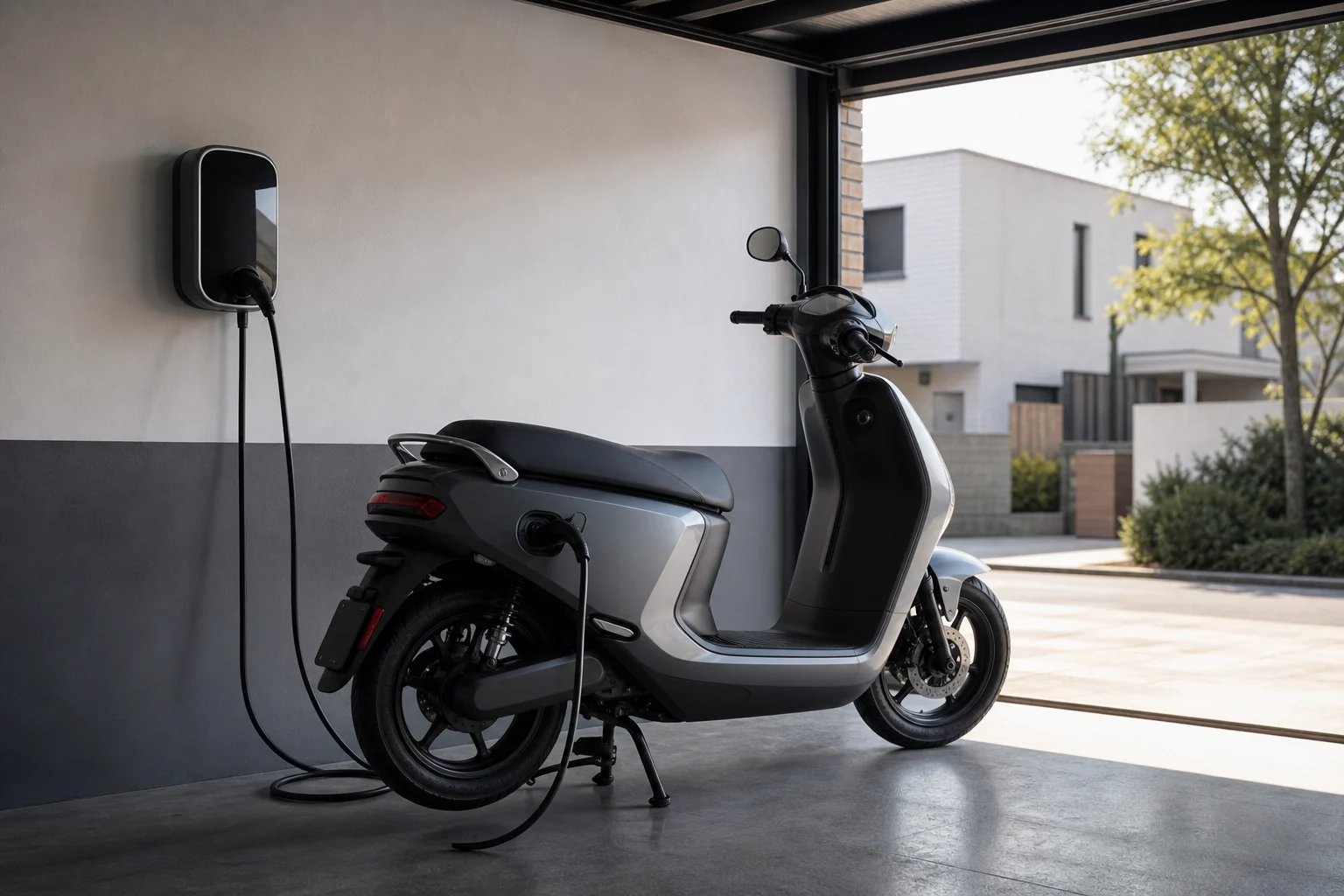
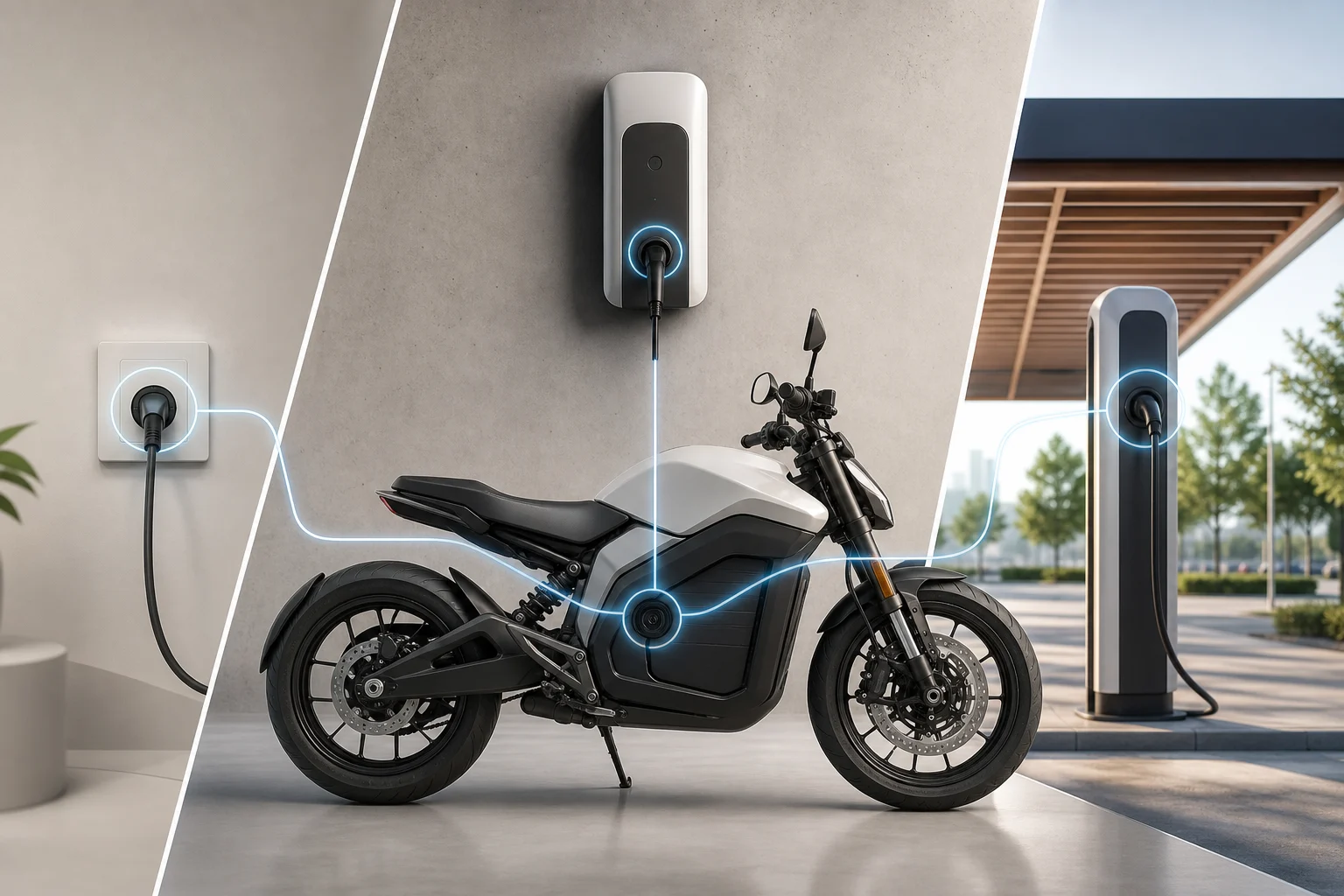
A conventional socket, a wallbox and a public charge point are not the same. They may work for the same model, but they do not imply the same cable, power or user experience. BMW documents a standard Schuko socket, a wallbox and public charging through an available Mode 3 cable for the CE 04.
For an electric-vehicle charging installation in an existing single-family home, the specific configuration must comply with ITC-BT-52. In new single-family homes with parking, the instruction provides for an exclusive charging circuit. Before choosing between a conventional socket and a wall-mounted unit, it is advisable to review the existing installation and check that the outlets, connectors and protections match the options envisaged by the regulation.
In a shared garage, review the current rules and the installation conditions before planning a point in an individual parking space. It can be useful to clarify from the outset how the point will be supplied and how consumption will be measured.
Section references: ITC-BT-52 sobre infraestructura de recarga ↗ · BMW CE 04: autonomía y carga para España ↗
- Review the planned charging installation before choosing between a conventional socket and a wall-mounted unit.
- Confirm with the motorcycle manufacturer the authorised conditions and cable for each solution.
- If you have questions about the planned installation, consult a professional.
- In a shared property, it can be useful to document costs, cable routing and consumption measurement.
- Check the motorcycle and charging-system documentation to see whether adapters are permitted.
How to estimate charging time: a useful range, not a promise
Charging time should be treated as guidance from the model manual, not as a universal promise. The energy left to replenish, the charging power accepted by the motorcycle and the available point all affect the result.
To estimate whether charging fits your routine, compare the standard time stated in the manual with the place and time you will actually have to leave the motorcycle connected. The CE 04 warns that the result at a public point depends on the particular point, and the S01 manual shows that battery temperature can even prevent charging from starting.
Work with an operating range. Before basing a workday or a journey on it, check the applicable requirements in the manual and the point’s status with the operator. If available time is tight, plan regular charging somewhere you can leave the motorcycle for the necessary time, rather than only where an attractive maximum power figure is displayed.
Section references: BMW CE 04: autonomía y carga para España ↗ · Manual de usuario S01 MY25, versión 1.0 ↗
- 1. Check the standard charging time stated in the manual for the exact version.
- 2. Check the stated charging conditions and temperature limits.
- 3. Confirm the point’s status if you will use public infrastructure.
- 4. Avoid relying on a single point for a critical need.
Public charge points: check in advance and have a backup plan
A public charge point should be checked before setting off, not when you arrive with a low battery. The European AFIR Regulation requires static data to be provided, such as connector type, current type—AC or DC—maximum available power and vehicle-type compatibility. This is exactly the information you should compare with the motorcycle documentation.
Also review data that can change: operating status, availability, opening hours and price per charging session. A location on a map does not confirm that the point is accessible, free or ready for your vehicle. For category L vehicles of up to 3.7 kW AC, AFIR provides for options such as Type 3A or sockets compliant with IEC 60884-1 for Modes 1 or 2; this reinforces that there is no automatic compatibility between every motorcycle and any infrastructure intended for cars.
Before an interurban journey, identify a reasonable alternative and do not make a single public charge the only condition for being able to continue. If the operator does not clearly specify connector, current, power and compatibility, consider the point unverified until you obtain confirmation.
| Scenario | What to confirm before buying | Failure it avoids |
|---|---|---|
| Existing single-family home | Compliance of the charging installation with ITC-BT-52, charging solution permitted by the motorcycle, cable and available power. | Choosing a charging solution other than one permitted by the manufacturer or envisaged for the installation. |
| Work | As a practical check, opening hours, connector, required cable and actual availability during your working day. | Relying on charging that is not available when needed. |
| Interurban journeys | Connector, AC or DC, power, motorcycle compatibility, status and alternative. | Arriving at a point that is inaccessible, occupied, out of service or incompatible. |
Section references: Reglamento (UE) 2023/1804 (AFIR), texto consolidado ↗
- Check in advance the connector, AC or DC, maximum available power, and vehicle compatibility.
- Check operating status, availability, opening hours and price.
- Confirm which cable you need to bring and that the model supports that connection.
- Plan a second compatible point or a charging alternative before starting your route.
- On arrival, check that the connector and accessories match the manufacturer’s documentation.
Final checklist before buying
Ask for documents, not just a sales explanation. Gather the technical specification and owner’s manual for the motorcycle you will receive; check that version, market and equipment match. The difference between standard charging and an option can completely change whether the purchase suits your routine.
Simulate three situations: arriving home, a workday and an outing that requires public infrastructure. For each one, note where you connect, which cable you use, what power the motorcycle can accept and how long it can remain parked. If one of these answers depends on an unconfirmed assumption, resolve it before deciding.
As a buyer’s planning criterion, prioritise a compatible, documented regular location for everyday trips. Public points can expand the possibilities, but require more variables to be checked. See our Motorcycles section and Energy and electrification content to keep comparing options.
Section references: Reglamento (UE) 2023/1804 (AFIR), texto consolidado ↗ · ITC-BT-52 sobre infraestructura de recarga ↗ · BMW CE 04: datos técnicos para España ↗ · Manual de usuario S01 Connected MY25 ↗
- Technical specification for the exact version: battery, charging power, AC/DC if covered by the model documentation, and connector.
- Owner’s manual: internal charger, maximum current, indicative times and charging conditions.
- List of included or optional cables, adapters and equipment.
- Contractual documentation applicable to the purchase.
- Check of the home installation or shared garage.
- Validation of at least one compatible public point and an alternative if you plan to travel.
Can I charge an electric motorcycle from any domestic socket?
You should not assume so. The manufacturer may permit charging from a conventional socket, but you need to confirm that the socket, cable and manual conditions are compatible. If an electric-vehicle charging solution is installed, its specific configuration must comply with ITC-BT-52.
Will a more powerful public charger charge my electric motorcycle faster?
Only if the motorcycle, its integrated charger or the installed equipment can accept that power and the connector is compatible. Check the documented limits of the motorcycle, its charging equipment and the specific point.
How do I calculate how long an electric motorcycle will take to charge?
Check the standard charging time in the manual for the exact version and use it as guidance. Compare it with the point and manual conditions, because the result can vary and charging may not even start outside certain temperature limits.
Do I need permission from the community of owners to install a point in my parking space?
In a shared garage governed by the horizontal property regime, installing a private charge point in an individual parking space only requires prior notice to the community of owners. The installation and consumption are entirely paid for by the directly interested parties.
What should I check in a public charging operator’s information?
Connector type, AC or DC, maximum power and vehicle compatibility, as well as operating status, availability, opening hours and price. It is also advisable to identify a compatible alternative.