Campervan auxiliary battery: calculate off-grid runtime
Ah alone are not enough to know how many days you can stay without plugging in. Learn to calculate usable Wh, daily consumption and the effect of charging in a campervan.
Key points
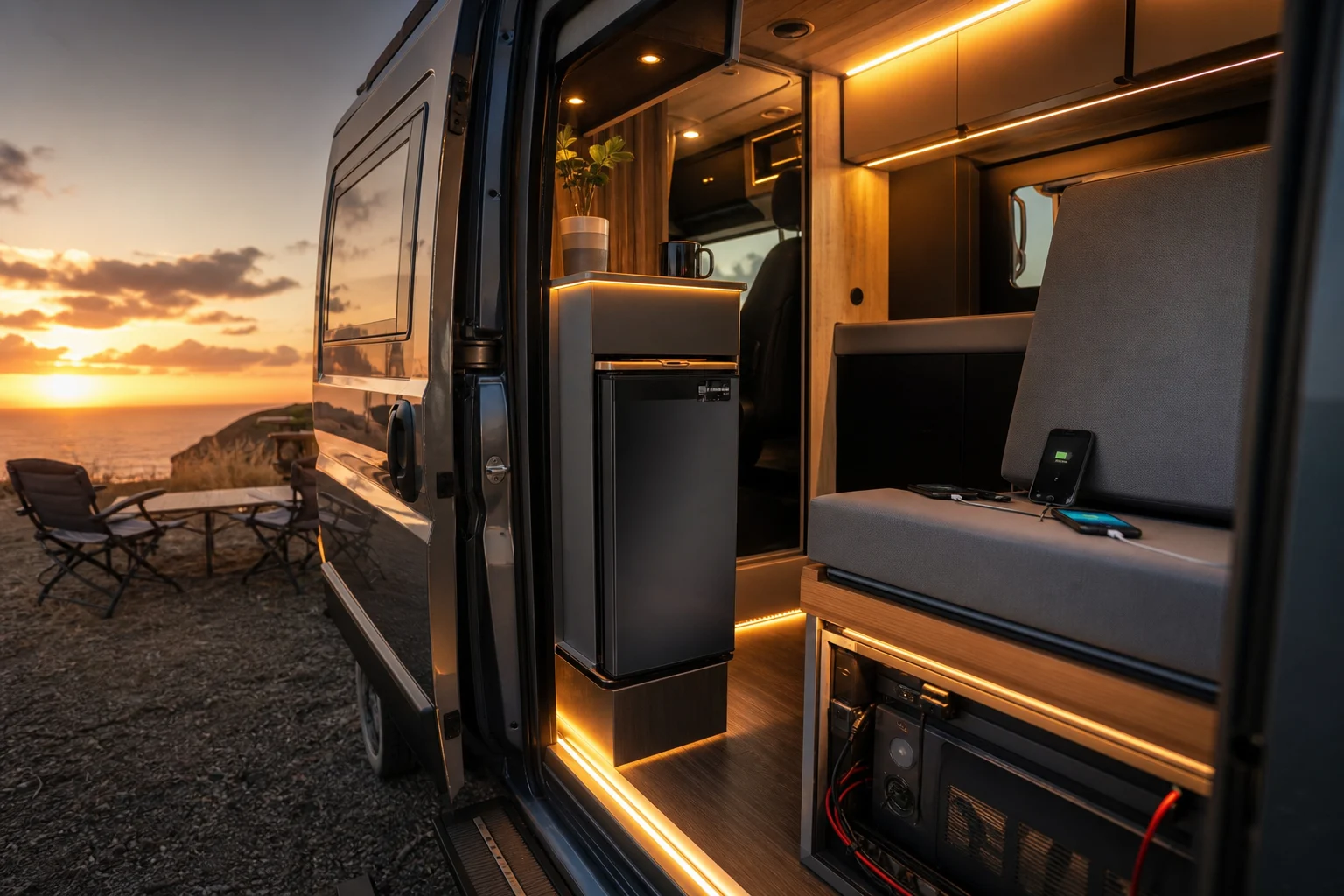
To calculate a campervan auxiliary battery’s range, convert its capacity into Wh and divide the planning energy—confirmed in the specific manual—by a realistic daily consumption budget. Then compare the result with the charging available while travelling, from mains power and solar.
The quick answer: calculate planning Wh and divide them by your daily consumption
A campervan’s electric range cannot be worked out by looking only at the amp-hours (Ah) printed on the battery. A useful calculation brings together four figures: nominal energy in watt-hours (Wh), a share of energy chosen for planning and confirmed in the battery or installation documentation, expected daily consumption, and the energy that can be recovered while driving, plugged into mains power or using solar panels.
The calculation sequence is straightforward: first, nominal energy = nominal voltage (V) × capacity (Ah). Second, planning energy = nominal energy × the share you have chosen to use after confirming the battery or installation documentation. Third, daily consumption = the sum of each device’s power (W) × its actual operating hours. Finally, theoretical range in days = planning Wh ÷ daily Wh.
This is an estimate for comparing installations and planning habits, not a promise of a certain number of days of range. For specific equipment, published temperature effects and appliance test conditions can change the result. Before buying or renting, ask for the specifications of the battery, chargers and major loads in the specific installation.
Section references: Victron Lithium Smart Battery Manual — datos de capacidad, energía, descarga y ciclos ↗
- Do not directly compare batteries with the same Ah if they operate at different voltages.
- Use Wh to add consumption and capacity; use Ah for battery capacity and A when the device manual only provides current at a known voltage.
- Separate range without charging from range with driving, external mains power or solar support.
- Also check the permitted continuous discharge current: having enough Wh does not guarantee that the battery can supply every simultaneous load.
The information you need before doing the maths
Start by identifying the battery chemistry, nominal voltage, nominal capacity, nominal energy and published operating limits. To illustrate why voltage matters, the same lithium battery family states 100 Ah and 1,280 Wh at 12.8 V, while at 25.6 V it also states 100 Ah but 2,560 Wh. Identical Ah ratings at different nominal voltages can correspond to different nominal Wh values; Wh make it possible to budget the system.
Note the depth of discharge you want to use for planning and check whether the specific manual publishes applicable guidance. Depth of discharge also affects cycle life: in the documentation reviewed for one lithium battery, 2,500 cycles are associated with 80% discharge, 3,000 with 70% and 5,000 with 50%, always under the conditions specified by that manufacturer.
Include continuous-current limits, both for the battery and intermediate equipment. If there is an inverter or DC-DC chargers, their stated values are part of the installation’s compatibility. A battery may have enough energy for one night but not deliver the current demanded by a combination of high-power appliances.
| Information | What it is for | Where to check it |
|---|---|---|
| Nominal voltage and Ah | Convert capacity into Wh | Battery specification |
| Planning depth of discharge | Calculate the Wh used in the estimate | Battery or installation manual |
| Power or current of each appliance | Create the consumption budget | Device manual or label |
| Permitted continuous current | Avoid exceeding delivery limits | Battery and inverter specifications |
| Charging capacity and settings | Estimate recovered energy | Charger and solar controller manual |
Section references: Victron Lithium Smart Battery Manual — datos de capacidad, energía, descarga y ciclos ↗ · Victron Lithium NG Battery Manual — efecto de temperatura y profundidad de descarga ↗
- Battery specification: chemistry, nominal V, Ah, Wh, maximum current and recommended continuous current.
- Manual or configuration: published guidance on applicable depth of discharge and protection thresholds.
- List of loads: voltage, power or current, and expected hours of use.
- Installed charging: DC-DC charger model, 230 V charger, solar controller and nominal panel output.
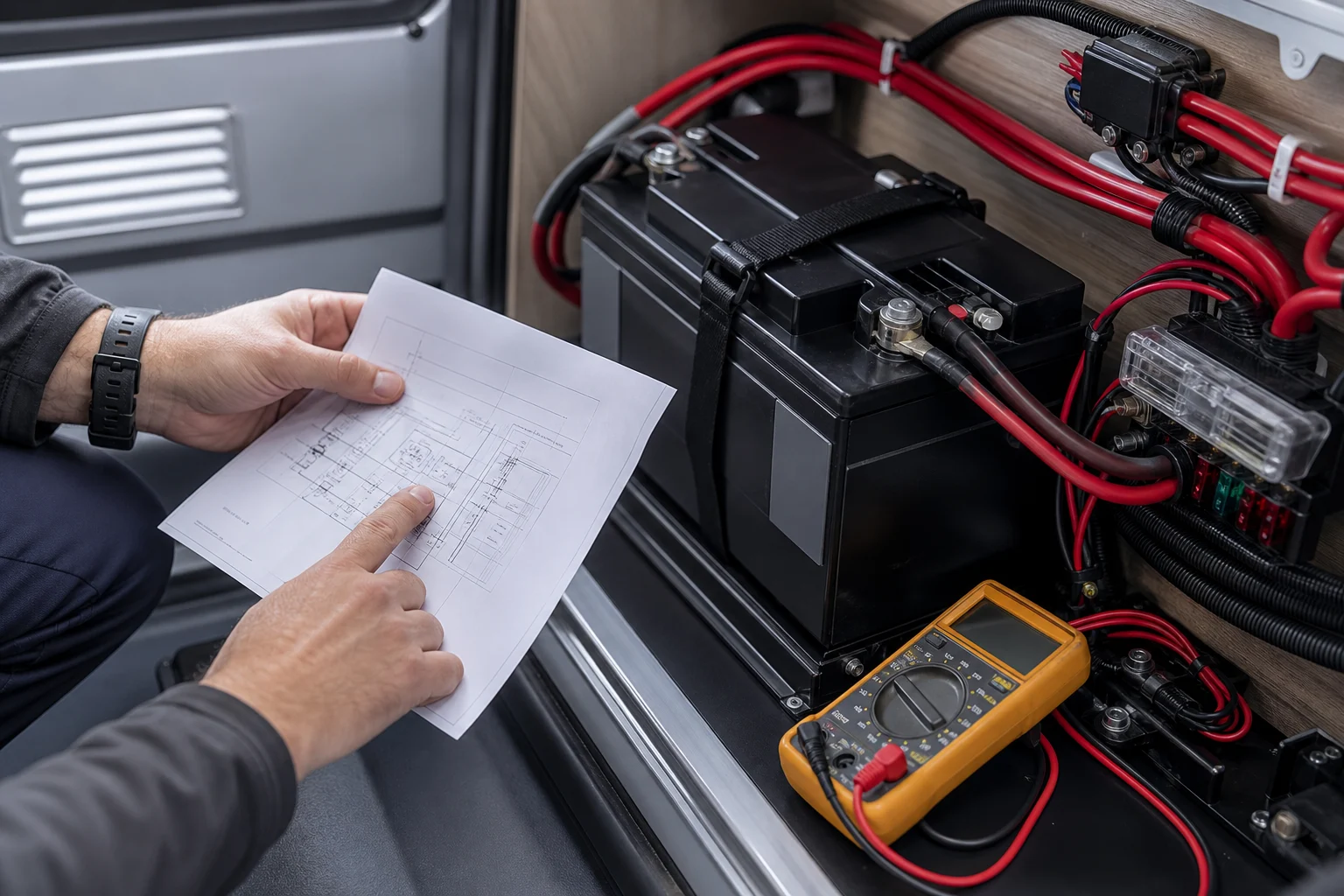
Build a daily consumption budget, appliance by appliance
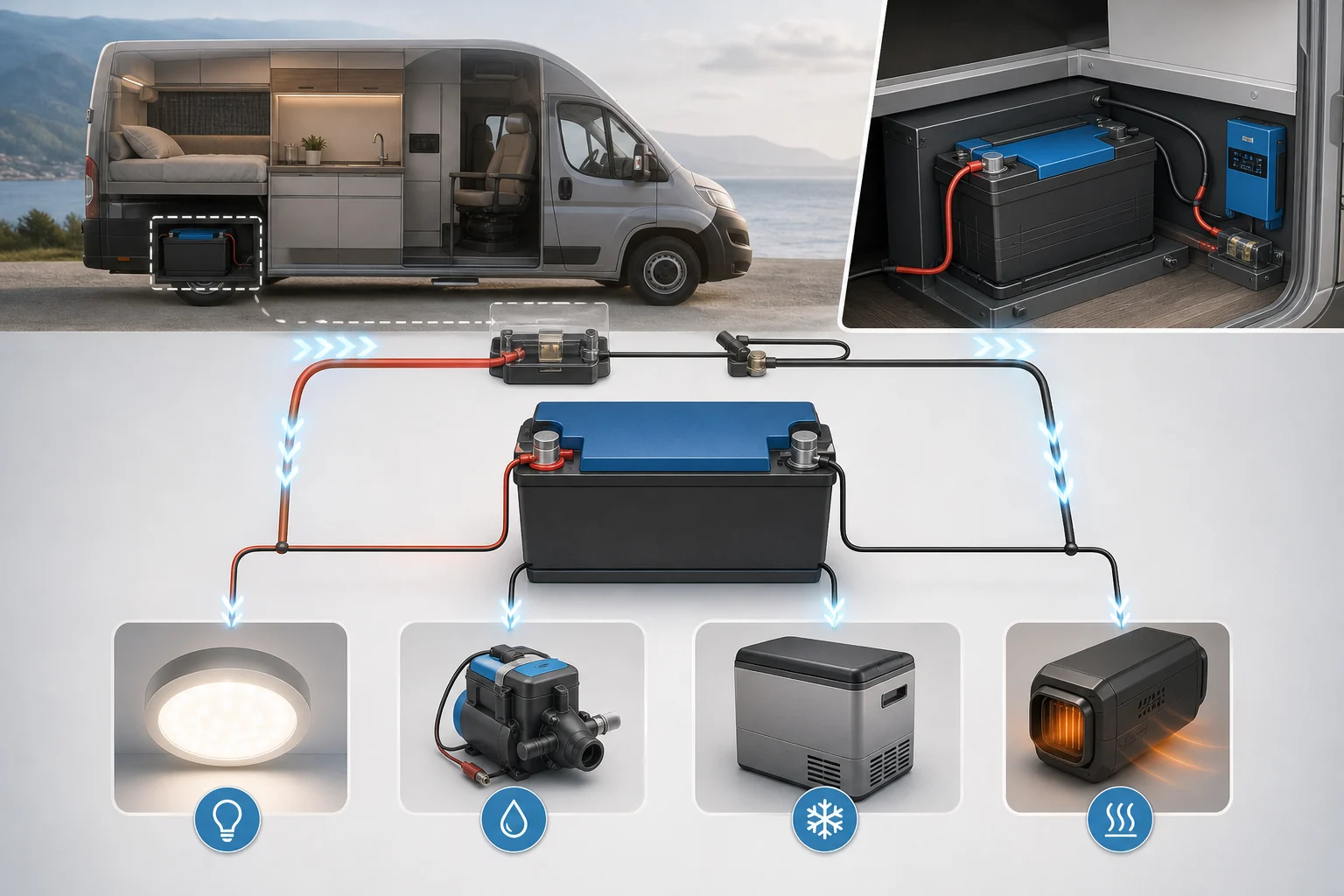
For each 12 V load, multiply W × hours of use. Where the manufacturer states current, a practical approximation is V × A = W: a 12 V pump rated at up to 5 A is approximately 60 W. But a pump runs intermittently; do not multiply its power by 24 hours. Estimate the actual minutes spent opening taps, showering and draining water, then convert them to hours.
The compressor fridge deserves its own line because published figures vary by version, installation type and test conditions. Look for the exact test condition in the manual. Dometic, for example, publishes consumption for its NRX range in kWh/24 h at 25 °C for a freestanding appliance condition and in Ah/h at 32 °C for another built-in installation condition. These figures are useful for comparison only if the measurement context is retained.
With a gas heater, always separate fuel and electricity. The gas Truma VarioHeat comfort states electrical consumption of 0.65, 2.75 and 5.4 A depending on the setting, in addition to its fuel consumption. Battery energy must be counted separately from gas use. To plan for a cold night, select the expected setting and approximate operating hours, but leave a margin in the plan.
If you connect 230 V appliances through an inverter, add conversion losses and no-load consumption. An example inverter states 87–88% maximum efficiency and 4.2–5.2 W with no load, depending on the version. Therefore, leaving it on to supply a small load may use energy even when that load is disconnected.
Section references: Dometic NRX Compressor Refrigerator Series — consumos bajo condiciones de ensayo ↗ · Truma VarioHeat comfort — consumo eléctrico de una calefacción de gas ↗ · COMET OCEAN / OCEAN-PLUS — especificaciones de bombas de agua de 12 V ↗ · Victron SUN Inverter Manual — rendimiento y consumo sin carga del inversor ↗
- Lighting: total power of the lights you will actually switch on and nighttime hours.
- Pump: power of the exact model and operating minutes per day.
- Fridge: daily or hourly consumption, together with its temperature and test condition.
- Heater: 12 V current for each setting and expected operating hours.
- Phones, laptops and other devices: charger power and charging time.
- Inverter: consumption of 230 V appliances, efficiency and no-load consumption.
Nominal capacity: check the published conditions for your battery
The nominal figure is a starting point, but it may be stated under specific conditions. In the documentation reviewed for one lithium battery, nominal capacity is based on 25 °C and discharge at 1C. The same manufacturer indicates an approximate 20% reduction at 0 °C and around 50% at −20 °C compared with that reference. For that battery, it is not advisable to size a winter trip using nominal capacity as if it were always at 25 °C.
Choose the depth of discharge you will use for planning and confirm the applicable guidance in your battery or installation manual. Reserving capacity avoids basing a trip on systematically reaching the limit and leaves room for unexpected consumption. Do not replace that check with a universal percentage: chemistry, manufacturer, configuration and the protection system can change it.
Before making a decision, carry out one documentation check and one real-use check. For the documentation check, compare the limits of the battery, inverter and chargers. For the real-use check, record heater and pump operating time and fridge consumption during a trip under those trip conditions. Then replace the assumptions in your budget with your own measured data.
Section references: Victron Lithium Smart Battery Manual — datos de capacidad, energía, descarga y ciclos ↗ · Victron Lithium NG Battery Manual — efecto de temperatura y profundidad de descarga ↗
- Common mistake: calculating with nominal Ah while leaving out voltage and planning depth of discharge.
- Common mistake: copying a fridge consumption figure without copying its test temperature and installation type.
- Common mistake: forgetting the no-load consumption of an inverter left switched on.
- Common mistake: using in winter the capacity published at 25 °C for a battery whose specification states that condition.
- Final check: make sure the simultaneous current of the loads does not exceed the continuous limit of the components.
Charging on the road: check the contribution from the installed equipment
Charging can change the daily balance, but it must be estimated from the equipment installed. For alternator charging, identify the DC-DC charger and its input and output current settings, as well as actual driving hours. As an example, the Victron Orion XS allows current to be configured between 1 and 50 A and states up to 1,400 W continuously at 40 °C. That specification does not justify assigning 50 A to every campervan: the selected setting and specific installation are what matter.
With external mains power, check the charger’s maximum current and that its profile is compatible with the battery chemistry. The cited Blue Smart IP22 range includes 12 V chargers rated at 15, 20 and 30 A, plus a 14.2 V lithium mode. These are specifications for particular models, not an automatic equivalence of recovered energy.
For solar, begin with the panels’ nominal W and the controller limits. One MPPT controller manual illustrates that two 120 W panels total 240 W both in series and in parallel, although voltage and current change. Check the permitted electrical configuration and controller limits.
Section references: Victron Orion XS 1400 — especificaciones de cargador DC-DC desde alternador ↗ · Victron Blue Smart IP22 230 V — especificaciones de carga desde red exterior ↗ · Victron MPPT Solar Charger Manual — configuración y límites de generador fotovoltaico ↗
- Alternator: DC-DC model, configured current and expected driving time.
- External mains power: maximum current, charging profile and battery compatibility.
- Solar: nominal panel output, permitted electrical configuration and controller limits.
Hypothetical example: from a 100 Ah battery to days of use
Suppose, purely to learn the method, a 12.8 V and 100 Ah battery. Its nominal energy would be 12.8 × 100 = 1,280 Wh. If, for this installation, you chose to plan for 80% depth of discharge after confirming it in its documentation, planning energy would be 1,024 Wh. That 80% is an assumption for this example, not a recommendation that applies to every battery.
To obtain days of use, complete the budget with the published data for your equipment and your actual operating hours. The table separates published information from the assumptions the reader must provide. For a fridge, also note the manual’s test conditions: Dometic documentation distinguishes, for example, between kWh/24 h at 25 °C for a freestanding appliance and Ah/h at 32 °C for a built-in installation.
Once you have added up your daily consumption in Wh, divide the assumed 1,024 planning Wh by that total. If an inverter is left on or the fridge cycle increases in hot weather, the figure falls. If energy is recovered while travelling or through an external mains connection, include in the balance only the energy actually measured. This calculation reveals whether you need more capacity, lower consumption, more frequent charging, or a combination of all three.
| Equipment | Published information | Reader assumption | Daily consumption |
|---|---|---|---|
| Lighting | Power of the installed model | Hours of use | Complete in Wh |
| Pump | Up to 60 W in the example model | Operating minutes | Complete in Wh |
| Fridge | Consumption and manual test conditions | Your own use conditions | Complete in Wh |
| Heater | 2.75 A at 12 V at the cited setting | Operating hours | Complete in Wh |
| Personal devices | Charger power or charging energy | Time or number of charges | Complete in Wh |
| Total | Add up your daily Wh |
Section references: Victron Lithium Smart Battery Manual — datos de capacidad, energía, descarga y ciclos ↗ · Dometic NRX Compressor Refrigerator Series — consumos bajo condiciones de ensayo ↗ · Truma VarioHeat comfort — consumo eléctrico de una calefacción de gas ↗ · COMET OCEAN / OCEAN-PLUS — especificaciones de bombas de agua de 12 V ↗
- 1. Convert the battery: 12.8 V × 100 Ah = 1,280 nominal Wh.
- 2. Apply the selected planning depth of discharge: in this assumption, 1,280 × 0.80 = 1,024 Wh.
- 3. Complete each daily consumption figure in Wh using the equipment manual and your use record.
- 4. Divide planning Wh by your daily Wh and leave a margin for cold, heat and unplanned use.
- 5. Repeat the calculation with your specification sheet and a real-use record before expanding the installation.
How many days does a 100 Ah auxiliary battery last in a campervan?
It depends on voltage, the energy you choose to use for planning after consulting the applicable documentation, and your daily Wh. A 12.8 V and 100 Ah battery states 1,280 nominal Wh in the cited example; you then need to apply the planning assumption and divide the result by actual consumption.
Which is better for calculating a camper battery: Ah or Wh?
Wh, for comparing capacity and adding consumption. Ah are directly comparable only if voltage is the same. The practical relationship is Wh = V × Ah, using the nominal values published for the battery.
Does a compressor fridge use the same amount every day?
No. Its consumption depends, among other factors, on temperature conditions and installation type. Check the manual for the exact model and retain the test conditions that accompany the figure.
Can I count solar output as guaranteed energy every day?
It is not advisable. Use the panels’ nominal W and the controller limits to check compatibility, but plan solar as variable support and keep an alternative charging option.