Buying a Used Boat in Spain: Documents to Check Before Signing
A guide to checking identity, ownership, charges, navigation documents, CE marking and the contract before buying a used recreational boat in Spain.
Key points
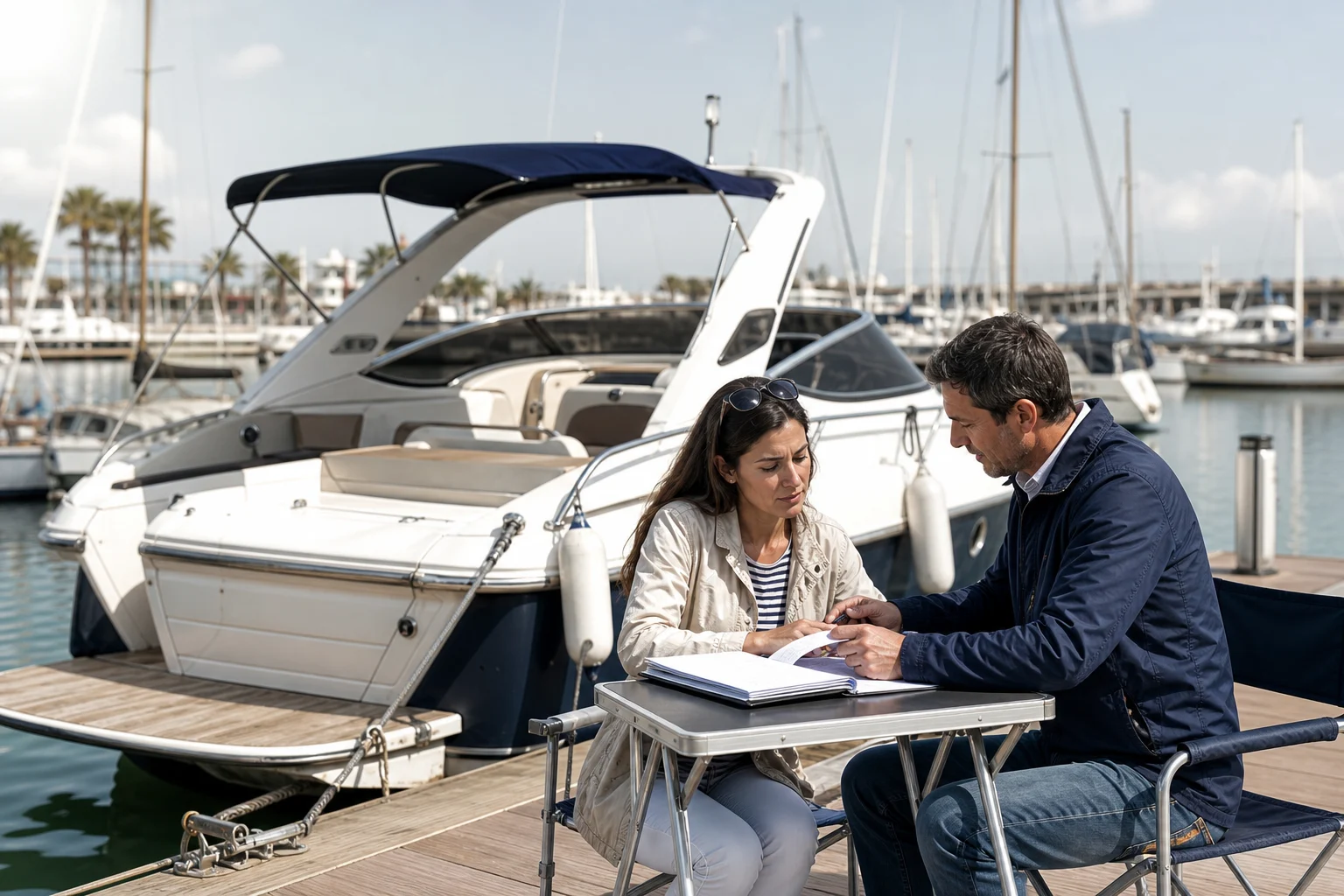
Before paying a deposit on a used boat, verify its administrative identity and the available ownership and charge information against the applicable navigation and technical conformity documents. The contract and transfer notification should state unambiguously which vessel, equipment and documents are changing hands.
Before paying a deposit: request a file, not just photos
When making a first purchase, it is easy to focus on the engine, electronics or the condition of the upholstery. However, the documents for buying a used boat answer an earlier question: confirming that the advertised vessel is identified and reviewing the available ownership and registry information alongside its administrative status and intended use.
Request legible copies before paying a deposit. They should allow you to verify the vessel's administrative identifier, registration number, name and, where recorded, CIN; the ownership and charges shown in the Ships Section of the Registro de Bienes Muebles (Register of Movable Property) where registry information exists; as well as the applicable technical and certificado de navegabilidad (navigability certificate) documentation. Do not proceed until the seller provides an explanation and the applicable documents or checks make it possible to identify the unit and assess its status.
Nor should you assume that every unit follows exactly the same route: the general regime is flag registration and vessel registration, while a special regime exists for vessels up to 12 metres whose vessel and propulsion equipment bear CE marking.
Section references: Ley 14/2014, de Navegación Marítima ↗ · Inscripción y abanderamiento/matriculación de embarcaciones de recreo ↗
- Request the name, registration number or folio, and the CIN where recorded, before visiting the vessel.
- Request the available administrative document and check that it is not an incomplete or illegible image.
- Obtain or request information from the Ships Section of the Registro de Bienes Muebles (Register of Movable Property) to review the entries and registered charges.
- Request the certificado de navegabilidad (navigability certificate) where applicable, paying attention to its validity and upcoming inspections.
- Request the EU declaration of conformity, CE marking and manual where they apply to the unit.
- Postpone the deposit if the seller cannot link the available documents to the specific vessel being offered.
Identity: match the registration number, name and CIN where recorded
For a vessel registered in the sixth or seventh list, the entry for the maritime district records the registration number, CIN and name. The registration marking is the alphanumeric combination that identifies and individualises the vessel; it includes the list, maritime province, maritime district and folio/year.
Record the CIN exactly as it appears in the documentation provided, without filling in characters based on guesswork. Compare it character by character across the available documents. Do the same with the name and registration number. A name change may have an administrative explanation, but any discrepancy between the advertisement and a document requires prior clarification and consistent paperwork.
This comparison avoids a basic mistake: negotiating on the basis of a commercial description—length, make, model or colour—that may resemble another unit's. The subsequent contract should retain these identifiers where recorded, rather than being limited to a generic description such as “6-metre motorboat”.
Section references: Real Decreto 1435/2010, abanderamiento y matriculación de embarcaciones de recreo ↗
- Record the CIN where it appears in the available documentation.
- Compare the CIN, registration number and name across the available documents, where applicable.
- Check that the seller identifies in the contract the same unit you inspected.
- If one of the details is missing or there are discrepancies, request that they be corrected or documented before paying.

List, vessel registration and the Registro de Bienes Muebles: three separate layers
The registration number serves identification and administrative control; it does not replace a check of ownership and encumbrances. The Spanish Maritime Navigation Act assigns that information to the Ships Section of the Registro de Bienes Muebles (Register of Movable Property). It is therefore advisable to treat the vessel's administrative documentation and registry disclosure as complementary checks, not alternatives.
The list also matters because it states the declared purpose. The sixth list includes, among other cases, recreational vessels commercially operated for leisure, sport or non-professional fishing. The seventh list covers those intended exclusively for sport without profit-making purposes or for non-professional fishing. If the buyer's intended use does not match the documentation, it is advisable to stop the transaction and consult the applicable procedure.
Registration of a recreational or sporting vessel in the Ships Section of the Registro de Bienes Muebles is optional. Even so, the section is public and anyone may request information on its entries. A nota simple (an informational registry extract) provides information on the registered description, characteristics and charges; to prove ownership and the absence or existence of charges before third parties, the prescribed means is the registrar's certificate.
Section references: Ley 14/2014, de Navegación Marítima ↗ · Real Decreto 1027/1989, sobre abanderamiento, matriculación de buques y registro marítimo ↗ · Publicidad del Registro de Bienes Muebles ↗
- Do not treat the registration number as sufficient proof that there are no charges.
- Request a nota simple to learn the registered description, characteristics and charges.
- When you need to prove ownership or freedom from charges before third parties, consider requesting a registry certificate.
- Check that the documented list and purpose are compatible with the use you plan to make of the boat.
Charges and navigability documentation: two checks with different purposes
Registry disclosure should be read for both the unit's identity and any registered charges. The law covers, among other matters, security interests, retention-of-title clauses, restrictions on disposal, finance leases and other encumbrances. If these situations are registered, they are enforceable against third parties only when they appear on the register. Do not complete the transaction based on a verbal statement that the boat is “free of charges”: request an up-to-date nota simple and resolve any entry before signing or releasing the final payment.
Separately, where applicable, the certificado de navegabilidad (navigability certificate) confirms that the regulatory inspections have been carried out and records the date of the next ones. It does not establish who owns the vessel or replace registry information. Its function is different: to evidence the applicable inspections. Failure to carry out or pass them on time causes it to lapse, and the certificate must be carried on board and kept up to date.
Request the applicable certificate and check its status before committing. The ministry's website provides for first issue, renewal and exchange for recreational vessels with a length of 24 metres or less. If it is missing, expired or does not match the unit, make this an express condition of the sale, with the responsible party, deadline and financial consequence defined.
Section references: Ley 14/2014, de Navegación Marítima ↗ · Certificado de navegabilidad de embarcaciones de recreo ↗ · Real Decreto 1434/1999, reconocimientos e inspecciones de embarcaciones de recreo ↗ · Publicidad del Registro de Bienes Muebles ↗
- Read every charge, restriction or note appearing in the nota simple.
- Do not confuse a nota simple with the certificate that proves matters before third parties.
- Check, where applicable, that the certificado de navegabilidad (navigability certificate) details match the vessel.
- Review the date of the next inspections and whether the document remains valid, where applicable.
- Do not accept that a charge or expiry will be resolved merely verbally.
CE marking, EU declaration and manual: what they verify and what they do not
Where applicable, CE marking, the EU declaration of conformity and the manual are relevant technical documents. The manufacturer draws up the EU declaration of conformity and affixes the CE marking after demonstrating the product's conformity. In addition, the declaration must accompany vessels when they are placed on the market or put into service.
The declaration identifies the product in a way that enables traceability. Use it, where applicable, to strengthen your check of the unit's technical documentation. The manufacturer must include an instruction manual containing safety information in Spanish or Castilian. Request those documents where applicable and keep copies with the rest of the file.
Its limitation is equally important: neither CE marking nor the EU declaration alone proves current ownership, the absence of charges or that regulatory inspections are up to date. A robust file combines, as applicable, technical traceability, administrative status, registry information and the transfer document.
Section references: Real Decreto 98/2016, requisitos técnicos y de comercialización de embarcaciones deportivas ↗
- Check, where applicable, that the declaration identifies the offered product in a traceable manner.
- Request the instruction manual in Spanish or Castilian where applicable.
- File the declaration and manual with the administrative documentation when they apply.
- Do not use CE marking as a substitute for a registry check or certificado de navegabilidad (navigability certificate) where applicable.
Contract, payment and transfer of ownership: create a complete audit trail
The acquisition of a ship or vessel must be recorded in writing. In addition, to have effect against third parties it must be registered in the Ships Section of the Registro de Bienes Muebles in accordance with the documents provided for by law. From a practical perspective, the contract is the link between the inspected boat, the identified seller and the agreed price.
The Spanish Civil Code defines a sale as the delivery of a specific item in exchange for a certain price; agreement on the item and the price completes the sale and binds both parties. Therefore, draw up a contract with no ambiguous gaps: identify the parties, describe the vessel by name, registration number and CIN where recorded, and state the price, date, method of payment and delivery. Add an inventory of the included equipment and a list of all original documents and copies handed over.
After the transfer, it must be notified by the seller and may also be notified by the buyer within a maximum period of three months from the transfer, providing the supporting documents. Before signing, confirm which procedure applies in the specific case, who will submit it and how its submission will be evidenced.
| Document or check | Detail to verify | Who must provide it or process it | Warning sign |
|---|---|---|---|
| Available administrative documentation | Registration number, name and CIN where recorded | Seller | The available details do not match each other or the advertisement |
| Nota simple from the Registro de Bienes Muebles | Registered description, characteristics and charges | The buyer may request this informational registry extract directly | A charge, restriction or different identity appears |
| Registry certificate | Ownership and the absence or existence of charges before third parties | The interested party who requests it | The transaction is to be completed without clarifying an entry |
| Certificado de navegabilidad (navigability certificate), where applicable | Inspections completed and date of the next ones | Seller, within the available documentation | Expired document or details that do not match |
| EU declaration of conformity and manual, where applicable | Product traceability and safety instructions | Seller, within the available documentation | They cannot technically be linked to the unit or are missing without explanation |
| Written contract | Specific vessel, parties and certain price | Buyer and seller | It does not include the registration number, CIN where recorded, inventory or delivery date |
| Transfer notification | Evidence of the transfer | Seller; the buyer may also do it | There is no responsible party or proof of the procedure |
Section references: Ley 14/2014, de Navegación Marítima ↗ · Otros trámites relativos a datos registrales de embarcaciones de recreo ↗ · Código Civil — compraventa ↗
- Include the name, registration number and CIN where recorded in the contract, not just the make and model.
- Identify the buyer and seller and state a certain price, date and method of payment.
- Attach an inventory of included equipment and a list of documents handed over.
- Specify when delivery of the vessel, keys and original documents takes place.
- Agree in writing who will notify the transfer and retain the proof.
Decision order: do not sign until discrepancies are resolved
A practical review sequence is simple: first identify the vessel; then compare the administrative documents; next review the registry disclosure and the applicable technical or certificado de navegabilidad (navigability certificate) documentation; and only then finalise the contract, payment and transfer. This prevents a good impression of the boat from causing a documentary incompatibility to be overlooked.
A discrepancy does not always prevent a purchase, but it changes the transaction. It may require a correction, an update to the paperwork, cancellation of a charge or a specific condition in the contract. The prudent decision is not to interpret incomplete papers, but to request that the situation be evidenced before taking on a non-refundable deposit or the final payment.
Keep a file with the copies reviewed, registry information, signed contract, inventory, payment receipts and evidence of the transfer notification. That audit trail will be useful for demonstrating what was acquired and which documents were delivered.
Section references: Ley 14/2014, de Navegación Marítima ↗ · Otros trámites relativos a datos registrales de embarcaciones de recreo ↗
- Do not pay a deposit without documentary identification of the specific vessel.
- Do not complete the transaction while a registry charge or restriction remains without an evidenced explanation and solution.
- Do not accept, where applicable, an expired certificado de navegabilidad (navigability certificate) as if it were proof of current navigability documentation.
- Do not leave the definition of equipment, original documents and responsibility for the ownership transfer until later.
- Keep every receipt from the deposit through to the transfer notification.
Does the registration number prove that the seller owns the boat and that there are no charges?
No, not on its own. The registration number serves identification and administrative control. Information on ownership and encumbrances is held by the Ships Section of the Registro de Bienes Muebles (Register of Movable Property). A nota simple reports registered charges, whereas the registry certificate is the prescribed means of proving ownership and the absence or existence of charges before third parties.
What is the difference between the sixth and seventh lists?
The sixth list includes, among other cases, recreational vessels commercially operated for leisure, sport or non-professional fishing. The seventh list covers those intended exclusively for sport without profit-making purposes or for non-professional fishing. It is advisable to check that the intended use fits the documented status.
What is the certificado de navegabilidad (navigability certificate) for?
Where applicable, it confirms that the regulatory inspections have been carried out and states the date of the next ones. It does not prove ownership or replace a check for charges. If inspections are not carried out or passed within the deadline, the certificate lapses.
When must the transfer of a recreational vessel be notified?
The transfer must be notified by the seller and may also be notified by the buyer within a maximum period of three months from the transfer, with the supporting documents. It is advisable to agree in the contract who will do this and retain the proof.