Buying a Used Combine Harvester: Hours, Header and History
What to ask the seller and how to check that the hours, header, paperwork and logistics suit your harvest before you buy.
Key points
A used combine harvester is only a good fit if its capacity, configuration and header suit your crops and harvesting schedule. Cross-check the hours against its history, confirm the paperwork and transport arrangements, and request an independent inspection when the available information is not enough to assess the risk.
Start with the harvest, not the price
When comparing used combine harvesters, the price and operating hours are only two parts of the decision. The machine must suit the crops, acreage, schedule and pace of work you need. A machine that looks attractive on paper may not be if its header is unsuitable for your crops or logistics make it difficult to get it to your fields.
First, define what you want to harvest, how many hectares you expect to work and over what period. Add the yield you expect and the distances between fields. You do not need to turn these estimates into an exact capacity figure: they help you ask whether the machine and its configuration suit your harvest, and identify needs that the advert does not clarify.
Also compare buying with hiring a harvesting service. If the area or intended use does not justify taking on the purchase, storage, transport and potential downtime, asking for a service quote is a useful point of comparison. Do not decide on the initial cost alone: consider all the needs you will have to address.
- List the crops, expected acreage and harvest schedule.
- Describe the fields and distances the machine will need to cover.
- Compare buying with hiring a service, including the logistical tasks.
Operating hours: ask for the figure and check what it means
Ask which meter reading is shown in the advert and request clear photographs of the gauges. Some models may have separate records; for example, John Deere's inspection sheet for S-Series combines with serial numbers 745100–784999 distinguishes engine hours from separator hours. This example does not mean that all manufacturers or models have the same meters.
Ask the seller to identify each reading and provide any available records to put it in context, such as invoices, service records and usage notes. Compare the stated hours with the documentation and the general condition as assessed by a qualified person. Hours alone do not describe the full history or guarantee the condition of a machine.
If records are missing, readings cannot be explained, or the advert's details do not match what the machine displays, do not fill in the gaps with assumptions. Ask for written clarification and consider an independent inspection before committing. If an important point cannot be verified, treat it as uncertainty in your decision.
Section references: Inspección de cosechadoras John Deere S-Series, números de serie 745100–784999 ↗
- Ask for the make, model, serial number and each available meter reading.
- Ask which meter reading is advertised and how the figure was obtained.
- Compare readings with invoices and records; do not interpret the hours in isolation.
Machine identity, maintenance and paperwork
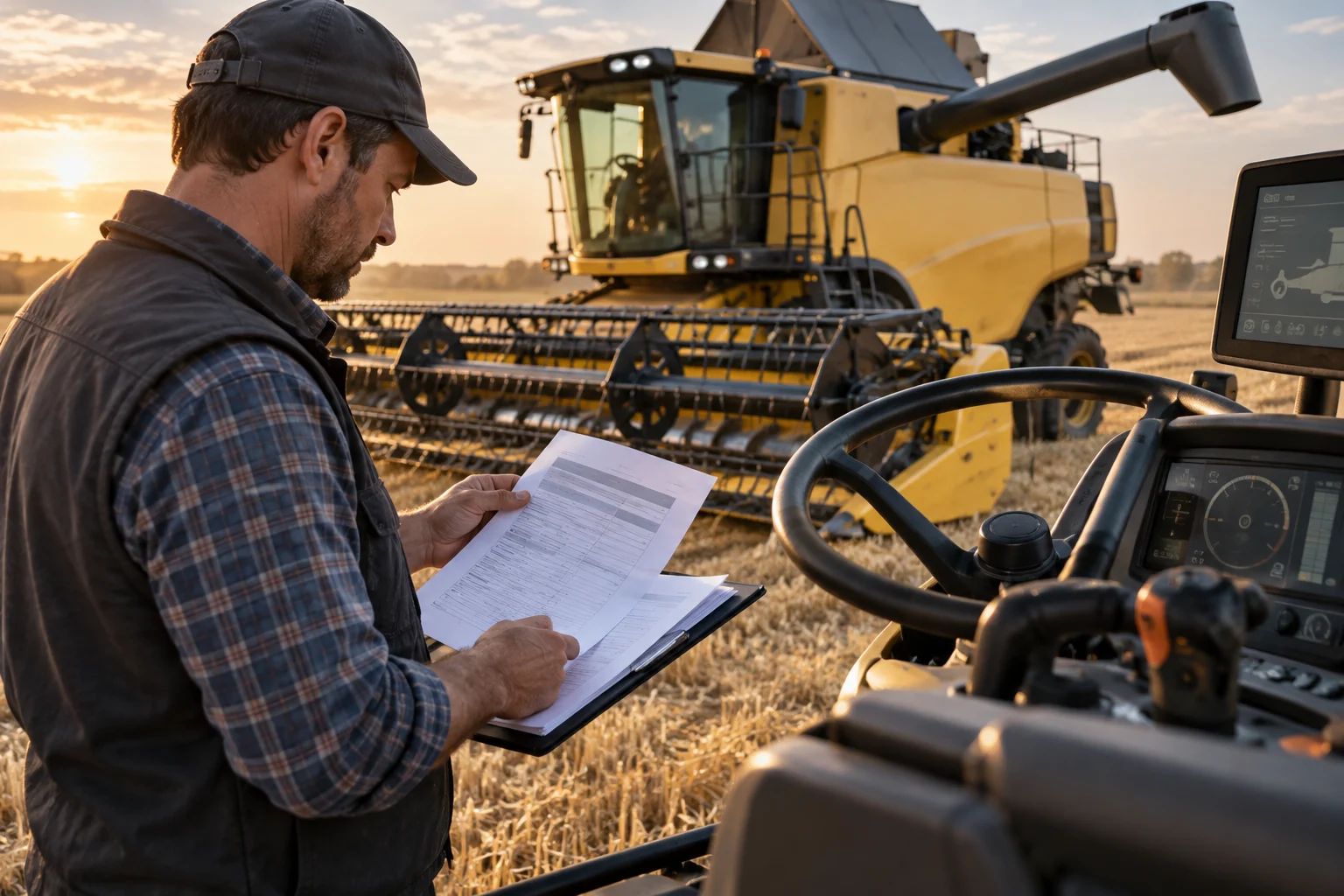
Before going any further, confirm that the details in the advert, on the machine and in the documents match: make, model and chassis or serial number. Ask for the stated year, available invoices, recorded services and a list of repairs known to the seller. Also clarify what paperwork they can provide and which claims about the machine's history they can support.
In Spain, self-propelled agricultural machinery is among the groups that must be registered in the ROMA (Official Register of Agricultural Machinery). For a change of ownership, Royal Decree 448/2020 provides for registration and verification that the previous owner's registration has been cancelled; the sale documents must identify the make, model and chassis number. Confirm with the relevant authority what documentation your case requires, and do not assume the process is complete just because the seller says the paperwork is up to date.
If the physical identification differs from the documents, paperwork is outstanding, or you are unsure who can formalise the sale, pause the transaction until these points are clarified. It is safer to resolve them before agreeing payment and delivery. Keep copies of the documents you receive and record which items are included in the sale.
Section references: Real Decreto 448/2020: caracterización y registro de la maquinaria agrícola ↗
- Check that the make, model and chassis or serial number match on the machine and in the documents.
- Ask for invoices, service records and declared repairs; distinguish documented facts from claims.
- Confirm the change-of-ownership process and registration status before completing the purchase.
Header, attachments and configuration: clarify what you are buying
Do not assume the header shown in the photos is included, or that any advertised header will fit the machine. Ask for a written list of the items in the offer: the header, trailer or other attachments included by the seller, as well as any parts or connections that are excluded. Ask for each item's identification and confirm compatibility with the specific combine harvester and the crop you plan to work.
The New Holland CX7 and CX8 ranges illustrate why it is not enough to look at the width: the manufacturer offers headers suited to different crop types and farms, with advertised widths from 4.57 to 12.50 metres. These figures apply to those ranges and should not be extrapolated to other series or brands. For your machine, check the exact part reference and approved configuration against the manufacturer's documentation or with a service technician.
Before completing the purchase, clarify who is responsible for checking fit and operation, and what will happen if the offered header is incompatible. A header suited to one crop may not be the right choice for another; also check whether your farm's needs require a different configuration. If the seller cannot specify what is included, ask for details before negotiating the final price.
Section references: Cosechadoras CX7 y CX8: cabezales y anchuras disponibles ↗
- Ask for a list of everything included in and excluded from the offer.
- Check part references, compatibility with the model and suitability for the crop.
- Confirm in writing which header and accessories you will receive and their condition.
Transport, capacity and support during the harvest
The machine must be able to reach your fields and work within your operation. Before buying, agree who is responsible for transport, what configuration will be used for the journey and what road-use restrictions may apply to that machine. In Spain, the General Vehicle Regulations set a specific rule for the width of agricultural machinery on the road and provide an exception relating to folding or removable components that have not been folded or removed. Check the specific case before planning the route.
Also consider how grain unloading will be coordinated: which trailers you have available, how movements around the fields will be organised and what resources are missing. These are planning questions, not a guarantee of the combine harvester's output. If the seller advertises a working capacity, ask them to explain which configuration and conditions it refers to, and compare it with your actual needs.
Check the availability of technical service and spare parts for the model and the area where you will work. Include consumables, transport, storage and potential periods without a machine in your budget. There is no universal figure for these costs: request quotes that apply to your location and leave room for items that have not yet been confirmed.
Section references: Real Decreto 2822/1998: Reglamento General de Vehículos, tabla de anchuras de circulación ↗
- Decide who will transport the combine harvester and in what configuration.
- Check the width and road-use requirements that apply to the specific journey.
- Confirm trailers for unloading, technical service, spare parts and outstanding costs.
When to request an independent inspection
An independent inspection makes particular sense if the machine is a major investment for your farm, its history is incomplete, the readings are hard to interpret, or you cannot otherwise confirm the header's compatibility. It is also reasonable if you cannot personally assess important components or if the seller will not allow a sufficient check before the purchase.
Agree on a specific scope, not a generic approval. The report should identify the machine inspected, state which documents and records were checked, and detail the areas examined, the limitations of the inspection and any points requiring follow-up. As a specific reference, the cited John Deere inspection sheet covers areas such as the feeder house, transmission, wheels and tyres, and the header drive and connections. That list relates to that inspection sheet and does not replace an agreed scope for other machines.
A visual inspection of your own can help you prepare questions, but it does not replace a professional assessment or automatically verify the machine's history. Ask for any issues found to be described clearly, and for the technician to distinguish what was checked from what could not be assessed. If an important issue remains unresolved, renegotiate with sufficient information or do not proceed until you understand its implications.
Section references: Inspección de cosechadoras John Deere S-Series, números de serie 745100–784999 ↗
- Agree with the inspector which model and serial number will be examined.
- Request a written report covering its scope, limitations and findings.
- Do not treat a visual check or generic checklist as a guarantee of the machine's condition.
Is it enough to choose the combine harvester with the fewest hours?
No. Hours should be considered alongside available records, the machine's identity, maintenance and configuration. There may also be different meters depending on the model; ask the seller to identify exactly which reading they are quoting.
Is the header shown in the advert included?
Not necessarily. Ask for a written list of what is included and excluded, and confirm compatibility with the specific model and the crop you plan to harvest.
What paperwork should I check in Spain?
Check the make, model and chassis number against the machine and the documents. For a change of ownership, ask about the applicable ROMA requirements and confirm that the previous owner's registration has been cancelled before completing the transaction.
When is it worth paying for an independent inspection?
When there are doubts about the hours, history, condition or compatibility, or when the investment and intended use make it important to reduce uncertainty. Request a written report that explains what was checked and any limitations.